#DailySportsHistory, #TimDonaghy, #NBAScandal, #BasketballHistory, #SportsScandal, #NBAToday, #SportsPodcast, #BettingScandal, #RefereeScandal, #NBALegacy
Buy me a coffee: buymeacoffee.com/dailysportz
Newsletter: https://substack.com/@dailysportshistory?r=3en496&utm_medium=ios&utm_source=stories&shareImageVariant=light
DailySportsHistory.com
Email: dailysportshistory@gmail.com
YouTube: YouTube.com/@dailysportshistory
Twitter: twitter.com/dailysportshis
Facebook: facebook.com/profile.php?id=61551687917253&mibextid=ZbWKwL
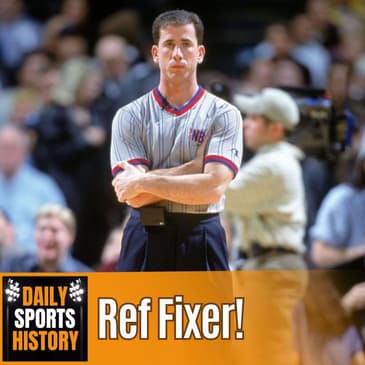
On August fifteenth, two thousand and seven, former NBA referee Tim Donahue pleads guilty to two federal chargers related to betting and fixing NBA games while he was an NBA ref and his sentenced to fifteen months in a federal prison, ruining his career and reputation and having the NBA having to work on fixing their own reputation. Today, we're going to dive into what all happened in the scandal on Daily Sports History. Welcome to Daily Sports History. I'm Ethan Reese, your guide to a rapid deep dive into sports history every day. And today's trivia question is what NBA player actually threatened Tim Donahue personally while Tim Donahue was an NBA ref. Now we've had a couple episodes on gambling. We had one about the legal of sports scandaling recently that has seen a huge financial boom, and we also have had a couple of scandals in the NCAA and in hockey about possible fixing games. But we haven't had one about a referee who holds control in the game even more so than some players. As a referee in basketball can control how many fouls are called, how the flow of the game runs with the way they call the game. But luckily, at least there has been very many referees caught doing anything scandalous like Tim Donahey did in accepting money for refeing games. It often shows that there is control and usually we have to put even more regroactively than proactively. And that's how sports has always been run. We always are retroactive rather than proactive. But how did Tim donahue end up in this situation? Well born in Philly, he went to Cardinal O'Hare High School in the Philadelphia area and interestingly enough, three other referees that came from that high school, making a very fertile high school referee location. Now, to become a referee, it's very similar to how athletes become pro athletes. So you start at the lower level. So an athlete starts in little league, well, usually a referel start in little league. Then they move on to middle school, high school, college, and then if they're lucky, they go on to NBA. That's exactly what Tim donahey did. He started, but he had a leg up as his father was an NCAA ref previously, so after he went to Villanova and graduated with a degree in sales and marketing. But after he begins to start becoming a referee in high school, following his father's footsteps, and he had does this for about five years and then he moves to college and he does this for about seven years being a referee in college, eventually working his way up to the NBA where he gets his shot in nineteen ninety four and he's given the uniform number of twenty one. And yes, referees also have numbers. If you ever watch a GBA game, they have numbers on their back of their jerseys. This is one so that they can see who the ref is when they review tapes if you didn't know. The referees are often graded on how they ref a game. This is to help control fixing, but also just to review a referee see if they're doing good, if they're doing bad things they need to work on things to get better on and who actually goes on to ref in the playoffs or at the NBA Finals on the biggest stage to the biggest moments. And this is important because you also get bonuses as a referee for refing in the playoffs and in the NBA Finals, just like a player does. And when he started in nineteen ninety four, an NBA ref made a really good salary of about ninety thousand dollars and that has gone up to now being somewhere between one point fifty and three hundred thousand dollars depending on your years of service. And you know, are you refing in those larger games. So it was a great gig to have. It's a challenging one, just as it is for an NBA player. You're traveling to different locations, so you're being away from your family. There's and often you're not well liked, not by fans at least some of them have pretty good relationships with the coaches and players, but that doesn't mean that it's all that there's no conflict. In two thousand and three, after Tim Donahe wrecked a game in Portland, Rashid Wallace, a portant Trailblazer player, actually went into the tunnel and inverbally threatened Tim Donahey to his face, something that very rarely he's ever done. And if you know Rashid Wallace, who holds the record for the most technical fouls ever by an NBA player, So while it's doing this is normal, but it still was a major factor in this and over it is Tim Donnahe's career. He was actually graded out as a pretty good referee, you know, he didn't show obvious signs of having issues and wouldn't actually be thought of as someone that was bad. But everything started to come down on July twentieth, two thousand and seven, when it was reported in The New York Post that the FBI was investigating an NBA referee for betting on games to control the point spread. Now, if you don't know, NBA referees are giving a code of ethics, they're not allowed to gamble on any NBA events. At this time, that was the case. Now they've given even stricter policies now, but at the time they couldn't gamble on any NBA events for any level. But that doesn't mean there wasn't gambling going on, and many were. Many NBA refs were posted to gambling, but a lot of them would go to casinos and gamble blackjackick and things like that. But the reason why this thing is in there is because they want the games to be fair, and why it's an FBI case, it's because gambling needs to be fair because if someone has inside information, as in the stock market, if you have inside information, that's illegal. It's also illegal in sports. So if a player, you know, shape points, meaning they're making sure they're not scoring above a point spread, then that is illegal because they have inside information. The referee that says kind of the same thing. They can kind of shave the points a little bit, you know, make the end of the game go one way or another by calling fouls here and there. But it was revealed that the investigation saw Donahue placing bets in two thousand and five all the way to two thousand and seven, and he did so with two other people placing bets. And the way it worked was he there was a middleman in the in the situation who was an old friend of Donihue who came to Donahe with an option to make a little bit of money as he had a friend in the in sports gambling that he could that he could give him advice on games, and he could get that information to his friend that could place the bets for them and they would all get a little bit of money from it. That's the basics of it, and the way he would do this is he would call his friend the middleman and talk about one of his brothers, one that lived in the Philadelphia area where they grew up and one that lived away from the Philadelphia area, And depending on which one he mentioned, that was one that was where the bet should go. And that way, he wasn't actually saying which one in this descriptive, so if anyone happened to be listening, they wouldn't catch on to exactly what he was doing. And forever in doing this, for every pick he got right, he would receive two thousand dollars, but as they kept doing going good, he would receive up to five thousand dollars, and in total he received somewhere around three hundred thousand dollars, which is a lot of money, but he was also making good money, close to one hundred to two hundred thousand dollars a year towards the end. Now you may think how exactly was he fixing these games? And donahe himself says he wasn't actually fixing the games, And a lot of the games he would bet on would be games he wouldn't actually referee. But what he would do is he would hear inside information. This player is injured, or this players going through divorce. You know, this referee doesn't like this guy, or you know, different things like this that are really inside information that you know, the public doesn't actually have this information, but he did being in the inner circle of the NBA and NBA referees, you know, deal with players, deal with coaches. You know, they know this information. They know, Hey, this player is not going to play. We haven't announced that yet, because you know that way they are accustomed to, you know, who they're going to referee, and you know, giving the referees the most information they can, you know, can have a better outcome for their game. But they later learned that this went back all the way to two thousand and three, and he had been and Donnie, he had been involved in some big moments. He was involved in the Malice at the Palace. So in two thousand and seven, the FBI was working on another criminal investigation and they stumbled upon this case as they were looking into another organized crime investigation, and through wire taps they were able to hear conversations and stories about this as it kept happening more and more, and they finally narrowed it down to Tim Donahee, and they had him arrested, and on August fifteenth, two thousand and seven, Tim Donahe appeared in a Brooklyn federal court and pled guilty to conspiracy to engage in wire fraud and transmitting wager information through international state commerce. Donihe was fined five hundred thousand dollars in order to pay at least thirty thousand dollars in restitution, and on June nineteenth, two thousand and eight, the NBA actually filed against Donihee asking for reimbursement for the league for the cost of airfare, meals, complimentary tickets, and other expenses including uniform and they claimed that he would owe them back one point four million dollars, including over half a million dollars in pay and benefits over the four seasons where he was gambling on NBA games, although he wouldn't end up paying that full amount, and on July twenty nine, two thousand and eight, Donahee was sittenced to fifteen months prison, of which he would serve eleven months in prison and finish the final remaining in a recovery house and be treated for gambling addiction. Now Donnahey claims that he was actually attacked while he was in prison and threatened by multiple people. But what he didn't also while he was in prison is he wrote a book called The Blowing Whistle in the Culture and Fraud of the NBA. And on number fourth, two thousand and nine, Donnahey was officially released from prison and has released his book and been featured on a documentary film called Dirty Games The Dark Side of Sports as well as Netflix's Bad Sport series. And in two and twenty one, Donnahe made his wrestling debut for the Major League Wrestling, becoming what is known as a heel referee. And after this, the NBA looked into restructuring their gambling policies, making it so that any type of gambling was restricted for NBA officials, making the ban on gambling absolute, and to announce the referees for the games until ninety minutes before tip off to reduce the value of the information to gamblers. Like we said before, as in most things in sports, retroactive is how we usually go buy things instead of proactive. This was a dark moment in the NBA, but luckily it has not stayed in the NBA, as it has continued to grow more and more every single year. I want to thank you for listening to today's Daily Sports History. If you like this, please reach out to a friend that little share button and let them know all about the sports history you're learning so they can learn it too. And come back tomorrow for more Daily Sports History. And did you catch the answer to today's tribute question? What NBA player actually threatened Tim Donahue back when he was a ref in the NBA, And that was Rashid Wallace.