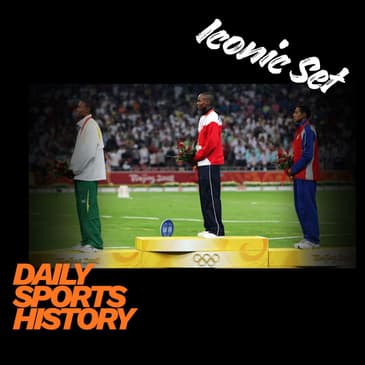
This episode dives into the surprising origin story behind those three famous steps every athlete dreams about. We trace the idea back two years earlier to Canadian journalist and sports executive Melville “Bobby” Robinson, who tested a tiered winners’ stand at the 1930 British Empire Games in Hamilton to clean up messy, flat on‑field award ceremonies. IOC president Henri de Baillet‑Latour loved the concept so much that in 1931 he ordered both Lake Placid 1932 and Los Angeles 1932 to use a formal podium with gold in the center, silver on the winner’s right, and bronze on the left—plus flags and national anthems for the first time as official protocol.
You’ll hear how local organizer Godfrey Dewey and his crew in Lake Placid built the first Olympic podium out of simple wooden sleepers, then scrambled to fix a mix‑up when silver and bronze were placed on the wrong sides just before Shea’s 500‑meter medal ceremony. We’ll put you on the ice that day with Shea flanked by Norway’s Bernt Evensen and Canada’s Alexander Hurd, the trio who turned a crude Adirondack platform into a global ritual.
From there, we follow the evolution of the podium from a practical visibility hack into a powerful stage for politics, branding, and identity. We connect Lake Placid’s humble stand to iconic moments like Tommie Smith and John Carlos’ raised‑fist human‑rights salute in Mexico City in 1968, when the podium became a symbol of protest seen around the world. Along the way, we touch on how host cities have reimagined the podium’s design—from simple wooden boxes to sculpted, recycled, and even 3D‑printed structures—without ever changing the basic three‑step hierarchy that Robinson first imagined.
By the end of the episode, you’ll know:
• Who actually invented the modern victory podium and why it started outside the Olympics.
• How a small winter town in 1932 became the test lab for the medal ceremony every athlete now dreams of.
• Why Jack Shea’s two golds at Lake Placid made him not just a hometown hero, but the face of a brand‑new Olympic ritual.
• How the podium evolved into a universal sports language—from “podium finishes” in cycling and motorsport to the most political medal ceremony in Olympic history.
Buy me a coffee: buymeacoffee.com/dailysportz
Newsletter: https://substack.com/@dailysportshistory?r=3en496&utm_medium=ios&utm_source=stories&shareImageVariant=light
DailySportsHistory.com
Email: dailysportshistory@gmail.com
YouTube: YouTube.com/@dailysportshistory
Twitter: twitter.com/dailysportshis
Facebook: facebook.com/profile.php?id=61551687917253&mibextid=ZbWKwL
The very first Olympic podium was born in nineteen thirty two in tiny Lake Placid, New York, the very first Olympics on US soil, and it was not as organized as we see today. It was awkward. There's just three rough wooden tiers with the winner standing just about a foot above everyone else in the silver and bronze winners standing next to him. And that winner was Jack Shay who won the speed skating competition on February fourth, nineteen thirty two, where everyone got the first taste of what a podium was, although they took it from another event that happened just a few years earlier. It has now become a staple in sports and really puts a special moment for countries that win the gold and anyone participating in the Olympics or a sport that uses the podiums. Today, we're going to dive into the history of the sports podium, how it began, and how it got. To where it is to day today on Daily Sports History. Welcome to Daily Sports History. I'm Ethan Reese, your guide because I once finished sixth in a race and got to stand next to the podium. So the idea for the podium. How did the podium actually start? Because we had the very first modern Olympics, they didn't even have actually gold and silver and bronze then, let alone have a podium. It was a lot just kind of thrown together. And things have evolved over time, and it wasn't even the Olympic Games that actually gave us the podium see Olympic organizer just for the Lake Placid Olympics. Attended the British Empire Games that happened in Hamilton, Ontario, and can it now? This was done by Marx Bobby Robinson. He put together this. He organized the British Empire Games and he introduced a tier pedestal system where the winner stood in the middle and silver was to his right and bronze to his left, a little bit lower, kind of those tiers signifying how they went. This made it really easy for fans to visualize who came in first, second, third, and it was really good and so this made it really great for the fans. And who was there well, IOC President, the International Olympic Committee President, Count Henry de Bele Latour. I'll be honest, that's probably not how you pronounce it, but I'm not French. He attended these games and got inspired and he decided to formulize it via a May nineteen thirty one directive Lake Placid the next cooming Olympics games, which was the Winter Olympics in Lake Placid, and this was three pedestals and they would pair these pedestals for the Olympics with their flag being even more patriarch moment whoever won the event, And after this went so well, they actually adopted it for the nineteen thirty two Summer Olympics, again held in America in Los Angeles, and they gave it a little bit more flair because in Hollywood and they had already done it before. And so just so happened in the very first event at the Winner Olympics to have a final, and so a winner was the five hundred meter escape. So Jack Shay was a local hero in the New York area and had in gold medal, and second was Burnt Everson from Norway, who initially when he got onto the podium actually went to the wrong side and IOC president had to move him to the right side. And bronze was Alexander Heard from Canada, who was also petitioned in the wrong place, so it was a kind of chaotic moment when they first got up there, and interesting enough, Jack Shay would go back up to the podium the following day for winning the fifteen hundred meter goal. So this went out well, and they did it throughout the whole nineteen thirty two, and this was a very popular Olympic game because so the first time it was in America and the first time that the Olympics kind of branched out from Europe too, So it was a very popular moment. And so when they did it for la they kind of uped it up. They put numbers on the front and made them out of fiberglass, so it was one was in the middle, two to the left, and three to the right. If you're looking at it, if you're standing on it, it's different. And they continue this kind of style. It was a very simplistic style, but easy way to see it through to the nineteen sixties, and then in the nineteen seventies they started to play with it depending on where you're at, trying to make it feel more connected to the city or the country it was in. In nineteen ninety six, it had in the Atlantic Games, they had lots of leaves to make it look like an ancient wreath, back to the kind of greaselike look, making it very royal and ancient looking. In the two Thousand Games they had cylinders that were gold, silver, and bronze that you stood on, making it more modern. And sixteen they made every everything out of reforested wood and native plants. In Tokyo they made everything out of recycled metals, made very minimalistic. In twenty fourteen there's Eiffel Tower monifs throughout it all and there was digital flags going on. It's become a technological thing that is very common. We all enjoy it. It's very popular now. Over the years, the podium is very iconic and it's very respectful. Everyone is usually respectful and nothing usually happens. You watch it, you feel proud for your country. You see lots of people cry when they're up there. They accomplished something amazing, no matter what position they're actually finished in. But there are times when it's actually gone a little different. The biggest one happened in Mexico City when Tommy Smith won gold and John Carlos won bronze, both from the US, and they each held a fist up with the black glove. Now this was a nod to the black panther civil rights movement that they were trying to promote. They had other plans, but this was a good rememberance and this was the most iconic moments in all of podium history and Australian silver medalists there. Peter Norman, a white guy from Australia, had on a human rights badge to help support Smith and Carlos as they were talking before they got to the podium. Another act of defiance was when the Americans refused their silver in the nineteen seventy two basketball game after a controversial finish against the USSR in Munich. They decided that they were robbed of their gold and they did not attend and boycotted the silver medal. Carrie Struggs had another iconic moment. She was the gymnast in nineteen eighty six for the US team that broke her ankle but was able to still finish and get gold, and her being up there on just one leg was a very monument moment. There's been lots of other moment. Now it's not just the Olympics that do the podium. This tier system is done all over some for world championships as well in many other pro events. Most common Formula one does it, Motor GT does it, in motorsports, BMX does it. Some cycling does it as well. This is a common form for racing and done also in where where there's a big crowd and you had a competition that it's where a podium works out great because you can see from far distances who actually won. Esports and outdoor sports such as fishing or casting, shooting, these are very common things as well that use the podium. And it's amazing how just this small thing that created a moment. You get the trophy, you get that glory, but being able to stand on that podium and giving them the gold and giving them their metal on that podium is a very simple moment that they could do back over almost one hundred years ago, that we still do to this day. The fact that something so simple has stuck around and has largely been unchanged is quite impressive. That doesn't happen in sports very much. Trophies changed, sports change, All these things happen, and that's all happened in the Olympics, where lots of changes have happened but the podium is the one thing that stays true. That podium has stuck around since nineteen thirty two in all winter and summer Olympics, and it's not going anywhere. It's like the one thing everyone is constant about. There will be a podium at the next Olympics, and the Olympics after that and after that after that. It's iconic and it's a great thing to see every single time we see it. I want to thank you for listening today's Daily Sports History. It means a lot to me that you took the time out and I want to know from you what other Olympic traditions do you like. You can hit us up on our socials that's in comments below Daily Sports History, on Twitter, Instagram, Facebook, TikTok, or you can reach out to us on our website Daily Sportshistory dot com. You can leave a voicemail or leave a comment there. I'd love to hear from you guys. It means a lot to me every time I do. And I will see you on the next one.