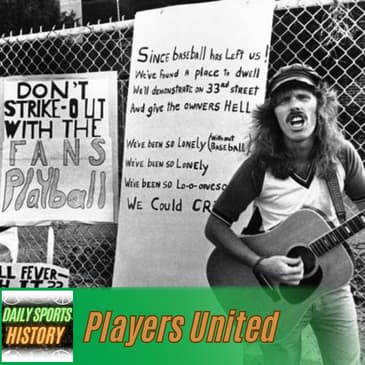
Step into the batter's box as we revisit a pivotal moment in baseball history—the 1972 MLB strike—a showdown between players and owners that brought America's pastime to a standstill. In this short episode, we unravel the events leading up to the strike, the issues at stake, and the impact it had on the sport and its fans.
Join us as we explore the tensions simmering beneath the surface, from disputes over player pensions to demands for increased minimum salaries and improved working conditions. Follow the negotiations, the ultimatums, and the eventual resolution that allowed baseball to return to the diamond.
Through concise storytelling, we capture the essence of the 1972 MLB strike, its significance in the labor movement within sports, and the lasting legacy it left on the game of baseball.
Tune in for a quick swing through baseball history as we examine the clash between players and owners during the 1972 MLB strike.
We are being featured on PODCAST GURU:
https://app.podcastguru.io/podcast/daily-sports-history-1715849627
Website: dailysportshistory.com
Email: dailysportshistory@gmail.com
YouTube: YouTube.com/@dailysportshistory
Twitter: twitter.com/dailysportshis
Facebook: facebook.com/profile.php?id=61551687917253&mibextid=ZbWKwL
Tiktok: tiktok.com/@daily.sports.history?_t=8hHPnNSCqfm&_r=1
#sports #sportshistory #sportspodcast #podcast #strike #union #baseball #mlb #money
Buy me a coffee: buymeacoffee.com/dailysportz
Newsletter: https://substack.com/@dailysportshistory?r=3en496&utm_medium=ios&utm_source=stories&shareImageVariant=light
DailySportsHistory.com
Email: dailysportshistory@gmail.com
YouTube: YouTube.com/@dailysportshistory
Twitter: twitter.com/dailysportshis
Facebook: facebook.com/profile.php?id=61551687917253&mibextid=ZbWKwL
On April fifth, nineteen seventy two, was the very first time Major League Baseball games were canceled due to a strike, as the players union decided to go on strike due to issues with pensions and salary arbitration. This was the first player strike in North American professional sports history and truly changed sports forever. Here's the story behind the very first professional athlete strike today on Daily Sports History. Welcome to Daily Sports History. I'm Ethan Reese, your guide to a rapid deep dive into sports history. Now, professional baseball started way back in eighteen sixty nine. We did an episode previously on the Cincinnati Red Stockings, the very first professional team. In those early days, they did a lot that actually affected baseball over the years, not only how the game is played, but how we actually pay players. And way back in eighteen seventy nine, baseball instituted a reserve clause into their bylaws, which I actually stuck around for years. What that meant was the very first team to sign a player to a professional contract would own his rights for the rest of his career. They could trade him anytime, cut him anytime, and decide exactly what to pay him and the player's only recourse. The only way to fight back was to quit, and by nineteen seventy two the players had had enough into a man named Marvin Miller, who forever changed the game. Even though you may have never heard his name, he was pivotal in organizing the very first union for Major League Baseball and negotiated four years earlier, in nineteen sixty eight, the very first collective bargaining agreement, which gave minimum salaries to baseball players of at least six thousand dollars, which was huge at the time, which is roughly fifty one thousand dollars a day, giving them a basic living salary for even lowest paid player. But Marvin wasn't done, especially the players, as there was always issues with this reserved player rights and players couldn't really negotiate for higher contracts. Now they had a base salary, but what about if they wanted more, if they were stars. There was a story back in nineteen fifty seven where Mickey Manno was having one of his best years of his career. He hit over three hundred and sixty five that year and won the Most Valuable Player award, and despite all this, his salary was actually cut by five thousand dollars despite being the best player in the league, and that's not the only time, and stories like this were very common as there was nothing they could do and many players who weren't stars even had to work in the off season, taking part time jobs as clerks or teachers. So the players wanted to do something, especially after Marvin Miller found out during the off season that the pension they had set up for players after they retired had a surplus of over eight hundred thousand dollars, and they simply asked them to release the funds to the pension, and the owners would not budge, so when they had their player representation meetings for the union, they all voted all voted forty five to zero to strike, making it the first time a professional league has striked, and on April fifth, nineteen seventy two, was the first time games were missed due to the strike, and it lasted for twelve days, so not the longest strike ever, but it caused there to be a total of eighty six games missed and the owners wanted the players to make up these games, but they wouldn't agree to pay for the games, so the players wouldn't do it so that year you had teams playing different amount of games, roughly between one hundred and fifty three and one hundred and fifty five games that year instead of the customary one hundred and sixty two and cost some interesting standings at the end of the season, and after missing multiple games, the owners finally caved on April thirteenth, and they allowed for five hundred thousand dollars of that surplus in the pension to go into to help to help the pension players out and agreed to arbitration, meaning players could negotiate their contracts, which was a huge step forward. At the time, the top salary in baseball was about one hundred thousand dollars with inflation, that's still not over a million dollars. Within fifteen years though, that number had jumped to twelve million and continued to grow every single year. But the main reason it continued to grow was because the sport continued to grow and the popularity of the athletes continued to grow. The players were standing up for how much they were valued and how much the team should value them, and that was the main reason for the strike. For the players to be able to argue their value and with many of the teams being worth more than a billion dollars to day, it's hard to argue the value wasn't worth it. Thank you for listening today's Daily Sports History. If you like this, please follow us on our socials, were on Twitter, Instagram, Facebook, TikTok YouTube, Pinterest, threads, all these different social medias wherever you liked to socialize, we're there and you can get in short video clips everywhere to see the topics we talk about every day, and come back tomorrow for more Daily Sports History.