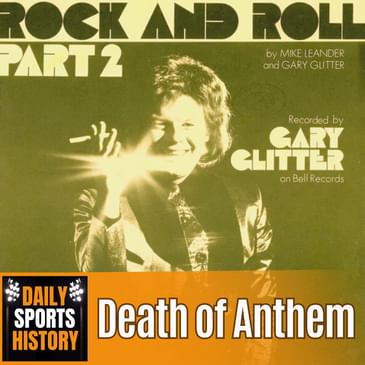
🏟️ How Rock and Roll Part 2 became a legendary stadium anthem
⚡ The pivotal moments that led to its removal from sports culture
💰 The debate over separating art from the artist
🎵 What songs have replaced it in today’s stadiumsCan you really erase a song from sports history? Let’s find out.
Check out Music History Today:
https://podcasts.apple.com/us/podcast/music-history-today-network/id1207673653
Website: dailysportshistory.com
Email: dailysportshistory@gmail.com
YouTube: YouTube.com/@dailysportshistory
Twitter: twitter.com/dailysportshis
Facebook: facebook.com/profile.php?id=61551687917253&mibextid=ZbWKwL
Bluesky: https://bsky.app/profile/dailysportshistory.bsky.social
https://www.instagram.com/dailysportshis/profilecard/?igsh=OWl1MzIyYndqOGU2
Threads
https://www.threads.net/@dailysportshis
#SportsHistory #RockAndRollPart2 #StadiumAnthems #GaryGlitter #MusicInSports #NFL #NBA #NHL #MLB #SevenNationArmy #MusicControversy #Throwback
Buy me a coffee: buymeacoffee.com/dailysportz
Newsletter: https://substack.com/@dailysportshistory?r=3en496&utm_medium=ios&utm_source=stories&shareImageVariant=light
DailySportsHistory.com
Email: dailysportshistory@gmail.com
YouTube: YouTube.com/@dailysportshistory
Twitter: twitter.com/dailysportshis
Facebook: facebook.com/profile.php?id=61551687917253&mibextid=ZbWKwL
No No, Hey, Da Da Hey. On March third, nineteen seventy two, a song that will go down in sports history as one of the most iconic sports anthems of all time is released by the artist Gary Glitter. The name of the song is called rock and Roll Part Two, but many of us just know it as the Hey Song and as the music behind some of our favorite memories of attending sports, whether it's in the basketball arena, on the football field, or in the hockey rink. It's been played across all different kinds of sports, but you may have noticed recently the song has slowly disappeared. Why is that? And how did they get so big only to fade away? And there's a very sad reason for it. And we're gonna dive into the history of this song today on Daily Sports History. Welcome to Daily Sports History. I'm Ethan Reese, your guide as you daily learn more about sports history, increasing your sports knowledge. And today's trivia question to listen out for is how high did this song rock and Roll Part Two get on the UK charts. Listen throughout the episode to find the answer, and if you miss it, I will give it to you at the very end. Now let's first dive into the early seventies in the music landscape. The seventies really saw a change in music. The sixties really had the boom of the Beatles and rock and roll started to take over, but the seventies had a change. Artists were wearing different things, music was getting louder, and the guitar was taking over and it was more of a theatrical, high energy show. And there were big names coming out that were known as glam rock type of bands. New York Dolls was a major influence. Kiss was probably the most famous being a glam band as they wore makeup and had hair go crazy, and that led to hair metal, which was popularized by bands like Queen Poison and def Leppard. And this is where our story really starts with Gary Glitter. Gary Glitter is not his real name. His real name is Paul Gadd and he's a British musician and he was struggling to find an identity in the late sixties early seventies and he eventually settled on the name Gary Glitter in nineteen seventy one to glam onto this glam rock trend. See what I did there. And he was a flamboyant guy, wore platform shoes, secret outfits, and wasn't over the top persona. We'll have some pictures of him on our social media so can see him in his regalia, to see that kind of glamor rock style. But what really led to him having success because he was a struggling artist, as most musicians are until they get that big break. And his big break was so unusual because he got a big break without almost anyone knowing who he was. See him and his So we're putting together kind of an orchestra rock arrangement. You don't know what orchestra rock is. It's a lot of what Queen did in their music. If you think of Bohemian rhapsoy, that's kind of an orchestra rock style, using a lot of different sounds and different ways to create a scene in the music. And the girl was to be both musically powerful but also simple enough that the audience could follow along and even chant in parts of the music. So what they did is they put together a side a of their vinyl, which, if you don't know vinyl, it's a circular disc that you've played music on. That was a precursor to CDs and a precursor to now where we listen on downlands and streaming, and so on one side you'd have your front side, and that's where your most popular songs, that the songs you thought would be the biggest hit song where everyone would listen first. Inside B you try some different things, and so on side A they had a song called rock and Roll Part one, and rock and Roll Part one had lyrics you'd recognize the sound behind it, but I had lyrics and it was really generic, really just repeated rock and roll, rock and roll a lot for its chorus, and if you hear it, you'd be like, sounds really weird because you know the background music, but you don't know the actual lyrics. And then on the second side of the album, the side B, they decided to create a stripped down version of that that was just intrumental except for when they chanted. Hey. They thought this would be good to be played in places where they're dancing and it could be a good fun time, so creating two different versions of the song, so if you liked it when you're out dancing, you could like it when you were listening to the real song. If it got played on the Radio News were released and Part one actually did become a hit in the UK, but it didn't really hit in the US. Then, in nineteen seventy four, a PR director for a minor league hockey team in Kalamazoo, Michigan, came across the recording randomly while looking for stuff to play over the loud speakers during their games. Now, if you want to go for the lowest of the low in the smallest kind of place you would play sports music. It is a minor league hockey team in Kalamazoo, Michigan, And he came across this and it had a beat that was kind of similar to the organ sounds that we are very accustomed to when you go to a baseball game, the charge where you had that hey, just like that charge, kind of that strong beat behind it that led up to it. That kind of people liked, and so he thought it might be a hit, And when he played it the first time at one of their games, it really took off with the fans. The fans were able to dance to it and then chant with it, which is a kind of a staple for these sports songs. So when you think about sports songs and how they have effects on the fans. There are some key factors you need. One is stripped down lyrics. If there's a lot of lyrics, the fans can't really follow it unless you know the whole song. You can't really follow the lyrics very well. But if there's just instrumental, you can play it during any point of the game and it's not going to bug anybody, and no one has to know the words. You just had that beat playing kind of give people up. Because music has a distinct effect on us. If we're sad, we listen to sad music. If we're happy, we listen to happy music. So if you play exciting, happy music, then the fans will be excited and happy. And that's the kind of the goal of these songs. And it started with the pipe organ, like we mentioned earlier, playing across baseball stadiums. It made its way into hockey, it made its way into other sports. But you know, the organs were big and expensive. You had to have an organ player. You have be able to maintain it. And in the nineteen seventies you were starting to get away from that because you had final records, you had speakers, you could play it across the stadium without having to have an organ, and it was a good change in something that has evolved throughout the years. So there's a lot of rock songs that we like that become sports icons that kind of follow this model. The Charge song, the Hay Song, or the rock and Roll Part two and we Will Rock You that has that beat that you only need that part and that we will rock you like you don't need anything else. So an easy beat and limited lyrics and that's what you need to have a success, and that's exactly what this did. So after the success at the minor league hockey team in Kalamba Zoo, well, the PR director took it to Colorado where he was able to climb the ranks and move up to the Colorado Rockies where he played it there too, And then it really expanded, as in while in Colorado, then the different Nuggets took ahold of it and made it its way into the NBA and it started to spread kind of from Colorado out as every team that came in it is like I like that song, and every visiting executive would like that song and they would go tell their team and it would just expand from there, and it expanded pretty quickly and got to be one of the most popular songs played in sporting events. It was able to hit number two on the UK charts and made its way into the top ten of the US charts, giving Gary Glitter the biggest hit of his career. And as sporting events grew, the NFL grew during this time, college sporting grew. During this time, the NHL grew, the ABA joined the NBA, it continued to grow. So sports continued to boom and music continued to boom with it, and this song didn't go away. It just grew with the sports. If you went to a sporting event between eighty and in early nineteen nineties, you would have heard this song at every single sporting event, if not multiple times. So if you went to a sporting event, you heard this song. And it really made its peak in the mid nineteen nineties when the Chicago Bulls really used it during the Jordan's second three peat, and it really was iconic during this time as everyone was watching this and the Denver Broncos used this song as a rally during their first Super Bowl win in nineteen ninety eight, and this led to other songs and other recording artists to understand that there's ways to make sports anthems like this song too from the band Blur in the White Striped seven Nation Army become staples in sports rock. But this was a very unique song. As if I told you what is this song? If I interviewed one hundred people on the street, I guarantee you less than five of you would know what the name of it was and who created it. You just know it as the Hey Song. And it became popular, and that's great. You still got royalties from it and everything for Gary Glitter. But the problem was Gary Glitter was not a great guy. In nineteen ninety seven, Gary Glitter took his computer into a place like a geek squad at Best Buy to get repaired. Problem was Gary had thousands of images of chyld porn on his hard drive and this led to a scandal. And after nineteen ninety seven, once this news broke, some sports began to distance themselves from the song, so it slowly started to fade away. Honestly, it didn't fade away a whole lot because most fans didn't connect the song to the creator. It was known as the Hay Song, which isn't even its name, and no one could tell you who created the song by nineteen ninety maybe if you were there when the song first came out, and it happened in the UK where he was arrested, not in the United States, so we were slow to catch up onto it. Remember, even though it was nineteen ninety seven, nineteen ninety eight, things still moved slow. We had computers, we had the Internet, but it was dial up and it was slow, and things did move slow, and sadly, despite the conviction he had in getting arrested, he was later released and he got arrested in Vietnam for sexually abusing underage girls. And this is when sports leagues began to really take action against this song. The NFL removed it completely from their playlist, the NBA and NHL slowly faced it out, but Major League Baseball actually kept playing it throughout twenty ten. You know, people kept complaining and they slowly faded out. Now, college in high school sports is a little different. They have marching bands that play songs, and there's only so many songs the marching band can played kind of pump up their fans, and so a lot of colleges he had stayed in rotation at a lot of colleges in high schools without us even knowing. And why is it a problem we play? It's an issue of is the artist responsible for the art? If the artist is a terrible person, but the art is great, is that still okay? And most of the time it depends on the medium of the art, And in this case of music, there are royalties involved. So anytime you listen to a song, the artist gets a royalty, and you don't want royalties go to a criminal, especially one that endangers kids. And so it makes sense that they pulled the song. Except he no longer makes money from the song, as he sold the rights to Snaper Music in nineteen ninety seven, so he no longer makes any money from the song. But is it still okay? You're still celebrating something he created. And despite the fact that it's been pulled, as of twenty fourteen, it was still making two hundred and fifty thousand dollars a year from just that one song. And he's not the only artist whose song has been kind of removed from the sports light. R Kelly, another artist who's been involved in numerous scandals and is imprisoned rightfully. For a long time, I've had most of his songs taken off the air and taken off anywhere they can play. But despite all of this, for a moment in time, it is the most popular sports song played in an arena. It got played multiple times for any event across the world because the one word it does say is hey, which can be said in any language, which is part of what made it such a great sports song. Though some of us may listen to it and have fond memories of a sporting event we went to, or you know a movie we watched that add it in it, it's still sadly, it's the artist being such a terrible human being doing what he has done to kids. Doesn't make up for what he did. It's a sad moment and it makes us question about art a lot. And usually I'm not talking about this as a sports one, but this song permeated sports. If you could name a song that what is the most iconic sports song, most of us would name this song or We Will Rock You. Those are two of the most iconic sports anthems. But that doesn't mean sports anthems aren't great. We've talked about previously the song Gloria being the precursor the anthem for this Blues to win their first Stanley Cup, and the Boston Red Sox sings Sweet Caroline by Neil Diamond every seventh inning stretch, and even colleges have their own songs. From the University of West Virginia sings take Me Home, Country Road. And these songs have words in them. They break the trend of not having words, but they are iconic to these teams. And it's just to these teams. There is more out there and music is a part of sports. Every station you watch football on has a tag, a song tag that you listen to that you hear and you know it's football time. Music gets us ready for sports, and it's amazing how these songs have impermeated our lives and how great they are in everything we do. So we may not hear the Hay Song or better known as Rock and Roll Part Two at sporting events, but it was a moment in sports history. And if you want to hear more music history, check out the Music History Today Network podcasts, where day they dive into something in music history that happened today, so you can increase your music history knowledge as well. I want to thank you for listening to Daily Sports History. If you like this, please follow us on our socials. There'll be links in the description below. We are on Twitter, Instagram, Facebook, Blue sky LinkedIn. Check out those so you can see pictures and videos of all our episodes. It come back tomorrow for more Daily Sports History. And did you catch the answer to today's trivia question? How high did the song rock and Roll Part two get on the UK charts? The answer is it made it all the way to number two.