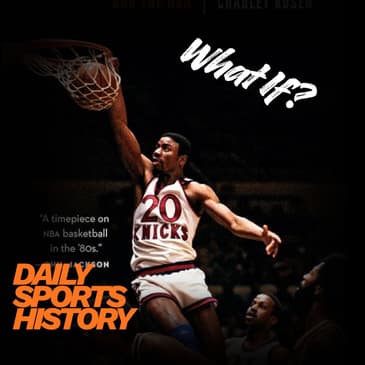
Discover Richardson’s unreal stats (14.8 PPG, 7.0 APG, elite steals) and why he was “Magic Johnson’s prototype.” Explore the league’s hidden cocaine epidemic (40-75% player usage rumors). Relive the exact moment Stern enforced “third strike = lifetime ban.” Hear his post-NBA glory: European titles, coaching wins, and the quote: “He saved my life.”
Buy me a coffee: buymeacoffee.com/dailysportz
Newsletter: https://substack.com/@dailysportshistory?r=3en496&utm_medium=ios&utm_source=stories&shareImageVariant=light
DailySportsHistory.com
Email: dailysportshistory@gmail.com
YouTube: YouTube.com/@dailysportshistory
Twitter: twitter.com/dailysportshis
Facebook: facebook.com/profile.php?id=61551687917253&mibextid=ZbWKwL
It's the winter of nineteen eighty six, and NBA history is made not on the basketball court, but is actually made at an airport where the new Jersey nets have just landed. In. NBA security walks up to former All Star Michael Ray Richardson and lets him know that he has been banned for life for failing a third drug test, showing the power of the NBA and the crackdown they're taking on drugs and the loss of what could have been a Hall of Fame career. Join us today as we dive into Michael Ray Richardson in one of the greatest what if stories in basketball history. Today on Daily Sports History. Welcome to Daily Sports History. Welcome to Daily Sports History. I'm Ethan Reese, your guide because I once took over five minutes to complete a drug test. I just didn't have to be So who was Michael Ray richards You may vaguely remember him if you were watching if you watched basketball back in the eighties, but if not, you probably forgot or never even heard of him. He was born in Oklahoma, but bounced around from place to place, so really grew up in Denver, and he was kind of a small framed kid. He couldn't even beat his older sister at basketball most of the times because he was a smaller kid. But he did have a lot of skill and he was a great distributor and he was truly a full package player. He could score, he could pass, and he was great on defense. He was just a little small, but it was good enough for him to get one college scholarship. If he didn't get a college scholarship, he would have never went on to play basketball in his life would have been completely different. But the University of Montana offered him a scholarship and this is where he really shined because he grew to be six or five while in college. Basketball is one sports where you grow and you get better, and he did get better because of this. It made him a better defender, made him a better offensive player, made him better all around, and made him a pro typical size, and as he grew, so did his game. He would go on to average over seventeen points, six rebounds, and three assists over his career with the Montana Grizzlies and earned first team All Sky Conferences for three consecutive years. He would set the single game scoring record, and his senior year he would set the single season record for scoring, averaging over twenty four points. And what's crazy is even though he was at a small school, he surprised everybody when the New York Knicks, as doing a New York Knick thing, drafted him fourth overall in the nineteen seventy eight NBA draft and he was promoted as the next Walt Frasier two picks later. Larry Bird, Yes, they may he could have looked a lot different if the Knicks chose byrd, but it was not a bad thing for them to get Michael Way Richardson. Now, he came from a small town and played college in a small town, and he was now playing in the biggest city in the world with bright lights, fans everywhere, and he was breaking the mold. Everyone looks at Magic Johnson as breaking the mull to port guard, being so tall, being able to do so many things, and Magic Johnson even said that Michael Ray Richardson was him before him. He had that skill. He was a menace, both offensive and defensive. He would go on to lead the league in steals and assist in his second year, averaging over ten assists and three steals a game. Only the third person in NBA history to ever do that. He established franchise records for both. He recorded eighteen triple doubles, the second most enfranchised history. He would go on to be an All Star in his second year, and he would continue to have success up until nineteen eighty two when things started to change. He started to show up late only talk about going out misimportant meetings. Really change everything. Now, why was he doing this? Well, the NBA in the United States and pretty much the world who had a cocaine epidemic kind of going on. It was a new drug kind of on the scene, and it really was taking the world by storm. It was done by people who didn't have a whole lot of money and people who were very rich. It was a widespread problem and it leaked its way into the NBA. NBA players were known for being out late, for partying and getting into drugs at this point. That was the start of the drug scene, and Michael was very impressionable. When his college coach left after his sophomore season to go to take another job, he felt lost. He felt like he'd lost a father because he grew up without a father. So he clinged to people. He clinged to the Knicks, and over the last couple of seasons he'd lost his favorite teammates through trades and acquisitions, and so he clung onto the few people he knew in town who he knew through partying. He got into drugs and it was an issue. He would miss practices, have mood swings, be acting like a toddler. Basketball became second to drugs became first, and so the Knicks had enough and they decided to trade him to the Golden State Warriors in exchange for Bernard King, who may have been a little bit past his prime, was one of the greatest basketball players, but he barely played for them, only played thirty three games due to issues again finding a nightlife in the Bay Area and sticking to trucks, so they would flip him again back to close to where he was the New Jersey Nets. And while all this was going on, David Stern had taken over the reins as the commissioner of the NBA, and he wanted to clean up the NBA's image. He didn't want it to be known as these guys just play basketball and do drugs, because that was the reputation that was getting involved. So he leveled a drug policy that really stepped things up. First offense was treatment and suspension. Second offense was longer, suspension, stronger and even more treatment, and third was banned from the NBA three strikes in your out policy. And in nineteen eighty three he had his first positive drug tests and the coach of the New Jersey Nets was Larry Brown, who was trying to help him. He saw what he could do as he went toe to toe with Doctor j in the playoffs, but was so inconsistent. Larry Brown literally took him to a clinic where he sat in the room with the doctor and Michael said he didn't have a problem, he just liked to freebase every now and then. Larry Brown was shocked that someone could just casually say I like to freebase cocaine every now and then. He didn't even say anything, He had no words, and it wasn't surprised that the next year again he failed a drug test, and the next following year would be after a couple stints in rehab and still actually playing really great, he actually came back with the Nets after his second sit in rehab, really coming through and coming back in nineteen eighty four eighty five, reason he went back to himself. He averaged twenty points a game, the highest in his career, with over five rebounds, eight assists, and three steals. He was an All Star player again for the Nets, leading them to the playoffs. Everything looked like it was going his way, and it even included one game where he missed out on being the second guard to ever have a quadruple double, where had thirty eight points, eleven rebounds, eleven assists and ninth steals against Indiana Pacers. And he had contracts with Converse and other shoot companies. He was on top of the world, even winning the Comeback Player of the Year. He was the poster child for what the program of the drug policy was supposed to be, allowing someone to get treatment, work their way through the drugs, and come back stronger than ever. But it only takes one test, one slip up, and that's what happened. He failed a third drug test in nineteen eighty six, his third and three seasons, and he became the first NBA player to be banned by the league for drugs. Now, when you're banned, that money you got from the NBA, those endorsements, they're gone. Your money's gone, everything's gone. It's easy for someone in this position that has a drug issue, that just lost his identity and his livelihood to go back into what you had. But that's not what happened. See, Michael had fought his way back before, and that's what he was trying to do. He went on to play for the US Basketball League, a smaller league that would end up folding, playing for the Long Island Knights, and then he would play for the Continental Basketball Association the next year. Basically, the only thing he knew was basketball and drugs, and if he went back to drugs, he'd probably died. But if he went into basketball, he might have a chance. And so he went on to play actually in Europe in nineteen eighty eight and would play there till two thousand, another fourteen year career. He had overseas and he was part of a team that was playing an exhibition game against the Bulls, and David Stern was there and he came up and instead of like being mad at David sterne him out or anything, he came up, shook his hand and thanked him because without him banning him from the NBA, he would have never turned his life around. And would probably be dead at this moment. It was an emotional moment and he truly saw what it meant. And he was larger than life, and he was great overseas, being great just like he was here. He won a European Cup while over there and was even coached by George carl who coached Real Madrid back then. He played for multiple teams over there that have weird, funky names, but he played for fourteen years, usually in the second tier league, but was able to make a career out of this, playing until he was forty seven years old, acting as a mentor to the young kids trying to make it make basketball a career here or even over with the NBA. After this, he went on to coach a couple of smaller teams in the CBA and left a legacy not only for being the first guy banned for drugs in the NBA, and actually in nineteen eighty eight he actually got a chance to join the NBA again, but chose to stay in Europe and go with that lifestyle and overall this whole drug policy. There have been fifteen players banned from the NBA, with Michael Ray Richardson being one of the most notable because at his best he was a little Magic. Johnson and Isaiah Thomas said he was the only player he feared to go up against. It's amazing what if story. As he played eight seasons in the NBA, was a four time All Star, two time First Team NBA Comeback Player of the Year, three time Steelers Editor led the NBA, and assist in nineteen eighty along with a ton of accolades for his European career. His career is a huge what if story. If he were to continue to play, not gotten into drugs at all, it's likely he would be a Hall of Famer in a name that we compare with some of the greatest of all time. The Knicks may have won championships, Magic and Bird may had a third guy that dominated the nineteen eighties, but sadly that's not what happened. Michael had a great career in the NBA and overseas, and he valued his journey and it got him to where he needed to be. Just sometimes he's forgotten about and only remembered for the wrong reasons. Sometimes we forget we do off the court can be just as important for what we do on the court. I want to thank you for listening to Today's Daily Sports History. It means a lot to me that you took the time to listen and I want to thank you so much. Just a little bit of update on the show. I am currently in the process of movie, so it's a crazy time. I'm going to try to get all these episodes out as much as I can, so definitely check in and reach out. It would mean a lot to me if you reach out and tell me your favorite what if story and maybe I can make an episode on that. That'll help me narrow down the topics. And really that's what I love to hear from, and really hearing from you doing a topic that you send me is great. You can do that on our socials down below in the show notes, on Facebook, Instagram, Twitter, or you can reach out to me via email Daily Sportsistory at gmail dot com. Love to hear from you and I will see you on the next one.