Check out This week in Sports History
https://thisweekinbaseballhistory.libsyn.com/
Website: dailysportshistory.com
Email: dailysportshistory@gmail.com
YouTube: YouTube.com/@dailysportshistory
Twitter: twitter.com/dailysportshis
Facebook: facebook.com/profile.php?id=61551687917253&mibextid=ZbWKwL
#DailySportsHistory, #DesignatedHitter, #AmericanLeague, #BaseballHistory, #MLB, #DHRule, #SportsInnovation, #1973Baseball, #BaseballChanges, #SportsPodcast
Buy me a coffee: buymeacoffee.com/dailysportz
Newsletter: https://substack.com/@dailysportshistory?r=3en496&utm_medium=ios&utm_source=stories&shareImageVariant=light
DailySportsHistory.com
Email: dailysportshistory@gmail.com
YouTube: YouTube.com/@dailysportshistory
Twitter: twitter.com/dailysportshis
Facebook: facebook.com/profile.php?id=61551687917253&mibextid=ZbWKwL
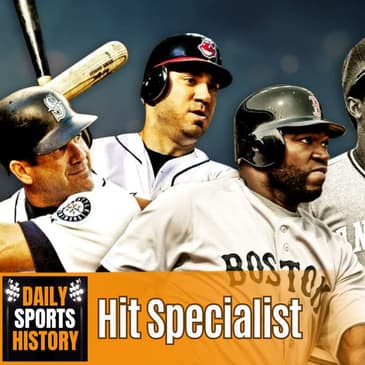
On December tenth, nineteen seventy two, Major League Baseball's American League voted to try the DH to help boost offensive efficiency as the previous decade was some of the worst offense in baseball history and it attempts to stay baseball and little did they know they would change the game forever. Today, we're going to dive into how this rule came to be and how it's affected the league on Daily Sports History. Welcome to Daily Sports History. I'm Ethan Reese, your guide as you daily learn more about sports history, increasing your sports knowledge. And today's trivia question to listen out for throughout the episode is who was the very first DH in baseball history? Listened to the episode to find out the answer, and if you miss it, we'll give it to you at the very end. So first, what is a designated hitters? Hitter in baseball is a player that only plays offense. They only hit, They do not take the field to play defense in any way. Now, a designated hitter does not necessarily need to take the place of the pitcher, but that's normally how it goes, as the pitcher is usually the weakest hitter. Now more recently with Shoheo Tani. That may not be the case, but more often that was the case back in the day. As in the eighteen hundreds, the difference between a pitcher's batting average and a traditional player's batting average was about fifty, so it wasn't a huge gap, but it was starting to grow. With every year and every decade till nineteen fifty, that difference continued to grow, and by nineteen seventy two, the batting average difference between a pitcher and a regular player was over one hundred, as pitcher had become more specialized in pitching and less than hitting, and the average batting average for a pitcher between nineteen seventy and nineteen seventy two was one forty seven, only slightly better than in the nineteen sixties when it was one forty three. Now, previously we covered the offensive. We covered the rules changed where they lowered the mound and changed the strike zone to help increase offense. As throughout the sixties, offense was dying and it was slowly getting better, but baseball wanted to continue to improve that because they saw how offenses contributed to better ticket sales, which made the owners more money. Made the players more money and made everyone more money, and that's what everyone liked, and it was a more enjoyable product on the field. But the history of the designated hitter wasn't a novel idea. The first time it was brought up was in eighteen ninety one, where the American League and the National League each brought their own proposals. Albert Goodwin Small, one of the small One brothers, who was a player himself, brought his own take to showing how pitchers struggled as they were more specialized players, and if a pitcher got injured hitting, it really destroyed the team's defense. So his proposal was to act actually have only an eight man batting order, so the pitcher only pitched, and you got rid of that player in the batting order completely. It's a very simple concept, but it wasn't one that really flew, and his friend Charles Temple actually suggested what is now known as the DHA player designated it to hit and replace presumably the pitcher, eliminating him from batting so he can focus on the defensive perspective. Now, they presented both the National League and the American League, and both of them turned this down. Because they thought that the truest form of the game was that a player played every single position, and if your pitcher was bad at hitting, the other team's pitcher would be bad at hitting, so it kind of equaled it out. It didn't give you an advantage either way unless you have once in a generational talents like Babe Ruth and hitter and shohe Otani, who's a great pitcher in hitter. But they continued to raise this idea. It was brought to the owners in nineteen oh six by Philadelphia manager Connie Mans and they can it fizzled out, and again it was rejected, and it continued to get rejected as salaries went up. It was like, also, well, does a pittuer get paid less? Does the hitter get paid less? How do they pay these players because they're only playing half the game. And it just caused more and more confusion, and they continued to kind of grease the wheels a little bit every time. And they took a four year trial period for the minor league system to try the designated hitter and it went to great success, and then two years later they actually allowed the American League to try this in spring training to see if it worked for the players as well, but the National League didn't want any part of it, which is a very unique system in baseball. We'll cover this at some point, but the American League and nationally kind of work separately. They're kind of like how states are part of the United States. They have their own legislation and their own laws, but they also are governed by the United States and a whole. That's what baseball is. These two states kind of govern themselves but are over the baseball umbrella. And after the success of this experiment, at the end of the nineteen seventy two season, and it was of American League owners voted eight to four to approve the designated hitter, and the National League again voted to not include it, but they did agree on one aspect. If there was ever interleague play, the team that was home would play by their rules. So if a National League team went to an American League, they could use a designated hitter, but if an American League team went to play in a National League team, they would not be allowed to use the detonated hitter. So they started this in nineteen seventy three under a three year trial, and on April sixth, nineteen seventy three, the very first designated hitter was put into place, and it was the Yankees' hitter Ron Blumberg, and with that at bat, he changed baseball forever. And this change actually helped increase batting average, increase scoring, and increase attendance at American League games. And after this three year try, the American League decided to continue this as a more permanent rule. In the National League still voted no, and it wasn't until two thousand and twenty two, very recently that the National League finally decided to adopt the designated hitter. It's a long time. It really was the major distinction from the National League to the American League, but as teams played more inter league play it kept happening more and more. It just seemed inevitable that the National League would join the American League. It just made sense as pitchers became even more specialized to this day, and putting your prize picture out there to hit run bases and the chances at more injury was just something that they couldn't continue doing. Now. Over the years, the DH has become a coveted position and so it has allowed hitters to be just as focused on hitting as pitchers are focused on pitching, and makes the DA's position even more valuable, and some of them continue to get paid an amazing out. And the first designated hitter to be inducted into the Hall of Fame was Harold Baines, but he's been followed by Edgar Martinez, Frank Thomas, and David Ortiz. Now these are players that played over fifty percent of their games at DH, with David Ortiz playing the most with eighty eight percent of his games played being a designated hitter. And these are more recent players and it's going to continue to get even more as the National League has joined, And we just had an MVP who was more of a designated hitter, and it continues to change and the game has had more success because of it. Offense always leads to more fun and engagement in the game, no matter what sport you're in, and it's a great thing to see Baseball continue to push the envelope to get a better product on the field. And it's great to see because games that just stay stagnant tend to be left behind, and baseball is focusing on not being left in the past. And I want to thank you for listening to today's episode. If you want more baseball history content, check out This Week in Baseball History with Mike and Bill, where every week they dive into history of baseball in unique ways. So if you want even more baseball history, we'll put a link in the description below for you to check them out. And if you enjoy today's episode, please go tell a friend about all the sports history you're learning and come back tomorrow for more daily sports history. And did you catch the answer to today's trivia question? Who was the very first designated hitter? The very first desonated hitter was Ron Bloomberg of the New York Yankees, who was able to use this new DH rule to help extend his career in baseball. And surprisingly, he wasn't known as a power hitter. He was more of a guy that continuously got on base. He wanted to escape them