Ali singing:
https://youtu.be/mq6BZ4ofd54?si=aiESZ2l6XAyGhPEv
Check out BoxHard Podcast
https://podcasts.apple.com/us/podcast/boxhard-boxing-podcast/id1048393982
https://open.spotify.com/show/5eIOO67pzqDPyu8KYPrqML
#DailySportsHistory, #MuhammadAli, #BuckWhite, #BroadwayHistory, #SportsAndCulture, #AliOnStage, #TheaterHistory, #BoxingLegend, #CulturalIcons, #SportsPodcast
Buy me a coffee: buymeacoffee.com/dailysportz
Newsletter: https://substack.com/@dailysportshistory?r=3en496&utm_medium=ios&utm_source=stories&shareImageVariant=light
DailySportsHistory.com
Email: dailysportshistory@gmail.com
YouTube: YouTube.com/@dailysportshistory
Twitter: twitter.com/dailysportshis
Facebook: facebook.com/profile.php?id=61551687917253&mibextid=ZbWKwL
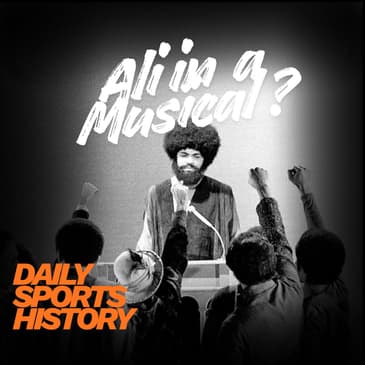
On December second, nineteen sixty nine, the world was given the chance to see a possible career change for the heavyweight champion of the world, Muhammad Ali, as he took the stage on Broadway for a new musical called Buck White, where he took the leading role of the same name and one of the hottest tickets in town when it opened, and yet it only lasted one week. Here's the story behind this crazy moment where Muhammad Ali took to Broadway On Daily Sports History. Welcome to Daily Sports History. I'm Ethan Reese, your guide as you daily learn more about sports history, increasing your sports knowledge. As today we learn about the musical of Buck White, and today's trivia question to listen out for is what was the first acting role Muhammad Ali had. Muhammad Ali is one of the greatest athletes that ever lived, and he changed the world of boxing, making it even more popular. But it wasn't just because of who he was in the ring. No, it was actually because who he was outside of the ring. He was one of the greatest speakers and amped up a fight more than anyone else. He was so charismatic that people just gravitated to him, and that is actually what led him to possibly a career change. The reason this happened was not because of the boxing ring. There was actually Ali's beliefs outside of the ring. Seeing in March of nineteen sixty six, Ali refused to join the armed forces as he did not believe in combat due to his Islamic religion, and because of this, he was denied a boxing license in every state and he was stripped of his passport, which meant he could not fight abroad. He could not fight in the States, and so he lost his heavyweight title, and from nineteen sixty seven to nineteen seventy, of the ages of twenty five almost twenty nine, he did not fight a single boxing match. But that doesn't mean he was outside of the media. He was a larger than like figure. He was a true superstar. And what he dove into even more after this was getting into his civil rights, as this is why he lost his boxing His civil right was he had the right to refuse to join, being a conscientious objector. But this made him a villian in many people's eyes, as everyone viewed being a part of the army as just your national right, and when such a public figure didn't join, it put a sour taste in everyone's mouth. And it wasn't like professional athletes and the stars hadn't joined the Armed Forces before. Ted Williams, Joe DiMaggio, some of the biggest baseball players ever had joined the Armed Forces before, including superstars like Elvis had actually joined the army as well. So what made Ali different, Well, he had more of a religious belief and that was different, and it was a different belief than everyone had at the time. See, he had joined the Islamic faith when most people in America at the time were Christian, So everyone viewed him as being anti American, and it's an anti Christian And one way people were protesting or putting out protests was in the theater. One of the most popular plays of all time is the play Hair. Now, if you've never seen Hair, there's actually a movie of it, and one of the most popular songs from it, Aquarius, was at the very end of forty year old version, so you probably heard at least that song. It was a very famous song and it's been revived multiple times on Broadway and done in theaters across the world. And it started in nineteen sixty seven. It's a Broadway in following year in nineteen sixty eight. With its success, other plays wanted to get involved, and one of those plays was called Buck White, and it was a similar concept. It really focused on, you know, the rights of African Americans and rights of people to protest. It was a protest type play and originally was not musical. See Actually, Muhammad Ali actually attended the play back in San Francisco and he actually was able to hang out with some of the actors and directors after the play and they got to have a kind of party scene and he got to singing with him and we'll put a clip in the description below of him actually singing a song from this play on the Ed Sullivan Show in the description below, and he is able to sing pretty good. And this caused the directors to actually think about taking this play and putting it into a musical, and they brought the idea to Muhammad Ali with like would you start in this? It gave them a star for the play as the play revolved around Buck White, a black activist who was very charismatic, and no one was more charismatic than Muhammad Ali. And this wasn't Ali's first acting role. He actually appeared in the film Requiem for a Heavyweight in nineteen sixty two. He just had a small role and wasn't a whole lot of acting, so he agreed to this and they started to put together songs to make this into a musical, and they actually took it onto Broadway with the support of Broadway veterans behind it, including the writer and the director, and they had a star in Cassius Clay who's one of the biggest well known people in the world, so they were able to get on Broadway and the promotion behind the show was actually really good. See, they got on the Ed Sullivan Show, which was at the time one of the most popular programs in the world, being seen by millions and millions of viewers every week. And you don't know what the Ed Sullivan Show is, Well, it was a variety show where they would have musicians on and they would talk to important people and to where the Beatles got their big break. And this was a big break for Buck White, and their preview went extremely well. Now, if you don't know what a preview is in theater or even in films, they do a preview for critics so they can review the film, have something written up ready to go and get put out good information about the show. In films, you go to a theater, you watch it, then you write it. It's easy. But in theater, it's a live show. It's basically a dress rehearsal, a practice run for the real show that the critics are seeing, and that is definitely different because anything can happen. You can still make mistakes, you can still have issues. It's not going to be precise. That's the fun of a live performance. But this went great. The preview went great. Critics were praising the show, praising the music, and praising Muhammad Ali. But why if this was such a popular and there was so much buzz around this and it went so well, why have we never heard of it? Well, the problem was, and he was doing great until opening night when it all kind of fell apart. He wasn't as charismatic, he wasn't as into it, he didn't have the flow he had in the preview, and the show just kind of felt dull. And after that that's what critics wrote about. That's what everyone was talking about. And it's just a play. It's not anything to go see. And it quickly fizzled out and within a week the show had closed. I had such promise, but the challenge was, I think Ali when you look at the Ali as in his profession, you put all your time and effort and getting ready for one show, that one fight, and you fight that one fight and then you're done. And he put all this time and effort in getting this role ready, he put into that one show, that preview, and after that he just couldn't muster up the same excitement, the same vigor for the other performances. And Broadway is a hard thing. The leading actor is usually done eight shows a week. That's two on the weekends, and they usually get Monday or Tuesday off and the rest of the day they do one show. So you are working usually six days a week at least, if not even more, and gets so heavily focused and takes it's so draining. It's a hard thing, but that's how Broadway actors need to make a living. You have to do a live show be able to have a paycheck, so it's very difficult. And coming from the boxing world where you box that one fight and then you rest until the next fight, and there's a lot of time in between, there's not the same and Broadway, and it's a challenge, and that's probably what happened. He put all of his might into that preview, and he couldn't get the same mte the second time and the third time. In the fourth time. It becomes repetitive and it becomes hard. That's why actors are so good. Even though they're doing the same thing they've done over and over and over and over, they still make it look engaging and exciting. And that's a hard thing to do, especially if you've not really done it before. Now, this wasn't his only foray into acting. In nineteen seventy seven he wrote an autobiography called The Greatest where he starred in it, and in nineteen seventy eight he'd start in Freedom Road, set around the Civil War times, where he was a slave and a Union soldier. But that was his last acting role. We've seen other other professional athletes getting to acting. Most prominantly is Dwayne the Rock Johnson, even though he wasn't the greatest football player, he was a professional football player in the Canadian Football League. And there have been other great athletes that have made the four way into acting. Some love it and some don't. And for Amahar Ali, he had his chance, and he eventually stepped away and focused more on boxing and his civil rights activism, and that's what he's known for and that's what he will be remembered for. But it's nice to know he also had another side with a beautiful singing voice, and maybe if it went well, he could have had another career in acting. Thank you for listening today's episode, And if you want more boxing content, check out the box Hard Boxing podcast where your hosts Joey Joey Kostman and fast Eddie Chambers go through all this stats, news, opinions and have great boxing guests so you can stay up all you need to know on boxing. And if you joined today's episode, please like and share it on all your social media's. Get the word out there about Daily Sports History so we can continue to grow this community and give you even more Daily Sports History. And did you catch today's trivia question? What was Muhammad Ali's first acting role. He first made a cameo role in nineteen sixty two in the film Recoro Were Ahead Vweight. It was a small role, but that got him ready for his Broadway debut. M hmmm mm hmm.