Buy me a coffee: buymeacoffee.com/dailysportz
Newsletter: https://substack.com/@dailysportshistory?r=3en496&utm_medium=ios&utm_source=stories&shareImageVariant=light
DailySportsHistory.com
Email: dailysportshistory@gmail.com
YouTube: YouTube.com/@dailysportshistory
Twitter: twitter.com/dailysportshis
Facebook: facebook.com/profile.php?id=61551687917253&mibextid=ZbWKwL
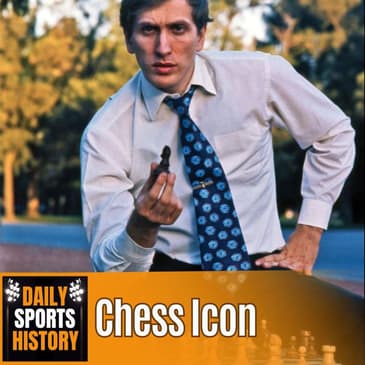
On April third, nineteen seventy seven, arguably be arguably one of the greatest chess players in American history, Bobby Fisher is stripped of his title of World Champion for refusing to defend it against Himtoti Kharpov of Russia, showing the downfall of Bobby Fisher, who was once the most iconic chess player in the world, playing in the match of the century and leading millions to get into the game of chess in America. Today, we're going to dive into the history of Bobby Fisher and what led him to give up his title and led people to ask where is Bobby Fisher today? On Daily Sports History. Welcome to Daily Sports History. I'm Ethan Reese, your guide as you daily learn more about sports history, increasing your sports knowledge as we dive into Bobby Fisher giving up his world title. Bobby Fisher was born in nineteen forty three in Chicago and Chicago, Illinois, and he grew up not having a lot of things, but he showed to be very intelligent and at the age of six, he got the game of chess and started to begin to learn everything he could about it and really became assessed with the game. He learned from other chess players around the Chicago area and continued to grow his game, and by the age of fourteen, he became the youngest US Champion in history, and he would go on to win all eight US Championships that he participated in, including a perfect score in the nineteen sixty three sixty four events, something that no American had ever done, and at the age of fourteen, he also became the youngest Grand Master Champion, which is the highest title you can achieve in the chess community and is awarded by the International Federation. Fisher revolutionized chess through meticulous preparation and innovative opening strategies, and in nineteen sixty nine he actually wrote a book called My sixty Memorable Games, which was celebrated in the chess community. As one of the which was celebrated in the chess community. His play style was aggressive and tactile, and from nineteen seventy to seventy one he had won twenty consecutive World Championship qualifying matches and defeated elite multiple elite players, and in nineteen seventy two, Fisher faced off against Boris past in the World Chess championship. This was amid the Cold War. It was Russia against the US and Fisher won, being the first American born world champion, and it was dubbed the match of the century. This game right here put Bobby Fisher in a new echelon, and actually he became a celebrity, which Bobby didn't really want. He didn't want endorsements. He was offered millions of dollars from all different kinds of businesses because he had beaten a Russian and at the time in the Cold War, that was huge. But Fisher declined all the endorsements he could. He tried to stay out of the light as much as he could, but that didn't mean that this didn't go to his head a little bit. See. After winning this championship, becoming a household name in America, Fisher became kind of a recluse and kind of shied away from the public eye and shied away from championships Between nineteen seventy two and seventy five during his reign as world champion, but he became increasingly dissatisfied with the International Chess Federation and believed that the existing championship rules were unfair to reigning champions and began to advocate for changes, and this is where the issue came to be. In nineteen seventy five, he was told by the International Chess Federation that if he did not defend his title at the nineteen seventy five chess match against and told he will lose his title. Fisher had some demands, which this wasn't the first time he demanded things. When he first won the title. He actually demanded more of a payout, which he actually got from a third party benefactor, but he still had some demands. Now the reason for these demands, some of them kind of makes sense, some of them don't. It seems like he was scared a little bit, but it could have been. He just didn't want the unfair practices. So his first thing he wanted was the game would the match would continue until one player won ten games with draws not counting, which draws would count like as a half in their points system. So I can understand not wanting draws. You only want the victories to count. That makes sense, and that's not a bad thing. And the International Federation eventually succeeded that and would allow that to happen. Then his number two would be there would be no limp to the games played. Now, this could cause issues because chess can be a long match and it can go on long time in long time because there's me so many in so many situations. So if they didn't limit the numbers, then logistically it would become hard. You don't know how long you need the space, you don't know how long the players need to come. It can be a hard challenge to get it organized and cover the event. But after multiple challenges they would succede to this. Now. The third one was the reason why Bobby Fischer is his World Championship title, because this was his demand. If the match reached a score a total of nine games to nine games, each player winning nine games, then Fisher would retain his title and the prize money would be split equally. This was the problem they had because this required for the champion to win by two and because of this, it made it too hard for someone to win. It meant whoever was winning previously would have an advantage over the other one. You could play defense over and over and over and make sure that they never beat you until they just got exhausted and gave up, since they would never budge on this demand, despite budging on the other two demands. After multiple deliberations, Bobby Fischer relinquished his title now and gave the title to Antok Karpoff, who was the next in line to challenge him Now. In Krlock's autobiography, he expressed disappointment that he never got the chance to play Fisher. He believed it hindered his own chess development, and despite multiple attempts to arrange some type of match against Fisher, no agreement was ever made, and this actually made Karpoff the youngest champion at the age of twenty three, and the standoff between Fisher and the International Chess Federation remains one of the most dramatic moments in chess history. Most of the time, we don't know about chess. We don't even know when the chess championships are happening, where they're happening. Most of us don't even maybe consider chess a sport. So after he was stripped, Fisher remained silent. Now this shock the world because Fisher had become kind of an icon in America. He had defended America from Russia in chess, which was a huge moment at the time, and Fisher essentially disappeared. If you've ever watched SNL back in the day with Will Ferrell, when he's doing the Cheerleader, we always hear the Bobby Fisher, where is he? I don't know. I don't know, Bobby Fisher, where is he? Because he had kind of disappeared, he declined to do media, He declined imitations to return a competitive play, but in nineteen eighty two actually resurfaced to face bors Boskovsky, who he had beaten to win the championship, and to do so, he did this in Yugoslavia, violating US sanctions. Although he did win the match, it did not restore his legacy, and he's remained mostly a recluse throughout his life, popping up to play random grand Masters here and there, but never really making a push to regain his World Championship hood, which he could have done. He actually left America and became a citizen of Iceland, but in two thousand and eight, Fischer died of kidney failure while in Iceland, passing away in relatively obscurity, though he had actually an estimated net worth of over two million dollars. He may always be remembered for leaving the game of chess that he loved rather than playing the game of chess he loved and can't always have the perfect ending. And I want to thank you for listening to today's Daily Sports History. If you like this, please make sure you follow or subscribe where every listening it really helps. If you want to leave us a review, I would love to hear it. I would love to hear if you think chess is a sport or not. I love to argue. I love to hear arguments about this and you can contact us also at Daily Sports History at gmail dot com. Love to hear from you, guys. Come back to next week for more Daily Sports History