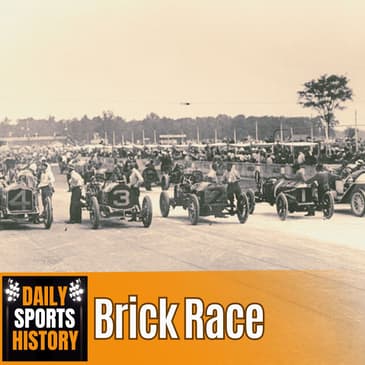
Join us on Daily Sports History as we race back to the inaugural Indianapolis 500 in 1911. Discover the excitement and drama of the first 'Greatest Spectacle in Racing,' the pioneering drivers, and the groundbreaking Marmon Wasp that took the checkered flag. Tune in for an exhilarating journey through the origins of America's most iconic motor race.
Website: dailysportshistory.com
Email: dailysportshistory@gmail.com
YouTube: YouTube.com/@dailysportshistory
Twitter: twitter.com/dailysportshis
Facebook: facebook.com/profile.php?id=61551687917253&mibextid=ZbWKwL
Tiktok: tiktok.com/@daily.sports.history?_t=8hHPnNSCqfm&_r=1
#DailySportsHistory, #Indy500, #1911, #MotorRacing, #RacingHistory, #Indianapolis500, #AutomotiveHistory, #SportsPodcast, #HistoricRaces, #RacingLegends
Buy me a coffee: buymeacoffee.com/dailysportz
Newsletter: https://substack.com/@dailysportshistory?r=3en496&utm_medium=ios&utm_source=stories&shareImageVariant=light
DailySportsHistory.com
Email: dailysportshistory@gmail.com
YouTube: YouTube.com/@dailysportshistory
Twitter: twitter.com/dailysportshis
Facebook: facebook.com/profile.php?id=61551687917253&mibextid=ZbWKwL
On March thirtieth, nineteen eleven. The greatest spectacle in racing, the very first Indianapolis five hundred, is held at the Indianapolis Motor Speedway, where it would get the nickname of the Brickyard. Here's a story behind one of the greatest races that is still held to this day today on Daily Sports History. Welcome to Daily Sports History. My name is Ethan Reese, and I'll be your guide to a rapid deep dive into sports history every day. And today's trivia question to look out for is how many bricks was originally on the track for the very first Indianapolis five hundred. Now, in the early nineteen hundreds, the automobile was a booming industry in the United States and it was only eighteen ninety three in Illinois when the first gasoline automobile was built on US soil. In a few decades after that, company after company was started for the automobile, you had big companies like the Ford Motor Company and many many other smaller companies popping up all over the country. Detroit became the largest automobile manufacturer in the United States, but by nineteen ten, Indianapolis was number two in the country, having car companies such as Coal National, Overland, Stutz, and Dusenberg all around the city limits. But despite having so many automobile companies around, Indiana had not developed its roads very well as this was such a new technology and many of the manufacturers wanted a way to test their automobiles to increase their capabilities. So local businessmen Carl G. Fisher got with other businesses around the town with a few other businessmen around the town for a great idea to build a huge motor parkway which would have long straightaways and gradual turns to allow all the automobiles they were making in the area to reach their fullest potential. It would be a private testing location but also could be used for competitive races to showcase their automobiles to the general public. And this all happened in nineteen o six and they started to look for multiple places where they could buy land near the city. They looked all over Indiana and just so happened about fifteen minutes from the middle of Indianapolis, and they wanted to make a large trek three to five miles, which was more than the traditional ovals that were at fairgrounds that were only a mile long. In the autumn of nineteen o six, Fisher and his friends went for a ride around Indianapolis, and just five miles northwest of the city in the countryside, they found a large strip of land of eighty acres that was for sale. They quickly bought up the land and put a plan together to start building. They originally wanted a five mile oval, but they modified it down to three miles with that two mile road course inside that could create a five mile lap, And they contacted an engineer to put this together, and he suggested that they actually go to two point five miles because they wouldn't have enough space on the land to have a three mile track and a grandstand, so they changed course because they wanted to make sure they could have stands for the everyday people to come watch the greatest race course in the world. So after they get the facility, they get the track built. In nineteen oh nine, they officially start their first season with a tart hoaded gravel track called Tyroid, which turned out to be a disaster for the tires and racers alike. Tires blew on it and the debris was flying everywhere and it created huge potholes ended up killing a driver after his car went airborne and flew eighty feet and killed two spectators. So they changed the surface in nineteen ten two brick and they used three point two million bricks that each weighed ten pounds and gave the nickname to the track the Brickyard, And they raced multiple races on this track throughout this time. They would start on Memorial Day weekend and go all the way to Labor Day weekend throughout the whole summer and run multiple races, all under two hundred miles. And this was very common back in the day. But they noticed on Memorial Day that first race they got huge attendants, and it dwindled down throughout the summer and they would get a little bump at Labor Day for the other holiday. So they decided that to make it just one giant race on Memorial Day when they got the biggest turnout. But they had to decide how big to make it. There was already the twenty four hour contest in Lemon and they thought that would be intriguing and they could give a large person and that'd be great for the auto manufacturers to touch their cars. But it's not a great spectator event, as many people can't just stay and watch a race for twenty four hours, so they wanted to find the right balance, and they settled on five hundred miles and they set it up to be on May thirtieth, nineteen eleven. So all the manufacturers were coming out from all over the country. There were once from Massachusetts, New York, Buffalo, Cleveland, Ohio, all making the trick out to Indianapolis in May to be part of this inaugural indy five hundred and there was forty six total entries, including some from Europe, and they added up that the total purse for the winner would be twenty seven thousand, fifty dollars. And to qualify for the race, the driver had to sustain an average of seventy five miles an hour, and of those forty six centuries, only forty qualified and then came. After all this qualifying and inspections of the cars, the race was ready to begin in front of ninety thousand fans and two hundred timing judges hired to make sure that every rate that they had accurate count of the race. And at ten am the race officially began. And what was unique about this race is it was one of the few races to ever start with a rolling start. They would have cars set up up five wide and use a pace car to get them all rolling to begin the race and start at almost full speed and at first Johnny Aikins, driving a National Car, took the lead for the first four laps. Then Spencer Wisehart took over in the Mercedes, but soon would be overtaken by a Fiat driven by David Bruce Brown, who would continue to lead for most of the first half of the race, but sadly, on lap twelve was when tragedy struck as and back in this time, many of these long races had two people riding in the cars. They were designed that way. One would be the driver and the other would be a mechanic who would look after the engine and the car's well beings such as the tires and the oil, but would also be a lookout letting the driver know if someone was coming up on a side, as they didn't have merrors attached to the cars back then, except for one driver who we will get to later. On lap twelve, Sam Dickerson, who was the riding mechanic for Arthur Griner, was the first person ever killed during the Indianapolis five hundred and sadly there have been more killed at this racing event. One of the front wheels came off of Grinder's car and caused him to lose control and both men were thrown from the car. While Grinder escaped with a broken arm, Dickerson flew fifteen feet from the car into the fence and was pronounced dead when the doctors arrived to check on him. The race continued despite the sadness that just happened, and something unusual happened. About halfway through the race. A driver named Ray Haroun, who was an engineer of the of the Marmon nor Dye company and had won racist previously at this speedway to finally took the lead. And there was something unique about Ray as he was not driving with a mechanic. He was the only one in the car and he was driving the first car that was ever recorded to have a rear view mirror. It was a unique mirror, as it said, actually just a little bit above him in front of the car. He didn't have side mirrors, just that one rear view mirror. And his car was known as the Marmon Wasp as it had a distinct point on the back of it, similar to a wasp tail. And the reason why it was even weirder that he was taking the lead is he was averaging only seventy four miles an hour, which wouldn't even qualify to make the race, but he continued that speed for one reason that he knew that others did not, as many had not driven on bricks this long. He knew that tires could not handle bricks at that speed, so he drove slower and was a tortoise against all the hairs. When what this caused was he only had to change four total tires the entire race, as many of the other competitors either crashed as there was eight recks throughout the race, or had to take multiple pit stops. He only took four the entire race, as everyone else averaged eleven pit stops, and that time difference is what really led him to win the race. It wasn't some photo finish and as he won the race, but it was also a contested win. He won the race. He was officially given the win, except they did review it as there was a lot of confusion. Even with those two hundred timekeepers keeping track of forty drivers through five hundred miles is a lot to make sure that we got every lap right. As another driver named Mulford thought he had actually lapped Ray, which he may have at some point earlier in the race, but Ray continued that slow and steady approached, which meant he probably passed him while he was in the pits. Eventually, no protest was filed, he just was upset at the time, and both claimed that Ray was the official first winner of the race and an innervator for racing as after this, the rearview mirror became a staple of not only racing but cars that we even drive to this day. So when you look at your mirror, you can remember Ray and remember that sometimes taking your time to think things out and have a great plan can be better than just jumping in and going as fast as you can. So whichever one you like may be right, but try to make a good plan for yourself. And if you want a topic to be told on Daily Sports History, all you have to do is leave us a review wherever you're listening, or send us an email at Daily Sports History and we will gladly get that done for you because we want you to be a great sports historian just like us, and come back tomorrow for more daily sports history. And did you catch the answer to today's trivia question how many bricks were used to pave the original ND five hundred three point two million bricks weighing ten pounds each