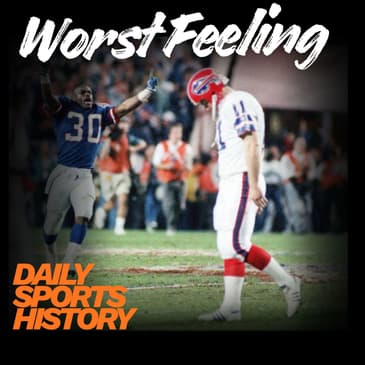
This episode drags you into the cold, gray winters of western New York, where Bills football is more faith than pastime and where a blue‑collar city poured its soul into Jim Kelly, Thurman Thomas, Andre Reed, Bruce Smith, and an offense that ran at warp speed. We trace how Marv Levy and Bill Polian turned a forgotten franchise into a juggernaut, and why that rise made what happened in Tampa feel less like a loss and more like a cosmic betrayal.
From there, we widen the lens to America in January 1991—yellow ribbons on lapels, war footage on hotel lobby televisions, and Whitney Houston stepping to the mic for a national anthem that felt less like pregame ritual and more like a national prayer. Against that backdrop, a young defensive coordinator named Bill Belichick pulled a thick, blue‑bound game plan from his bag. His idea was radical in its simplicity: invite Thurman Thomas to run, smother the passing lanes, strangle the clock, and turn a track meet into a grinding street fight where every possession—and every kick—mattered more than talent on paper.
Quarter by quarter, you’ll hear how that plan worked. The Giants lean into long, suffocating drives behind Jeff Hostetler and Ottis Anderson, while the Bills’ no‑huddle rhythm keeps getting chopped into pieces. Buffalo still moves the ball, still flashes brilliance, but time of possession quietly bleeds away until the scoreboard and the clock squeeze the game down to a single drive. By the time Kelly and the K‑Gun get the ball back on their own 10 with just over two minutes left, the most explosive offense in football is playing against the clock, against Belichick’s trap, and against its own suddenly conservative instincts.
We walk snap‑by‑snap through that final drive—the short throws instead of deep shots, the checkdowns, the one bailout run by Thurman Thomas that gets Buffalo into nominal “field‑goal range,” and the moment the Bills effectively tap the brakes and accept a 47‑yard attempt on grass instead of forcing the issue for something shorter. It’s an autopsy of choices: why a team built on aggression played safe when it mattered most, and how that caution quietly shifted the burden onto the one player least suited to carry it.
Then, time slows. We freeze with Scott Norwood at the 31‑yard line, the stadium humming around him. You’ll feel the quiet handshake with his holder, the deep breath, the three‑step approach, and the pure thud of leather as the ball rockets off his right foot with more than enough distance. In slow motion, we live inside the ball’s flight as it starts pure and then drifts, just a foot or so, wide of the right upright. In that 1.3‑second arc hangs everything—Buffalo’s first shot at a title, the validation of a rising dynasty, and the future of a man whose name would become shorthand for sporting heartbreak.
But this isn’t just about a miss. We open the locker room doors to show you the shock that follows: teammates circling Norwood instead of shunning him, Kelly and Thomas trying to shoulder the blame, Levy reaching for poetry to describe a moment that defies it. We track how the national media quickly turns Norwood into a symbol—a convenient “choke” narrative tossed onto highlight reels alongside Buckner and other infamous moments—while ignoring the distance, the surface, and the way Belichick and Parcells slowly engineered this game toward exactly this kind of difficult kick.
Most importantly, we go back to Buffalo. To the airport crowds who greet a heartbroken team with cheers instead of boos. To fans who decide to wrap their arms around Norwood rather than run him out of town. To a city that refuses to let one swing of a leg erase a season—or a man. Over time, “Wide Right” becomes less a punchline and more a shared wound, the first chapter of a four‑year Super Bowl odyssey that would define the Bills as the NFL’s tragic heroes.
Finally, we zoom out to the legacy. We look at how Belichick’s game plan ended up in the Hall of Fame and reshaped how defensive coordinators think about trading yards for time. How “Wide Right” became a phrase that still haunts Buffalo every time a big kick sails to that side, and how later misses by other Bills kickers echo that night in Tampa. And we ask the question that lingers over every replay: was this really about a single man and a single kick, or about a game, a strategy, and a set of choices that left too much distance between Buffalo and the life they’d been dreaming of?
“Wide Right: The Night Buffalo’s Dream Drifted Away” is a story about margins—the width of a football, the length of a kick, and the thin line between dynasty and myth. It’s about how a city absorbs pain, how a team protects its own, and why, decades later, we still can’t look away from that ball sailing just outside the upright
#WideRight, #BuffaloBills, #BillsMafia, #SuperBowlXXV, #ScottNorwood, #NFLHistory, #SportsHistory, #KGunOffense, #BillBelichick, #MarvLevy, #JimKelly, #ThurmanThomas, #AndreReed, #BruceSmith, #GiantsVsBills, #Tampa1991, #FootballStorytelling, #SportsDocumentary, #DailySportsHistory, #PodcastEpisode
Buy me a coffee: buymeacoffee.com/dailysportz
Newsletter: https://substack.com/@dailysportshistory?r=3en496&utm_medium=ios&utm_source=stories&shareImageVariant=light
DailySportsHistory.com
Email: dailysportshistory@gmail.com
YouTube: YouTube.com/@dailysportshistory
Twitter: twitter.com/dailysportshis
Facebook: facebook.com/profile.php?id=61551687917253&mibextid=ZbWKwL
So it's nineteen ninety one in Tampa, Florida, and everybody is watching the Super Bowl. And as the high powered Bills with the cake gun offense is innovating scoring like crazy, is behind the New York Giants, who are starting a back up quarterback and getting ran over by an old running back. And all comes down to the Bill's kicker, Scott Norwood, as he lines up for a forty seven yard field goal and misses in a moment so iconic the words wide right are known for this one kick and will follow Scott Norwood around for the rest of his life as he misses in the Giants win the Super Bowl. Join us today as we find out what happened in this game and how Scott Norwood took a lot of the blame that he shouldn't Today on Daily Sports History. Welcome to Daily Sports History. I'm Ethan Reese, your guide, because if I could get one close to the field goal, I would be happy, so love he Scott. So let's go back to nineteen ninety The Buffalo Bills are starting a new era. They were good back in the day with unfortunately O. J. Simpson, but they had struggled for years. They won a couple of championships in the AFL, but since they joined the NFL they haven't really won much. But that thing started to change when they hired Marv Levy as their new head coach and they brought in some new talent. They were able to bring in Jim Kelly, who was a star in the USFL, and that really changed sear trajectory. They brought him in, and they brought in Thurman Thomas, who was a great running back but fell in the draft due to a knee injury. And they found a great receiver in Andre Reid out of Kuttstown State. The only real dominant player they were able to get in the draft was a number one pick in Bruce Smith, who would go on to be one of the greatest sackers of all time. So they put this team together in the late eighties and they did something unusual. They developed a new offense that is kind of common that we see today, but back then it changed a lot. It was called the K gun offense. They called it k gun because Kelly his the name of Jim Kelly, and they were in the shotgun all the time. It was a no huddle, hurry up attack where Jim Kelly would call most of the plays right from the line of scrimmage, and this kept the defense tired and allowed them to get the upper hand as they weren't able to get set very much. We've seen this all the time across the league ever since because this was so successful. They were leading the league and scoring in yards and they just were dominant. Just to give me an idea how dominant they were. In the AFC Championship game, facing off against the Oakland Raiders, they put up forty one points in the first half and they ended up winning fifty one to three. They had such a good year this year. They were excited to get to the Super Bowl, and they may have been overly cocky because on the other side, the Giants, they were a pretty good team, but Phil Simms, their starting quarterback, got injured, and so they were starting Hostabler. And if you're going into a game against the back quarterback, are you gonna feel more confident? Obviously you are. They had a pretty good defense. Their offense was going like coming, like crazy, and so they were confident going into this game. And they were led on their defense by Lawrence Taylor. So their defense was a huge point and just some backdrop on this game. It was actually a really big moment. The United States had just gone into the first Golf War ten days before this, so a lot of people were feeling anxiety about this and just a lot of patriotism, so watching the Super Bowl became a very patriotic thing. The flyby was a huge moment, and hearing Whitney Houston seeing the national anthem was an iconic moment that still it is hard to live up to to this day. In this game, everyone thought the Bills were gonna win. Everyone was I did to see them go off offensively, the best offense against a backup quarterback, but what's going to happen? But the problem was they didn't expect the assistant coach, the defensive coordinator for Bill Parcells, the head coach of the Giants, to change things up so much that it would change the game. That defensive coordinator was Bill Belichick, and he readjusted their whole defense to not try to keep up with them, but to allow Thurman Thomas to run on them as much as possible, because if the ball was out of Jim Kelly's hand, at least they had a chance. So he had two down linemen, four linebackers, and five defensive backs, basically the entire game, daring them to run the ball as much as possible, and vice versa. Bill Parcells was running the offense. He was going to slow the game down, run the ball, try to hold the ball as much as possible to keep the ball away from the Bills. And this strategy worked. The Bills come out and they received the first kickoff, and they go through out with this light box and they're not able to really get any offense the first quarter, and the Giants actually score first on a field goal after a twelve play sixty one yard drive. And in the second quarter they're able just to drive just a little bit enough to get Scott Norwood a twenty nine yard field goal to tie the game at three. But then the second quarter comes out and it looks promising. See the Bills were able to have a great punt and pin the Giants back, and they got a holding call in the end zone, which meant they got a sack giving them a safety. So they go up five to three. But the Bills go on a twelve play eighty yard drive where they were Jim Kelly connected on six consecutive passes for sixty yards and Don Smith kept out the drive with a one yard touchdown run, giving the Buffalo's the lead ten to two. So the Buffalo is winning twelve to three after this safety, looking like okay, they're starting to take over, but Jeff Hosteller is not going to let that happen. They marched their way down ten plays eighties seven yards and Otis Anderson is going crazy running the ball all over them, including an eighteen yard run during this drive, ending in a fourteen yard touchdown pass to Stephen Baker with twenty five seconds left in the half, cutting the lead twelve to ten. They come out in the second half and the Giants get the ball and they resume their original game plan. They run fourteen plays for seventy five yards, with Otis Anderson running a one yard touchdown run, giving them the lead seventeen to twelve. The drive consumed a total of nine minutes and thirty seconds, putting their plan of keeping the ball away from the Bills into place as the Bills are not able to score in the third. In the fourth quarter, it takes the Bills just four plays sixty three yards to score a touchdown from Thurman Thomas to take back the lead nineteen to seventeen. However, there's still time left on the clock and the Giants went again on a fourteen place seventy four yards where they were able to get a field goal to take the lead twenty to nineteen. With two minutes and sixteen seconds left, the Bills have the ball back. It's the final possession. They have time and they are working their way down the field, but they are only able to get to the twenty nine yard line with eight seconds remaining, giving them a chance for a forty seven yard field gold. This case just give you an IDEA forty seven yards back then was not a chip shot like it is today. Kickers today are different and it is a different game, and he outwalks their kicker, Scott Norble. Now, Scott wasn't undrafted. He bounced around from team to team before he was able to settle in Buffalo, and he was very relied inside the forty yard line. And if it was on artificial turf, which this game was not played on artificial turf, it was played on grass. So for one, it was above his range that he wasn't very good past forty and it was on grass where he's not completely used to, but he's a kicker and it's the same motion. He just goes out there and does it. They feel confident, but Scott says it's about fifty to fifty if he could make it from that distance, and he goes out there for the kick after being iced by Bill Parcells with the course, and the snap happens. The hold is good, there's no mistakes, no one coults through the line. The kick itself looks pretty good, but it keeps shifting a little bit right, a little bit right, a little bit right, and it goes fourteen inches to the right, missing the field goal, giving the Giants the win. As an announcers say, he missed it wide right, giving this kick a name wide right. Carton Over would always be known for missing this kick wide right. This was awful. They lost. They felt awful. The Giants felt great. It was good for them. But Scott would go on to feel depression to hate from people in the town. But eventually that would subside because the next year they had a chance again and the next year. In the next year, the Bills went to three more Super Bowls in a row and lost them all and that's what makes this one such a devastating miss. Because he missed this kick, they didn't never get that Super Bowl because they've failed again and again and again. But that's not on him. If you talk to Jim Kelly, Andre Reid, Thurman Thomas, they all take blame for the kick, not Scott, because they say they could have done more on that drive to get hit closer or to score a touchdown. They could have done more. They set him up for a tough kick and he did his best. And I think we have to remember that kicking is a tough job. Everyone loves you when you make it, everyone hates you when you miss, and it's a fifty fifty shot every time. I want to thank you for listening Today's Daily Sports History. If you like this, please make sure you leave us a like and subscribe wherever you're at. That helps other people know that this is a great show and they can listen to and I want to and we'll see you on the next one.