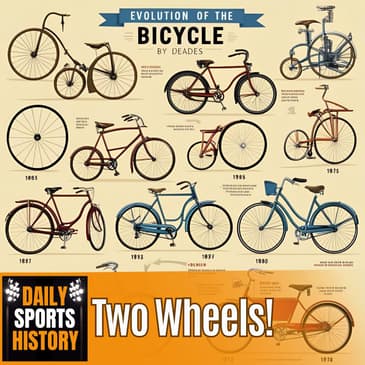
Journey through over 200 years of innovation as we explore the captivating history of the bicycle—from Baron Karl von Drais’s 1817 Laufmaschine to the high-wheel penny-farthing, the revolutionary safety bicycle, and the sport’s rise to Olympic status. Discover key milestones, legendary races, and how the bicycle shaped culture, sport, and society. Perfect for sports history enthusiasts and anyone inspired by human ingenuity.
Get the written podcast newsletter:
https://substack.com/@dailysportshistory?r=3en496&utm_medium=ios
📅 Listen now! 👉 DailySportsHistory.com 📲 Follow for more daily sports history insights!
Email: dailysportshistory@gmail.com
YouTube: YouTube.com/@dailysportshistory
Twitter: twitter.com/dailysportshis
Facebook: facebook.com/profile.php?id=61551687917253&mibextid=ZbWKwL
Bluesky: https://bsky.app/profile/dailysportshistory.bsky.social
#BicycleHistory #Cycling #SportsHistory #TourdeFrance #Olympics #BikeInnovation #OnThisDay #CyclingLegends #BikeLife #HistoryPodcast
Buy me a coffee: buymeacoffee.com/dailysportz
Newsletter: https://substack.com/@dailysportshistory?r=3en496&utm_medium=ios&utm_source=stories&shareImageVariant=light
DailySportsHistory.com
Email: dailysportshistory@gmail.com
YouTube: YouTube.com/@dailysportshistory
Twitter: twitter.com/dailysportshis
Facebook: facebook.com/profile.php?id=61551687917253&mibextid=ZbWKwL
Picture this. On May twenty first, eighteen nineteen, the first bicycle was introduced to the United States, before cars, before change. This was the fastest way to get around on two wheels, and it's come a long way since its first conception made of complete wood with two wheels and handlebars, to the high speed braces of the tour de fronts, the bicycle has changed how we move, compete, and even think about freedom. We're going to roll back through the history and discover how simple innovation sparked a global movement as today. We're going to dive into an incredible story of how the bicycle changed at different terms to become the bicycle we know today. It has brought the world goes together, the innovation courage seams. Lets go Welcome to Daily Sports History. I'm Ethan Reese, your guide as you daily learn more about sports history, increasing your sports knowledge. So to understand how the bike came about, it actually goes back to seventeen ninety a Frenchman, Comet de sirq rode a two wheeled wooden horse, as he called it. Now, this didn't have steering. It was just a block of wood connected to two wheels that you pushed in a similar way, but you had to stop to physically turn it. But it's even thought of that Leonardo da Vinci actually drew out an idea for a bicycle way back when he was around the nineteenth century in Europe, as it was known as the Year without a Summer. It was a very cold because in eighteen sixteen Mount Tambora erupted and this eruption gave volcanic ash that was widespread and caused many crops to die. And because of that, horses, the main source of transportation, died as well, prompting new innovations had to come about for alternatives, and in eighteen seventeen German baron Carl Vaughan Drys unveiled his invention, the loose Machine or the running machine, also be called a Dandy horse. Now. This machine had two wheels and was steerable and was made almost entirely of wood, weighing almost fifty pounds. It did include iron studs on the wheel and a rear wheel brake, and the front wheel could be steered with the handlebars, and it had a padded saddle for you to sit on and you would push using your feet, similar to the toddler bikes we see today to help them learn to ride. It has no pedals or anything. They just kind of pushed themselves along. It's very similar to that, but it does look like a basic form of a bicycle. If you saw a picture of it, you'd be like, yeah, that looks like really a wooden bicycle. And he debuted this by riding eight miles in under an hour, which is impressive for the time being, and he would get it patented the following year, and he quickly garnered attention in Germany, France, and England, and people started to take its design and improve on it. They created curved frames with larger wheels, and they really realized that riders preferred smooth pavements. And in the early eighteen sixties a Persian blacksmith, Pierre Mahooks, made a pivotal leaf forward, attaching pedals to the front wheel in a crank, allowing the wheel to be pedaled instead of just pushed by your feet. And Pierre Lamont, a carriage builder, actually moved to the United States and patent it here in eighteen sixty six, starting the graze of bicycles here. And this still was the basic wooden design using petals in the front, but it was an advancement in production. And what they actually did was try to go away from wood and use metal for a more sturdy frame. And they actually used cast iron, which is one of the heaviest metals, and they created a bicycle frame out of cast iron with wooden wheels and iron tires, and one of these bikes would weigh over one hundred pounds. It was very durable, but the ride quality was very bumpy. Of bikes were very common, and it actually became known as bone shakers because a lot of the streets back in England, a lot of the streets back in the day were made of bricks or cobblestone, which is very bumpy. Even if you ride on today's bikes or even cars, it's a very bumpy ride on those. But on a bicycle made of iron tires, it was called the bone shaker because you would literally use sure as you would ride and it would shake your bones, as they would say, and it was very uncomfortable. So this uncomfortability led to even more innovation. One way they did this was the penny feather bicycle, which is what we think of an old style bicycle. The huge bike in front and the little tire in the back, and it was first created by a Frenchman in eighteen seventies, Eugene Meyer and creating this it made the bike lighter, using wirespokes for tensions on the wheel, and it was called a penny feather bike because the large wheel resembled a British penny and the small wheel resembled a feathering coins and the pedals would be attached to the very front axle, which the bigger the tire meant, one turn of the pedals meant you went even faster. So some of these Petti feather bicycles could get up to twenty five miles an hour on a flat surface. And they used a solid rubber tire which created a smoother ride. It was a huge advancement to the metal tires that had been used before. Now the biggest problem with the pennyfeather is that front tire was very high. It was hard to get on and off and if you got the front tire caught on something or you hit something, you would likely take a header as they call it, going headfirst over the handlebars, causing serious and sometimes fatal injuries. And Thomas Stevenson famously rode a pennifeather bicycle across the world over twelve thousand miles before nineteen hundred. It took him almost over a year to do, but it showed how durable and sturdy the pennyfeather was. But it quickly fell out of favor because of its unpracticality. Now you could get injured very easily. Then we moved into what's known as the safety revolution, where there was some tricycle designs so that you were less likely to fall down. But the breakthrough came with a chain driven rear wheel designed by Henry Lawson in eighteen seventy six created the safety bicycle, which had two similar sized wheels, a diamonds shaped frame, direct front steering, a chain driven rear wheel in a lower center of gravity, which made it safer to stop because you could put your feet down when you had to stop. And they continued to tinker with this design, but this was the basic design that we even have today. Now the chain has been updated, the designs have been updated, but this was a real step into what bicycle was today, and because it was so safe as we consider then it really kind of took off, and especially took off when John Boyd Dunlap introduced a air filled tire for rides on harsh, bumpy roads to make it smoother and faster, and this was introduced in eighteen eighty eight and within five years almost all bicycles used TIS tire, and that dumb Lap name started the dun Lap Tire Company, which is still around to this day. And this innovation really made the bicycle what we know today. So by eighteen ninety three, bicycles are essentially what we would think of bicycles today. Had the same similar frame, similar tires, similar steering, but there have been innovations throughout this time. This wasn't exactly the bikes that we go to buy at the story of today, but this really made a social impact in a bicycle boom across the world. It led to mass productions which led to falling prices and millions of new cyclists that couldn't afford a horse or a car could afford a bicycle and still get around to most places they needed to at the time. And then came racing. As we always know we want to go fast and we want to see if we're faster than anyone else. In eighteen ninety nine Parls mile a minute, Murphy achieved a legendary milestone riding a mile in under one minute, doing it in under fifty eight seconds, going over sixty miles an hour, drafting behind a train, capturing the public's imagination, showcasing the speed potential of a bicycle. Now it's probably a bumpy ride if it was behind a train, but it still showed how fast you could go. As we continued to push the limit of speed even in bicycles, and in nineteen oh three the first Tour de France was ran and is now the most prestigious race in the world, running over fifteen hundred miles with multiple stages. And the bike got so popular that it was featured in both road and track events in the very first modern Olympics in eighteen ninety six. As technology continued to grow, we continued to add little things or ads things to the bicycle. The frames had become lighter weight, using lighter weight metals or even carbon fiber. To day, it actually led to a moment that actually empowered women because it allowed women who weren't allowed to ride horses or own car, but it was viewed okay for women to ride a bicycle around and it gave them more freedom in an athletic opportunity, and women's cycling actually debuted in the Olympics in the nineteen eighty four Olympics, and we've actually adjusted our bikes to be more specific nowadays. Now we have mountain bikes which have a thicker tire and more shock absorbing and gears to allow us to have more fun and be able to ride almost anywhere. Then we also have speed bikes that are made for racing with thinner tires in a lighter frame to really focus on how much speed you can actually get. And then we also got bicycles that were more for doing tricks like BMX, where we can do flips and spins that many never thought would actually happen. And we're getting a bigger push for bicycles, even e bikes, which are helpful to eliminate emissions that have been given out by the growth of cars in the industry. With an e bike, you're able to achieve faster speeds with less effort to get around your towns. Can be very helpful to reduce noise in air pollution and roadwear and make cities healthier to live by Countries such as Netherlands and Denmark have seen lower BTD rates due to this higher rate of bicycles, but bicicycles are a great sport. As over two billion bicycles are in use globally today, maybe we can increase that just by grabbing our own bicycle too. I want to thank you for listening to today's Daily Sports History. If you like this, please share it with a friend. The best way for us to continue to grow is through word of mouth. So share the episode, say all the great history you're learning about, and the more you share, the more episodes I can do for you. And come back tomorrow for more Daily Sports History