Get the written podcast newsletter:
https://substack.com/@dailysportshistory?r=3en496&utm_medium=ios
📅 Listen now! 👉 DailySportsHistory.com 📲 Follow for more daily sports history insights!
Email: dailysportshistory@gmail.com
YouTube: YouTube.com/@dailysportshistory
Twitter: twitter.com/dailysportshis
Facebook: facebook.com/profile.php?id=61551687917253&mibextid=ZbWKwL
Bluesky: https://bsky.app/profile/dailysportshistory.bsky.social
https://www.instagram.com/dailysportshis/profilecard/?igsh=OWl1MzIyYndqOGU2
Threads
https://www.threads.net/@dailysportshis
#dunks #basketball #NBA #ABA #History #inventions #Glass #NBAhistory #basketballhistory # phones #
Buy me a coffee: buymeacoffee.com/dailysportz
Newsletter: https://substack.com/@dailysportshistory?r=3en496&utm_medium=ios&utm_source=stories&shareImageVariant=light
DailySportsHistory.com
Email: dailysportshistory@gmail.com
YouTube: YouTube.com/@dailysportshistory
Twitter: twitter.com/dailysportshis
Facebook: facebook.com/profile.php?id=61551687917253&mibextid=ZbWKwL
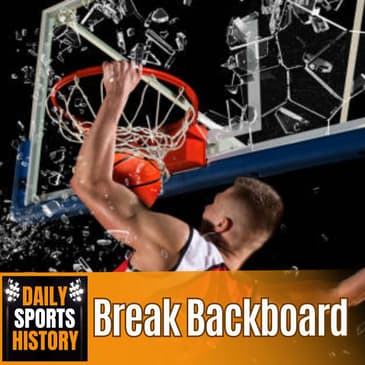
On April twenty third, nineteen ninety three, Shaquille O'Neal unleashed one of the most unforgettable displays of power ever in the NBA, dunking with so much force that he shattered the entire backboard support, sending the hoop crashing through the ground, halting the entire game. This moment was a testament to the physicality that Shaq played with, but he wasn't the only one to destroy a backboard and it marked and it marked a turning point in basketball equipment and engineering that has gone through years of improvement from when it first began to withstand this the physicality of superstars and thunderous dunks that have happened throughout the years. Today, we're going to dive into the legacy of the backboard and how it has adapted throughout the years. Today on Daily Sports History. Welcome to Daily Sports History. I'm Ethan Rees, your guide as you daily learned more about sports history, increasing your sports knowledge. As we dive into the history of the backboard. To first know about the history of the backboard in basketball, you have to go back to Win. It was created by doctor James Nasmith in eighteen ninety one when he just put a peach basket on a ten foot indoor running track and gave us the first hoop, which lacked a backboard, so if you missed the hoop there was no bank shot. You could only swish it and if you missed, it would go up on the track. Then a few years later they developed a wire mesh to go onto the balcony so that they would not have to continuously go up to the track level and get the ball. But these first backboards were actually made out of chicken wire in more like a fitence. It wasn't like the backboards we have today, but there wasn't much of a bounce to it, so it didn't have the square box yet, which would come later on on. Then in eighteen ninety five, a trapdoor net appeared, letting referees pull a string to release the ball, because before this you would have to physically get the ball out of the basket. But letting there be a hole this allowed the ball to come out easy without using ladders. Then in nineteen oh four they officially they made wooden backboards mandatory to replace the mesh wire that they had before. Now this is more in line of what we have today. You actually see wooden backboards sometimes in older gyms or outside and some outdoor backboards, so this is very close and similar to what we have today. Now. They do create more of a bank shot that we have today, but it still had some limitations, and when they realized that the ball would bounce off the wood very well and in a consistent way, they began to put a square roughly two feet by one and a half feet above the rim, giving you an aiming point. Now, if you don't know what temper glass, it is glass that is heat treated and it makes it four times stronger than regular class and it has made even more advances since the nineteen forties, But this was more prioritized as as we talked about last week. In the nineteen forties, pro basketball began to take even more effect and college basketball was getting even more popular, So more fans wanted to be able to see no matter where they sat in the stadium, and with the glass surface, it was a more consistent balance they would get rather than the wooden surface. As wood can warp throughout time, glass does not warp. But glass backboards remained still brittle, and there were still challenges and in nineteen forty six, Boston Teltic's Chuck Connors shattered a glass backboard during pregame warm ups with a set shot, not a dunk, and this caused them again to adjust the backboard as there was a lack of a protective barrier between the rim in the glass. Then it was about the nineteen sixties when Gus Johnson became the NBA's first cereal breaker as he played for the Baltimore Bullets. As when he played for the Baltimore Bullets in the nineteen sixties, he shattered three backboards with dunks, earning the nickname Honeycomb for his explosive style. And he had now he was a foreshadow for what would come in the modern NBA, as he was sixty six two hundred and thirty pounds, which was a larger player back then. And this is actually one of the reasons why the NCAA later would ban dunks because it was safety hazards because when you shattered glass, that made glass wheneverywhere glass could cut you could even tipper glass can cut you. It can slice, you can get stuck in your eyes or your body anywhere, and it was really hard to clean up and would really delay games by a lot. And then the ABA came along in the nineteen seventies who were known for their flashiness and started the dunk contest, meaning they had some of the best dunkers of all time, including Doctor J. But they had other great dunkers. There was Charlie Helicopter hints where on Novem, who shattered two backboards during a game against the con during a game where the pick where the Pittsburgh Condors took on the Carolina the Carolina Cougars and Charlie was a six five forward named the Helicopter for his leaping and dunking prowesses. He first in the first half he shattered one backboard on a drive to the basket, unleashing the power with a one handed dunk, tearing the rim down from the glass, shattering the backboard with a sound that was a cane to a shotgun blast. Cleaning the floor took over an hour, and there was no spare glass backboard, only a wooden replacement that was installed at the end. Then, just with one minute left in the game, with the Cougars leading comfortably, Helicopter broke away for another dunk for uncontested dunk. Despite warnings from the referee not to destroy the remaining glass backboard, he shattered it anyway with another thunderous slam with no replacements left. The officials and coaches agreed in the game, early finalizing the score as it stood, and fans rushed the court to collect charge of glass as a souvenir. Now, Charlie's now the Helicopter's Feet remains unique as he is the only one to shatter both backboards in a single professional game, but it also showed that they needed to correct these issues, especially with Daryl Chocolate Thundered Dawkings, one of the most famous backboard breakers of all time. In nineteen seventy nine, he shattered two backboards in three weeks with furious dunks, sending glass raining onto the court, causing our delays. His dunks were so powerful that the NBA began to view the backboard shattering as a safety and logistics issue, not just a spectacle. But charge of his glasses were collected and called Daryl's Diamonds. Then, in nineteen seventy six, great innovation made by Arthur A. Rant invented a breakaway rim which used a coil spring in the rim, which was originally developed for John Yet tractors to allow the rim to flex and break away, taking away the pressure from the backboard and putting it into the spring. Now, the breakaway rim absorbed the force of the dunks, protecting the backboard, making it less likely to break, and it was patented in nineteen eighty two and it was made standard at all levels of basketball. The NBA tested varieties and Darryl Dawkins actually was the one to test it as he could not break it, giving it the stamp of approval for the NBA a bank shot, further changing the sport again. Then in nineteen oh nine was the creation when we started to see the glass backboards emerge, offering fans a clear view of the game. Now, at this time, dunking was not a part of the game, so it wasn't much of an issue, so you could have glass and then fans could see no matter where they were sitting. But in nineteen sixteen, glass backboards were banned due to safety concerns. Then in nineteen sixteen, backboards were moved two feet away from the yes and up until this point baskets were still against a wall, which a wall wouldn't make it very hard to do layups, do dunks, play defense. It made a whole different game, and so taking it two feet off the wall prevented players from using the wall as leverage, and this marked the first step towards modern court geometry that we have today and forced players to use their vertical jump rather than the wall to assist them in their play. So the wooden backboards really stayed into play, with a few glass backboards being around until the nineteen forties when tempered glass began to become more common. So they tested multiple different rims, and you even even used Darryl Dawkins to see if he could break some of these new breakaway rims to test its efficiency, which he could not. Now, the spectacle of the backboard shattering in the nineteen seventies was actually a fun experience, even though it's very boring after because it's like, Wow, that big moment happened. Now we have to wait an hour till the games starts again. It definitely just fload the pace made it harder for the game of basketball to grow, so with a new breakaway rim, it helped so much. It limited the amount of times that the NBA had issues, But that wasn't the only issues with the backboard. There's another issue that came along, especially in nineteen ninety two when Shaquille O'Neil entered the NBA draft. Shaquill O'Neil's size and strength was a new challenge for the equipment. And he may not shattered the glass in every single time he brought down the rim, but he would pull down the entire basket supports. So a lot of times you see at gym's at high schools they have the basketball goal hung from the ceiling. In the NBA, they're playing in stadiums, they can't do that, so they have kind of an arch support to hold up the basketball rim. Well, that can only hold so much weight, and if you don't know, Shaquille O'Neil over seven feet tall, three hundred pounds and a lot of muscle included in that three hundred pounds, so he would bring so much force in his dunks, he would bring down the entire arch support so much so that they had to develop a new and he wasn't the only one. Chris Morris was doing it, and this led to even more interventions, and in the nineteen nineties they did a direct mount system the other leagues had been begin doing with rims to provide steal support arms that passed through the glass, helping diminish the force that was laid upon the rim and the glass, helping eliminate backboard shattering at the highest level. Another thing that changed was the rule of hanging on the rim. You often see this every now and then, especially in like street games or something where you do a pull up on the rim and you're exerting your entire weight on the rim. The problem is if you do that, the rim may not be able to support you. And if it doesn't support you and it breaks, you're falling ten feet onto your back, which is a very dangerous thing as well as glass is falling on top of you and under you. It was a safety concern and doing away with this hanging on the rim rule and making a technical foul really helped limit the amount of backboard breaking. And with all these rules and these changes, the last time the NBA's backboard was broken was by Shaquila Lee on April twenty third, nineteen ninety three. This was the last time a backboard was ever broken in the NBA due to technology and rule changes, and luckily this has kind of come full circle. The NBA took it and made great advancements, and then they also were able to make it cheap enough so that even high schools and even at outdoor parks. The breakaway glass has also become even more technology based. As we know now in our cell phones, we have breakaway glass in our cell phones. Some of our cell phones that we own today is the same glass thats done on the backboard. That's how crazy it is. Our connection every day to sports is in our pocket. I want to thank you for taking this walk down memory lane in sports history today, and if you'd like this episode of Daily Sports History, please make sure you like and subscribe wherever you're listening to. I keep track of those and every time I see more, it gives me so excited that we are growing, and it lets me know that you're out there listening, because otherwise I may not know. So like, subscribe and come back tomorrow for more Daily Sports History