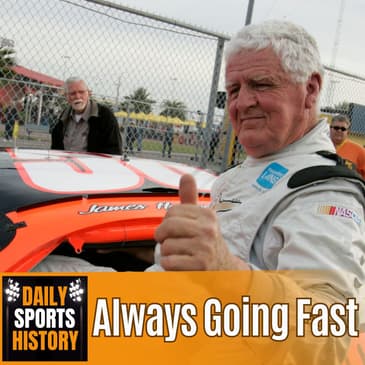
Discover the inspiring journey of James Hylton, the legendary NASCAR independent who became the oldest driver to compete in NASCAR’s top three series. From his humble beginnings in Depression-era Virginia to finishing second in Cup points three times, Hylton’s career is a testament to perseverance, ingenuity, and the heart of a true underdog. Learn about his historic wins at Richmond and Talladega, his advocacy for independent drivers, and his record-setting start at age 73. This episode is a must-listen for sports history fans and anyone who loves stories of grit and determination.
Check out The Scene Vault
https://www.thescenevault.com/
Get the written podcast newsletter:
https://substack.com/@dailysportshistory?r=3en496&utm_medium=ios
📅 Listen now! 👉 DailySportsHistory.com 📲 Follow for more daily sports history insights!
Email: dailysportshistory@gmail.com
YouTube: YouTube.com/@dailysportshistory
Twitter: twitter.com/dailysportshis
Facebook: facebook.com/profile.php?id=61551687917253&mibextid=ZbWKwL
Bluesky: https://bsky.app/profile/dailysportshistory.bsky.social
https://www.instagram.com/dailysportshis/profilecard/?igsh=OWl1MzIyYndqOGU2
Threads
https://www.threads.net/@dailysportshis
#JamesHylton #NASCARHistory #SportsLegends #RacingInspiration #Motorsports #UnderdogStory #Talladega #Richmond500 #OnThisDay #SportsPodcast
Buy me a coffee: buymeacoffee.com/dailysportz
Newsletter: https://substack.com/@dailysportshistory?r=3en496&utm_medium=ios&utm_source=stories&shareImageVariant=light
DailySportsHistory.com
Email: dailysportshistory@gmail.com
YouTube: YouTube.com/@dailysportshistory
Twitter: twitter.com/dailysportshis
Facebook: facebook.com/profile.php?id=61551687917253&mibextid=ZbWKwL
On May sixth, twenty eleven, James Hilton, at the age of seventy six, becomes the oldest driver to make a field at any level of NASCAR, qualifying for the nationwide event at Darlington Speedway. As he refused to give up what he loved and continued racing far beyond his contemporaries, showing true grit and determination, carving out a career that spanned over five decades that's seen him go against likes of today's racers and the greatest of all time. Join us today as we dive into the inspiring journey of James Hilton, a man that proved that there was no way you could stop him from getting in that car and going fast. Today on Daily Sports History, Welcome to Daily Sports History. I'm Ethan Reese, your guide as you daily learn more about sports history, increasing your sports knowledge now. Like many NASCAR people, grew up in a small town in the South in Virginia. He was born on a family farm in the heart of the depression in nineteen thirty fours. How far we're going back for this driver that was still racing in the two thousands. He was one of thirteen kids in a household that you had to work just to survive. Life was tough as him and his siblings worked from sunrise to sunset, tending crops in livestock, helping feed the family. He said in his own words, he said he had an excellent childhood. At the time, he thought it was awful, but looking back now, he wouldn't trade that lifestyle for anything. And he did end up going to school and it was an eye opener for James, as he could recall seeing kids from the city bringing slices of bread for lunch in his stark contract to the giant biscuit that his family had packed for him. These experiences gave him humility that he used throughout his career while racing, and he was introduced to driving as an early age as his older brother had taught him to drive the father's model te using three pedals on the floor instead of a gearshift, and that's what really got him into racing. As this happens at a young age on farms, you have to learn to drive different kind of mechanics the tractor, the truck or whatever it is. They have to learn at an early age, earlier than you would traditionally, and it gives you a step above all the rest. In His first race car was a nineteen thirty four for Coup, but he couldn't keep because he had to step back become a mechanic to help Macan's meat for his family, but becoming mechanical also helped him in NASCAR when he first started in the nineteen fifties. He would go on to work as a mechanic for Rex White in the NASCAR and quickly proved his worth, helping White win the nineteen sixty NASCAR Grand National Championship, and his reputation grew, and by nineteen sixty four, he was hired as a crew chief for Jed Jarrett, and under his guidance, Jarrett won fourteen of fifty five races in nineteen sixty four and finished second in points, and would dominate even the next year, winning team of fifty two races, capturing the Grand National Championship. By the age of thirty three, Hilton had contributed to two NASCAR championships as a mechanican crew chief before even taking the wheel for himself. In nineteen sixty six, he made a bold decision to return to the driver's seat. He bought a nineteen sixty five Dodge Cornett for fifty five hundred dollars and with crew chief Bud hartchie ran a single car team on the strictest of budgets, and that year Hilton stunned the racing world winning rookie of the year and finished second in the Grand National Championship points, which is a record for a rookie, and he can continue his success into the next year, finishing second again in the points, and for that first decade of his career he would finish top ten in points, showing how consistent he was from the start. He was finished second in points in nineteen sixty six, sixty seven, and seventy one, and finished third in seventy and seventy five, and would get his first win in nineteen seventy at the Richmond five hundred driving his newly purchased nineteen sixty nine Ford Torino. He dominated the race, finishing fifteen seconds ahead of NASCAR legend Richard Petty, and his success showed even more remarkable as he wasn't just a driver. He was one of the few drivers that was also an owner. He owned his team and he was consistent because he got lucky as well. When you own your car in your team. If you wreck, that's on you. You have to pay for those repairs, you have to pay for a new car if needed. You have to go through all that, and that can stick in your mind. But perhaps his most iconic moment came in August of nineteen seventy two when he won the Talladega five hundred, where he led over one hundred and six laps edging out Ramon Stado by Justic Carling, securing his second and final Cup Series win in true underdog fashion. And yes, you did hear that right. That was his final win in the nineteen seventies. But he wasn't done racing. Throughout the nineteen seventies, he actually was advocating for other drivers to become independent. This was something you could do, but it was getting increasingly harder as the money for the cars kept going up every single year, and NASCAR actually created a Winner Circle program. The program provided financial incentives for short tracks, giving him two hundred and fifty dollars and longer tracks giving him five hundred dollars to drivers in the top twenty five in points, helping smaller teams have the chance to compete against these bigger teams. That were showing up, but he was still an outlier in this aspect. Now, Hilton's determination actually started to fade with his age. He started to get older, but he wanted to still compete and he started competing in the lower division the Racing Series in the late seventies and continue that throughout his career, and in twenty eleven, at the age of seventy six, he recorded he set a record becoming the oldest driver to start a NASCAR Top three division at the Royal Purple two hundred in Darlington. Just to give you an idea of who he was racing against, Kyle Busch had won the poll and would end up leading forty one of the one hundred and forty seven laps, winning the race. That means he had raced against Richard Petty and Kyle Busch, putting him in two completely different eras of racing. And it's amazing to see that there were other great racers in this race. Denny Hamlin finished second in this race and the other great racers such as Clint Bauer would finish sixth. Casey Kane finished seventh, Carl Edwards finished twentieth, Rad Keselowski finished twenty seventh. There's some big names that had raced in this race, but unfortunately James did not get to finish this race. He started, was in two laps and had a rear end issue that took him out of the race in his number zero car. Not able to finish this race, but that didn't mean it was his last race. His final race came on October over, twenty thirteen. He was born in the Great Depression in the nineteen thirties and he was still racing in twenty thirteen. And he finished eighteen at the Kansas Speedway at the age of seventy nine, finishing his career with five decades of races more than eight hundred starts at all levels of NASCAR, showing that NASCAR wasn't just for young guys. Now a lot of people do argue he is racing actually a sport. It is a sport. You have to be fit to do this. Even though he was seventy nine and still racing, it doesn't mean he wasn't fit. You can be fit and be old. That doesn't mean you can't do it. He doesn't have the lung capacity. He's got to have endurance, and endurance you can have at an old age. You know, the sport of NASCAR and racing in general is still like that. We've had a lot of older gentlemen like Mario Andretti race as an older man too. There's lots of people that have raced in all different kinds of sports at all different kinds of ages. One of those sports that it doesn't matter your age so much as your age now, he won't be remembered for winning a lot of races. He'll be remembered for racing for a long time because he had the passion for it. He enjoyed racing, and that's what really cemented his legacy overall. He would finish with six hundred and two career Cup starts, one hundred and forty top five finishes, three hundred and one top ten finishes over a twenty seven year Cup career. And though he never won the Grand National Championship as a driver, that he did as a crew chief and a mechanic. He's experienced that came second, which is still admirable. But that's why you don't hear James Hilton's name very much because he was not the all star. He was that steady guy that was always around always there. You know, he went from facing young guys that are still racing to this day and had also beaten Richard Petty. Not many people can say that. I want to thank you for listening to Today's Daily Sports History. If you want more NASCAR history content, check out the Scene Vault podcasts. They're the best NASCAR history podcasts out there that cover all of NASCAR history all the time with interviews and using their personal experiences through their NASCAR careers, give you expert analysis and commentary every week so you can even learn more about NASCAR history. We'll put a link in the description below for you to check them out, and please make sure that you are subscribed wherever you are listening to this. That way you do not miss a single episode, because we're going to have another one tomorrow and the day after that, and you don't want to miss more sports history