Tune in for expert storytelling, rare stats, and the enduring impact of a day that still echoes through racing history.
Check out The Scene Vault
https://www.thescenevault.com/
Get the written podcast newsletter:
https://substack.com/@dailysportshistory?r=3en496&utm_medium=ios
📅 Listen now! 👉 DailySportsHistory.com 📲 Follow for more daily sports history insights!
Email: dailysportshistory@gmail.com
YouTube: YouTube.com/@dailysportshistory
Twitter: twitter.com/dailysportshis
Facebook: facebook.com/profile.php?id=61551687917253&mibextid=ZbWKwL
Bluesky: https://bsky.app/profile/dailysportshistory.bsky.social
https://www.instagram.com/dailysportshis/profilecard/?igsh=OWl1MzIyYndqOGU2
Threads
https://www.threads.net/@dailysportshis
#NASCAR #BillElliott #Talladega #MotorsportHistory #RacingRecords #OnThisDay #SportsHistory #212MPH #StockCarRacing #Winston500
Buy me a coffee: buymeacoffee.com/dailysportz
Newsletter: https://substack.com/@dailysportshistory?r=3en496&utm_medium=ios&utm_source=stories&shareImageVariant=light
DailySportsHistory.com
Email: dailysportshistory@gmail.com
YouTube: YouTube.com/@dailysportshistory
Twitter: twitter.com/dailysportshis
Facebook: facebook.com/profile.php?id=61551687917253&mibextid=ZbWKwL
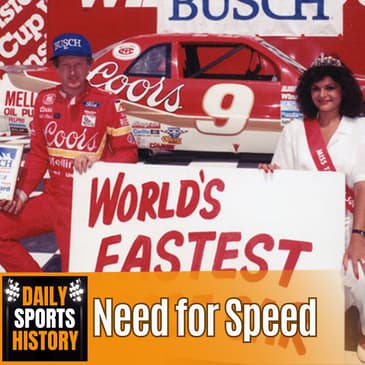
On April thirtieth, nineteen eighty seven, the Motorsports World held its breadth at Talladega Speedway, watching some of the fastest cars drive and once known as one of the fastest speedways to be run on in sports racing. They saw a red four Thunderbird do something that had never happened before and rewrite the record books for NASCAR forever, where Bill Elliott set a job dropping record having a miles per hour of two hundred and twelve point eight, a record that has never been matched since and because of what happened on this race weekend, will never be broken again. There's so much that goes into this story beyond the numbers on the speedometer. It's about a family and how NASCAR had forever changed for the safety of its fans and its drivers. It all happened in one weekend at Talladega Speedway. And join us as we dive into this fast moment sports history and this race weekend that changes the sport of NASCAR forever Today on Daily History, Welcome to Daily Sports History. I'm Ethan Reese, your guide as you daily learn more about sports history, increasing your sports knowledge. As we dive into Bill Elliott's record speed. Now Billy Elliott was born in Dawsonville, Georgia, in a town steeped in tradition of moonshine running and grow up in an environment around racing. His father had a passion and was a car owner, fielding race cars for local drivers and eventually would own his team and would lead his passion to help his sons in the sport. And it wasn't just father's son, it was father son and brothers. Bill's older brother would go on to be a crew chief and engine builder renowned for his mechanics, and his younger brother, Dan would be a transmission builder and a key member on his team, and together their tight knit family would help Bill become one of the greatest NASCAR drivers of all time. Now Bill started racing stock cars in nineteen seventy four and quickly worked his way up in the local circuit, and by nineteen seventy six his family team was able to make the leap to the Winston Cup Series. But it wasn't an easy way as they were underfunded and they almost folded in nineteen eighty until a Michigan tool manufacturer, Harry Melling, became their sponsor. And helped lead their way financially and helped Bill become one of the greatest drivers of the eighties now. Bill scored his first Cup Series win in nineteen eighty three at Riverside and his team would finish third in points that season, and he would continued his success after that season and in nineteen eighty five he would win eleven races, including the Daytona five hundred, the Winston five hundred, and the Southern five hundred, giving him the Winston millioned bonus. He got a million dollar prize for winning three of the top four marquee races and gave him the nickname Million Dollar Bill and would kindapull him into NASCAR superstardom, but Bill didn't let that take over, as he was humble and focused and had relentless work ethic. His connection to his family and hometown made him a fan favorite and he ended up winning a record sixteen Most Popular Driver awards and in nineteen eighty eight would win the NASCAR Premier Series Championship. And Bill was also lucky to be going on in the eighties. This was a time of transformation. NASCAR started in the nineteen forties and really changed over time. And had different eras for different years because cars changed over time. Stock car racing is where you take a car that can be driven on the road and you modify it a little bit, but it's a car you can drive on the road. Still to this day they give those cars names that can be driven on the road, even though they look nothing like the road the cars that drive on the road. But back then these cars did look like the cars driven on the road, a little souped up, but mainly the same. And there were many of these super speedways being built, including Talladega which opened in nineteen sixty nine, which we covered on a previous episode as well, and was known as the fastest track in NASCAR with steep embankments of thirty degrees which would help maintain speeds throughout the lap. And in nineteen eighty two, Benny Parsons would become the first driver to break the two hundred mile an hour barrier in qualifying. Before nineteen eighty six, all the drivers would be ended up qualifying all over two hundred miles an hour, But then came in the ninth generation of the Ford Thunderbird in nineteen eighty It was a game changer known as the arrow Bird. It had great aerodynamics which helped decrease drag and was a huge leap for stock cars with a speed of two hundred and nine miles an hour. Given the combination of the engines getting more powerful the aerodynamic getting more versed in the superspeedways of Talladega and Daytona set up a perfect storm of speed and we just kept getting faster and faster and faster every year and the next year. On April thirtieth, nineteen eighty seven, at Talladega Speedway, temperatures were hot in the high eighties and the air was thick as drivers were set to qualify for this year's Winston five hundred. But it turned out not to be just an ordinary qualifying day, as Billy Elliott would be chasing his own record in a field that was stacked with with some of the greatest drivers of all time, including Bobby Allison, Bobby and Davey Allison, Darryl Waltrip, and Dale Earnhardt. Bill was driving his number nine four Thunderbird for Melling Racing, and he decided to put the pedal to the metal and go for it all to win the pole for this Winston five hundred. He remained focused as he set out on his qualifying lap, covering the two point six to six mile oval in forty four point ninety nine eight seconds with an average speed of two hundred and twelve point eight miles an hour, beating his previous record by almost three miles an hour. The lap was so fast that only for the forty one drivers that attempted to qualify that day managed to break two hundred miles an hour, but he was followed close behind by Bobby Allison, who came in second with two hundred and eleven point seven miles an hour in his buickless Saber. Now, this was the fifth consecutive poll that Elliott had at the Talladega Speedway, and after this run, Elliott said, this doesn't get easier, it becomes harder. You were wanting to break records that no one has ever done, and you just go out there and do the best you can each time. This is this humility and focus that he had was what endeared him to his fans. And then days later, on May third, nineteen eighty seven, they held the Winston five hundred. However, Elliott would not be remembered for this race. This race would be remembered for another reason. Elliott was one of the top drivers at the time, and he had the pole position, so he had all the momentum behind him for the chance for him to get another wind at Talladega. But early in the race, something terrifying happened that changed NASCAR forever. We covered this previously when we talked about the Talladega Speedway, and in this moment deserves its own episode. But Bobby Allison suffered a tire failure running at nearly two hundred miles an hour, sending his airborne down the front stretch into the catch fence, tearing a massive hole into the barrier and showering debris into the grand stands. Miraculously, Allison was not seriously injured, but self spectator suffered injuries. And it's hard to watch because it's a scary moment seeing this car fly through the air towards innocent people with no protection other than a fence. And it sent shockwaves through the NASCAR community, and it showed the dangers of continuously increasing the speed of these cars. It seemed like we had reached the limits of what we could do with these cars to be safe. Now the race would continue after this accident, and Elliott would win the race, finishing out one of the greatest weekends in NASCAR history, setting the record for the highest speed that would never be broken because of what came after this. Immediately following this, starting in nineteen eighty eight, NASCAR implemented restrictor plates for super speedways such as Talladega and Daytona. What this meant was a restrictor plate decreases the airflow into the engine, which means cars cannot approach two hundred and ten plus miles an hour. They are usually around one hundred and ninety ish in max with these strict restrictor plates, which really helps them be safer and creates a new type of racing and really changed what NASCAR was. And NASCAR has continued to adjust and react to moments of danger and use technology to make the car safer. Technology has come a long way, but NASCAR is dangerous. There's a reason why most of us have never driven over one hundred and fifty miles an hour. Many of us haven't over one hundred miles an hour. It's a speed that is so dangerous that if something happens, our lives may be taken in the process, and safety is very important, but like the great Ricky, Bobby always says, I want to go fast and seeing fast is something we all want to see. And following this new rule, Bill Elliott's record will never be broken. The time of two hundred and twelve miles an hour in a stock car will never be broken unless they take away the restrictor plate, which is a safety concern. So it's probably never ever going to happen, at least in these cars. And Bill didn't end his career there. This wasn't the only thing he did. He ended up with forty four career Cup wins, fifty five polls. Was this NASCAR Cup Series champion in nineteen eighty eight and was a sixteen time voted most popular driver, and he would pass on the legacy to his son, Chase Elliott, who won the Cup Series in twenty twenty, making the Elliott's one of the few father son do to win the Cup. Sock cars are cars that are on the road, and the cars we drive on the road are not made to go two hundred miles an hour. Most of our O domeinors, if we still have O domeins instead of the digital ones, don't even go past one point fifty, so there's limits to what you can do, and we reached the limit that was safely done. We didn't want to put safety over how fast we could actually go, which is very important and really kudos to NASCAR. Have had a lot of issues in some aspects of safety, but this was a quick change that really may have saved lives. I want to thank you for listening to today's Daily Sports History. If you want more NASCAR history content, check out the Scene Vault podcast where they talk all about NASCAR history all the time. They interview guests of all types, going through their lives and careers connected to NASCAR and giving you all the breakdowns you could ever want to enjoy. We'll put a link in the description for you to check them out and come back tomorrow. And if you enjoyed today's episode, please make sure you leave us a review or rating wherever you're listening to five stars helps others know how great the show is and a review. If you want to tell me a topic you want me to cover, do that in a review and I will give you a shout out at the end of the episode, and come back tomorrow for more Daily sports history,