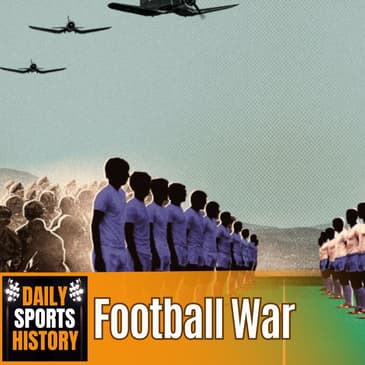
Explore the extraordinary events of the Soccer War on Daily Sports History. Learn how a series of intense World Cup qualifying matches between El Salvador and Honduras escalated into a 100-hour military conflict in 1969. Discover the historical context, key moments, and the lasting impact of this unique intersection of sports and politics.
Website: dailysportshistory.com
Email: dailysportshistory@gmail.com
YouTube: YouTube.com/@dailysportshistory
Twitter: twitter.com/dailysportshis
Facebook: facebook.com/profile.php?id=61551687917253&mibextid=ZbWKwL
Tiktok: tiktok.com/@daily.sports.history?_t=8hHPnNSCqfm&_r=1
#DailySportsHistory, #SoccerWar, #FootballHistory, #1969, #ElSalvadorVsHonduras, #WorldCupQualifiers, #SportsAndPolitics, #HistoricalConflict, #SoccerLegends, #SportsPodcast
Buy me a coffee: buymeacoffee.com/dailysportz
Newsletter: https://substack.com/@dailysportshistory?r=3en496&utm_medium=ios&utm_source=stories&shareImageVariant=light
DailySportsHistory.com
Email: dailysportshistory@gmail.com
YouTube: YouTube.com/@dailysportshistory
Twitter: twitter.com/dailysportshis
Facebook: facebook.com/profile.php?id=61551687917253&mibextid=ZbWKwL
In June nineteen sixty nine. El Salvador and Honduras were at odds as countries, but they were also playing each other for chance at the World Cup, which is often why these two moments overlap and gets known as the Soccer Wars or the football Wars. Well, shortly after their soccer matches, the two countries go to war. Here's the story behind how all this happened today on Daily Sports History. Welcome to Daily Sports History. I'm Ethan Reese, your guide to a rapid deep dive into sports history every day. And today's trivia question to watch out for is what did El Salvador hang instead of the Honduras flag during one of their matches? So let's dive into these two countries that are right next to each other in Central America. Let's start with El Salvador, which is a very small country roughly the size of Maryland, yet it has almost three times the population of Honduras, which is roughly the size of West Virginia, and due to this overcrowdedness is actually what caused the conflict between these two countries, as El Salvador was a small country and people needed more space as most people in El Salvador were farmers and they needed more farmland, so they went to Honduras right across the border, which caused this conflict back in the nineteen sixty nine. But also happening in nineteen sixty nine was qualifications for the nineteen seventy World Cup, which was actually being held in Mexico that year, which meant even more to the two teams trying to make the World Cup as it was a close location where fans could travel to and also another Latin country. So the two teams were set to face each other in the June of nineteen sixty nine to face each other for the right to play in the World Cup. So it would be the best of a three series. Whoever got two victories first would give the chance to advance to possibly get to the World Cup Final. And if you don't know, the World Cup final is a little confusing. To get to a World Cup, you have to face so many different countries and each one sectioned off. So like Africa gets to one, South America gets three, the European area at the time got up to nine, so there's and the North America in Central America and Caribbean areas got the chance for two in the World Cup, which meant it was a coveted spot for these two teams. So the first game they played each other was actually held in the capital of Honduras, and before the game, the fans somewhat rioted in the streets or partied in a different way, basically making a whole lot of noise, keeping the El Salvador team awake all night, hoping that they wouldn't be able to compete very well versus the Hunt team, which helped as the Honduras team only won the game zero to one, but they did win. The next game was to be held in El Salvador on June fifteenth. The L Salvador fans did the same thing to the Hondura's team, keeping them up through violence, sounds, partying everything so they would not be able to compete very well. The next day, and before the game actually started, as it is a custom in these international games, do you fly both flags for each country, El Salvador did not fly a Honduras flag. They actually flew a dirty rag for their flag, just showing their disdain, which wasn't just about football. As we have to remember, these two had given up diplomatic communications they weren't working together. The countries were at odds. There had been multiple murders, rapes, plundering, explosions already going on, violence everywhere, So the tensions between the two countries also magnified everything. And so the players of Honduras were honestly scared and didn't even want to win that game because they were afraid if they won that game and got the right to go to the World Cup, they might not make it out of El Salvador. So because of that, El Salvador won three to zero. Now, luckily, the last game on June twenty seventh was not held in either country. It was actually held in Mexico, where the World Cup would be held. This was a neutral site and there were less fans or less diehard fans, and less violence going on, so each team got the chance to really play against each other and it was a hard fought match where it was tied two to two and it went into extra time. Now, if you don't follow soccer, extra time is timecured throughout the game for stoppages and penalties and everything like that that kind of comes up that stops the game. So you want to make sure you get your full ninety minutes. That's what extra time actually is, and that's when Al Savador scored their final goal in extra time to give them a three to lead and win the game and the chance to go to the World Cup. And this was great for El Salvador, but it was bad for the Salvadorans, especially those that lived in Hunters. It's not that this game in them losing this game caused the war. The war was going to happen either way because the hundreds people were struggling and they didn't want the Al Savador people that lived in the country to be there anymore and take away the prosperity that they could get was really the main issue, and so they were driving El Salvadorans out of the country already in deplorable ways and making it just a location that no Salvadorian wanted to be in. And a few days after this they started the war, which is also known as the one hundred hour War because it only lasted four days. They called it fire on July eighteenth, and Al Salvador completely withdrew their troops on August two that year. So it was a very quick war, very small war. Both countries were very aggriculturally based, and even in nineteen sixty nine, both countries were using weapons from World War II, which was over twenty years earlier. They were buying whatever they could, old stuff, and so their armies weren't well equipped for a big war, and so that's really why it didn't last very long. But it also left three hundred thousand Salvadorians displaced as they fled or were forced out of Honduras, and almost one thousand El Salvadorans lost their lives and almost two thousand Native Honduras people lost their life too. And even after all of this, Alsavador went to the World Cup, but they lost all three matches. They faced the USSR, Mexico and Belgium and did not even score a single goal. But this moment, this war wasn't about soccer. Would have been great for El Zavador to win, yes, but these two also get very closely linked together because of how closely things happen. They face each other for the chance to make it to the World Cup and then they fight just a few days after, and so they always put them together, but they really don't have anything with each other. With each other, sports and war don't really go together, and sport politics are politics. But luckily, eleven years after the war, the two nations signed a peace treaty in nineteen eighty. But there is still some ill will between the two countries, as any countries that have gone to war against each others usually have, but luckily they stayed civil and have not broken out into war ever since. And I want to thank you for listening. If you like this, please share it with a friend. We love for more sports historians to come listen to everything we got to go on every day and come back tomorrow for more daily sports history and piping