Check out Iconic Season Podcast
https://podcasts.apple.com/us/podcast/iconic-seasons-hardwood-history-college-basketball/id1473012139
#DailySportsHistory, #NCAATournament, #MarchMadness, #CollegeBasketball, #SportsHistory, #BasketballLegends, #1985, #CinderellaStories, #SportsPodcast, #NCAABasketball
Buy me a coffee: buymeacoffee.com/dailysportz
Newsletter: https://substack.com/@dailysportshistory?r=3en496&utm_medium=ios&utm_source=stories&shareImageVariant=light
DailySportsHistory.com
Email: dailysportshistory@gmail.com
YouTube: YouTube.com/@dailysportshistory
Twitter: twitter.com/dailysportshis
Facebook: facebook.com/profile.php?id=61551687917253&mibextid=ZbWKwL
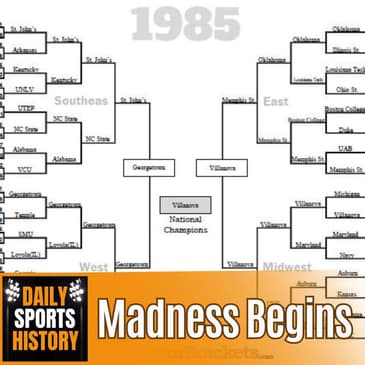
On January eighth, nineteen eighty four, the NCAA made a decision that changed the college landscape forever and gave March Madness its true start as one of the most iconic spectacles in sports as they moved to the sixty four team tournament and brackets that we have seen and come to love today and gave opportunities that previous teams would have never had to put their names in the record books and win championships. Without this change, who knows what we would do in March, but March Madness changed that. As we all fill out out of brackets and root for the underdog that we've never heard of before, we're going to dive into this iconic change that changed not only college basketball but America's consumption of it today on Daily Sports History. Welcome to Daily Sports History. I'm Ethan Reese, your guide. Do you daily learn more about sports history increasing your sports knowledge? As today we learn about the change to the sixty four team tournament in NCAA basketball And today's trivia question to listen out for is in what year was the first bracket pool started? Listen for the answer throughout the episode, and if you miss it, I will give it to you at the very end. Now, we actually talked about the very first NCAA basketball tournament on a previous episode. What a link in the description about that, and that happened in nineteen thirty nine. It was a response to the NAIT which had started a year previously with help from doctor James Naismith, the creator of basketball, which we also covered in a previous episode, and we'll put a link to those episodes in the description for you to check them out as well for a deeper dive. But these tournaments started very small, as the first NCUBA tournament had only eight teams and it was won by the organ Webfoots before they were the Ducks, beating the Ohio State Buckeyes. And despite the first tournament not being a financial success, they continued on every year after year to compete with the NIT, and for many years, the NIT was actually more popular than the nc DOUBLEA Tournament, as they both happened around the same time, but the NIT played in New York and had a larger audience when it first started out. But in nineteen fifty one they doubled the tournament to sixteen teams and it kept expanding throughout the years. The reason they did this was to accommodate the conference setup that they were starting to use in colleges, similar to what we see today, but on much larger scales. They didn't have these super college conferences as it was a lot of smaller conferences, and the winner of these conferences would be the ones that would get the bid to go play for the tournament, and many teams would actually when they first started compete in both the NIT and the NC DOUBLEA Tournament, which is crazy to think about today. It's a lot of basketball in a little time. But as there became more Division one schools and more automatic bigs given, they would generally increase the amount, and in nineteen fifty three they expanded the tournament to twenty two teams and added a fifth round with ten teams receiving a bye, And in nineteen fifty six they actually adjusted the regions that are more similar to what we know today, where they had an East region, a Midwest region, a West region, and a far West region, and those names have adjusted throughout the years, and in nineteen seventy six they adjusted those to the East, Mideast, Midwest, and West, which they kept until nineteen eighty five, and the reason why they did these regions is it allowed teams to travel less for the beginning of the tournament, which was much more needed back in the nineteen fifties where travel was a lot harder for college teams, and a big rule change in nineteen seventy one changed the tournament to what we know today, as it banned teams who declined the invitation to the NCAA Tournament to participate in any other postseason tournament, which meant no team could decide to go play on the n IT while also making the NCAA tournament as the NCAA tournament was connected to the NCUBLEA and the NCAA gives out the award, so they're not going to let you go play for another competing thing if you decline theirs. So you basically had to decide did you want to play NCUBA basketball or did you want to go play for the NAIT. This was in response to the nineteen seventy into Marquette, who was the eighth ranked team in the nation in the nineteen seventy season and they declined to participate in the NCAA tournament and it opted to play in the inn it and ended up winning that The reason for this, they said, was due to their placement in the region, but still it prompted the NCAA to make this rule, and this moment is what made the NCAA bypass the NI as the NCAA tournament was connected to the NCUABA, which you had to participate in to be part of these conferences and so so because of that, it really shot it up and moved n to more of a second thought postseason tournament, which it is today. And a second rule change in the nineteen seventies came in nineteen seventy five when they then allowed more than one team per conference to enter the NCAA tournament. This really arise when there was teams such as South Carolina in nineteen seventy who were undefeated in their conference but lost their tournament and were left out, or usc who was ranked second in the nation in nineteen seventy one but were left out to the top ranked UCLA that same year, And in nineteen seventy four, Maryland was ranked to third overall in the nation but lost the ACC tournament and was not able to join. So these issues happened, and so they included more than one team per conference could get to the bracket, which also meant that they could expand it even more, and they kept expanding little by little every year, and nineteen seventy nine was a big year as it had the magic Johnson Larry Bird tie game Michigan State versus Indiana State, which is the most watched college basketball game ever still to this day, and vaulted and in eighty four is when they finally expanded to sixty four teams and that would last until two thousand and one when they would go to sixty five teams to have a playing game, and in twenty eleven they would go to sixty eight teams and have four play in games. But even before nineteen eighty five, the brackets that we all know loved today had already started, as there was a bar named Judy's Club Force in Saten Island who put together a bracket in nineteen seventy seven that cost ten dollars to join, and there was eighty eight people that joined the bracket and the winner took home eight hundred and eighty dollars, not a bad haul back then, and it continued to grow every year as college basketball continued to grow into a more formed bracket, and everyone started to know that more and more, and by the time it got to two thousand and six, they continued to hold this pool at this bar. In two thousand and six they had over one hundred and sixty entries and the payout was one point five million. They had to shut it down after this as the IRS started to put scrutiny on it as it was a lot of money and gambling still wasn't as legal as it is today in the sports world. Although this the bracket is kind of the one thing that of a sports gambling that has always been kind of just looked at as well, we'll allow it. There's not been many much scrutiny on it, and interestingly enough, in nineteen seventy eight, in Louisville, Kentucky, a man named Bob Stintson had started his own office pool. Back in nineteen seventy eight. Now, given the Internet and social media that we have now, it's not unusual that this could happen in two different locations, but this happened independently of each other. These pools started a year apart independently and became popular and gross in the community and really helped steer their office bracket that we know today and still to this day, there has been no verified perfect bracket of the sixty four teams, even though there are sixty eight teams now, we still mainly fill out that sixty four bracket with sixteen teams in four different regions, as the playing games happened earlier, and we really just focus on the main first round that happens, which is technically the second round of the tournament, as everyone else has a buye. But in order to get a perfect bracket, you have a one and nine point two quintillion chance of getting every pick right. You have a better chance of getting struck by lightning, bowling a perfect game multiple times, becoming a professional athlete, winning an oscar, being dealt a Royal flush on your first hand, hitting a hole in one, or being killed by an asteroid. It's something that's never been done. In Warren Buffett offers millions of dollars for people to do it, do a perfect bracket, and no one still has ever done it. And in nineteen eighty five really showed that the tournament expansion helped, as number eight seed Villa Nova went on to beat the number one seed the University of Georgetown to become the highest seed to win an NCAA tournament as a number eight seed, and it was a proof of concept that has continued and we've seen eleven seeds make the final four multiple times in Georgetown VCU, Loyola Mayor, Mount Loyola, Chicago, UCLA, and NC State most recently this year. And there's been a fifteen seed in Saint Peter's in two thousand and two that made it all the way to the leit eight, and multiple fifteen seeds have made it to the sweet sixteen in Princeton, Saint Peter's, Oral Roberts in Florida, Gulf Coast all within the past decade. There's more parody in the college game and has allowed more teams the chance to win. And without the expansion, we wouldn't have these great moments from these lower schools that have have had major upsets in huge drives that have changed the game. Most commonly, look at Gonzaga, who made it to the sweet sixteen in the late nineties and used that momentum to become a power house in NC DOUBLEA and have now made multiple NC DOUBLEA championships. This expansion to sixty four teams not only changed how college basketball found its champion, it changed the nation as offices around the world do office pools, losing companies millions of dollars, but allowing us all to enjoy the games and keep track of what's going on in a bracket more than any other tournament, frankly, in sports history. It's something that transcends sports. Even people that don't like basketball do a bracket just for fun, and it's something that we can all enjoy. And it all happened in nineteen eighty five, over forty years ago. Changed the game, and it changed everything around the country and gave us what is now known as March Madness. I want to thank you for listening to today's episode. If you want more college sports history, check out The Iconic Seasons, a hardwood history of college basketball, where the host Aaron takes you back to the greatest college basketball seasons of all time through the voices of players, coaches, and journalists, reliving the excitement and drama and the unforgettable moments of these iconic seasons. And we'll put a link in the description below for you to check out his podcast. And if you enjoyed today's episode, Please leave us a review wherever you're listening, and tell us your favorite college basketball season, and come back tomorrow for more daily sports history. And did you catch the answer to today's trivia question? In what year did the bracket pool first start? It started in nineteen seventy seven at Judy's Club Forest Bar in Staten Island, where they started with eighty eight people paying ten dollars per bracket, with a payout of eight hundred and eighty dollars to the winner. M