Buy me a coffee: buymeacoffee.com/dailysportz
Newsletter: https://substack.com/@dailysportshistory?r=3en496&utm_medium=ios&utm_source=stories&shareImageVariant=light
DailySportsHistory.com
Email: dailysportshistory@gmail.com
YouTube: YouTube.com/@dailysportshistory
Twitter: twitter.com/dailysportshis
Facebook: facebook.com/profile.php?id=61551687917253&mibextid=ZbWKwL
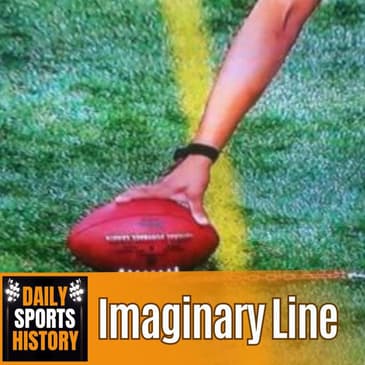
On September twenty seventh, nineteen ninety eight, on a Sunday night football game where the Baltimore Ravens were facing off against the Cincinnati Bengals, ESPN debuted a new technology that would revolutionize how we all watch football today. And this technology was the yellow first down line. Many of us have never watched a game without this marker, but it's changed how we view the game, and these technologies are why many of us prefer to watch the game on TV rather than in person. For the story behind it goes beyond just the yellow line. Today, we're going to learn about how it got started, how the technology was it created, and how it all works on Daily Sports History. Welcome to Daily Sports History. I'm Ethan Reese, your guide to help you daily increase your sports knowledge. And today's trivia question to listen out for is how much money did it cost in nineteen ninety eight to produce the yellow first down line for one game? Now, sports and technology have gone hand in hand in many different ways and slowly use each other to build momentum with each other. Before TV and radio, you had to go to a game and watch. When you first went to games, there were no announcers, no scoreboards. Then scoreboards were invented. Then a PA announcer would be there giving you the down and distance and would eventually transform into giving you player names and give you information on the game in a basic way. Then radio came along to cover games through live broadcasting, and they would give you even more details so you could envision in your head what was going on on the field. Gave a boom to baseball and football and boxing. Then TV came along, which we covered the very first televised football game, which we'll put in the description below. And they first started out with just the PA announcer, and then they got commentary involved give you even more information that was going on. And if you have ever watched the game today, ESPN has done on their multiple channels where they have a feed where you just watch the game with no commentary. And they've tested this before, and fans don't like no commentary. We've grown accustomed to the commentary, even though a lot of us don't like the commentators such as Chris Collinsworth. But without the commentary, the game feels odd and many of us have grown to enjoy watching the game on the television rather than in person. As you get more information, you get to know why players are injured, what the down and distance are. You get to know more about the players as they give you where they're from, or what they've done, or their stats. You can learn all this during the game that you don't get to learn while you are in person, which has made it very hard for some teams in the NFL to sell tickets as the game has gotten so good on TV. But one of those great technologies that has grown from TV was the first down yellow line. Pre nineteen ninety eight, when you watched the football game, they just told you where the first down was and what the down distance was. You didn't know exactly where the first down was. This concept was actually thought of years before. David W. D. Crane conceived and patented the idea for the first down distances in nineteen seventy eight, and he actually presented it to ABC News and ABC Sports into the CBS Technology Center and both decided that the broadcast industry was not ready for something this complex. But Ukraine wasn't done. He actually started a company called sports Vision, which has helped adapt graphics for all kinds of sports, and in nineteen ninety five they partnered with Fox to produce the Fox Track puck. Now they made a specialized glowing cup to help fans track the puck while they watched, as this was a complaint for many that watched the game, as at the time in the nineties, many of us were watching sports, but it was still a little bit grainy on live sports and it was hard to follow the puck around it as it is only about three inches in diameter. So they put a chip inside the puck that would make a glowing blue ring around it, and when the puck was hit more than seventy five miles an hour, it would create a red strand kind of like a fireball, showing where it was going. And this allowed you to really follow the game much better. But it wasn't conceived all that great, as many thought it was like a video game or a gimmick, and they just wanted to watch the game for what it was without this extra stuff. So when Fox lot's the contract for the NHL, that puck was left on the cutting room floor. But this gave them a chance to show that they could use their technology in live game situations, and that's when Sports Vision brought their technology to ESPN telling them they could create a first down marker, not only a line during the live broadcast, but a line that wouldn't cover any player. So basically it looked like a line on the field, but it wasn't really there. It's an interesting concept, but it took a lot of oversight, and how it actually worked was they would literally diagram each and every angle that all the cameras could be using, so they could know exactly where the line would have to be for this camera or that camera. So it was a painstaking process, but luckily, since the fields are all standardized, they could create this once and use that model for all the other locations. But it was a process for each every angle that the possible cameras could use, and that just allowed them to have the line. But what really took some time was having that yellow line not to cover up the players. And what they did to do this was they took the color of the field and enter that into their computer model, and they would tell the computer that anytime this line came across these colors of the field, to have it there, but if there was any other color that appeared on that surface, they would not cover it. So it's not a continuous line in the system. It's a lot of little dots. And even though the grass is green and the Green Bay Packers have green jerseys, because they are different shades of green, there's no problem. Usually. There is only a problem with this system when there is snow. As the snow changes colors constantly, then gets muddied brown. So they have to constantly update these colors throughout the game and let the system know that these are the kind of colors that we could come in contact with. But to do this it requires a whole team to be involved. First, you have to have the spot or that tells you where the ball is spotted, so they know where to put into the computer system where the line is supposed to go. And they need to update the color system as the game goes along because it's gonna be shading, there's gonna be changes in the snow, there's gonna be changes in the weather, so the view of the field will change as well. But before ESPN signed off on this, they wanted it to be one hundred percent accurate. So what Sports Vision Team would do is they would bring a whole truck in secret to all the NFL games and they would do basically the process they would do without broadcasting it, so it was a whole secret feed that they could test to see how it was going, and they had almost ninety nine percent accuracy, but they wanted to be one percent accurate before they did it, so they didn't start opening day and it wasn't until week four that sea where they felt confident that they had the system down and they decided to cover the ESPN Sunday Night football game where the Cincinnati Bengals took on Baltimore, and it was an immediate success. Fans loved the concept and the only negative comments they really got was that the line kind of shook a little bit sometimes when there was movement, which they have since updated through the years that now it's almost a perfect and it's almost one hundred percent accurate to where the line is compared to the first down marker, and they've even incorporated the line of scrimmage marker as well as including third down as well, including the down and distance and time and the game clock, so many things that can be included onto the field because of this same system, but because it required a team of six to operate each in every game, it cost twenty five thousand dollars per game, and so it was a cost the expense and in two thousand and one, Fox actually cut it to save some cost, but received huge fan backlash. The Fox immediately reinstated it as the cost was now just the cost of producing a game. And this one little thing that we take for granted many times when we're watching the games and we love because if they took it away, we would all cry about it changed how we watch football forever. And if you want to learn more about TV history, check out Inside the Box, the TV History podcast where Jonathan, Andrew and Steve take you throughout all history, including talking about regional sports networks and the history of the NFL films, as well as history of great television shows that we all love. So we'll put a link in the description for you to check it out so you can learn even more about TV history. And if you enjoyed this episode, please make sure you subscribe wherever you're listening so you don't miss a single episode, because the more you listen, the more you will learn. In the answer to today's trivia question, how much money did it cost in nineteen ninety eight to produce the yellow first Down? Line for one game, and the answer is to cover the expenses of a Sports Vision's team of six and a semi truck. It was twenty five thousand dollars a game.