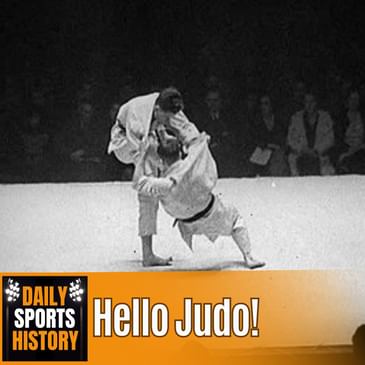
Step back in time to May 3, 1956, when Tokyo’s Kuramae Kokugikan hosted the inaugural World Judo Championship. Discover how 31 judokas from 21 nations competed in a dramatic open-weight contest that crowned Shokichi Natsui as the first world champion. Learn about the rise of European judo with Anton Geesink and Henri Courtine’s podium finishes, and how this event sparked the international expansion of judo, setting the stage for Olympic glory. Perfect for sports history fans and martial arts enthusiasts, this episode unpacks the drama, the heroes, and the legacy of a day that changed judo forever.
Check out Whistlekick Martial Arts Radio
https://www.whistlekickmartialartsradio.com/
Get the written podcast newsletter:
https://substack.com/@dailysportshistory?r=3en496&utm_medium=ios
📅 Listen now! 👉 DailySportsHistory.com 📲 Follow for more daily sports history insights!
Email: dailysportshistory@gmail.com
YouTube: YouTube.com/@dailysportshistory
Twitter: twitter.com/dailysportshis
Facebook: facebook.com/profile.php?id=61551687917253&mibextid=ZbWKwL
Bluesky: https://bsky.app/profile/dailysportshistory.bsky.social
https://www.instagram.com/dailysportshis/profilecard/?igsh=OWl1MzIyYndqOGU2
Threads
https://www.threads.net/@dailysportshis
#Judo #WorldJudoChampionship #SportsHistory #MartialArts #Tokyo1956 #JudoHistory #OlympicJudo #JudoLegends #SportsPodcast #OnThisDayYouTube Tags:
Buy me a coffee: buymeacoffee.com/dailysportz
Newsletter: https://substack.com/@dailysportshistory?r=3en496&utm_medium=ios&utm_source=stories&shareImageVariant=light
DailySportsHistory.com
Email: dailysportshistory@gmail.com
YouTube: YouTube.com/@dailysportshistory
Twitter: twitter.com/dailysportshis
Facebook: facebook.com/profile.php?id=61551687917253&mibextid=ZbWKwL
On May fifth, nineteen fifty six, Tokyo held the very first World Judo Championship in the city that was rising from the ashes of war. Thirty one judo warriors from twenty one nations gathered for a moment that would change the sport forever. This wasn't just a tournament. It was a class of cultures, testa spirit, and a birth of a new global legacy. Join us today as we go and find who will rise, who will fall, and how Japan's martial arts became a worldwide phenomenon, uniting athletes from every corner of the globe with just one legendary day today on Daily Sports History. Welcome to Daily Sports History. I'm Ethan Reese, your guide as you daily learn more about sports history, increasing your sports knowledge as we dive into the very first Judo Championship. Now. In decades before the championship, judah underwent a remarkable transformation from just a Japanese martial arts into a global sport. It was founded in eighteen eighty two by jing Ro Khana. It was originally a system of physical and moral education for Japan, but its reputation and discipline and technique grew international interests, and after World War II, the presence of US soldiers in Japan increased the cultural exchange, sparking a surge of judo in popular European and the United States and the Western partitioners were able to push this narrative. Now, Kanu himself envisioned judo being a universal sport, proposing forming an international judo organization in nineteen thirty. However, Japan was in a political turmoil and Kanu died in nineteen thirty eight, delaying these ambitions, and it wasn't after World War II the reconstitution of the European Judo Union in nineteen fifty one that the idea really mounted, gained momentum and angel the Lie nineteen fifty one, representatives from major European countries, including Argentina, met in London to establish the International Judo Federation or the IJF, and Aldo Toridi of Italy was appointed the very first president of the IJF. It would be succeeded a year later by Raisi Kanu, the son of the creator of judo. Now, this creation of this federation went across the entire world scale, and the European Championships were actually held in nineteen fifty one, but there was no global contest to crown a world championship yet. To remember, it was the nineteen fifties. Travel was not as easy and countries were just coming off of war, so having it centralized made more since But for Japan, hosting a world tournament in Tokyo both mattered for pride and it was a strategic move. Judo was a symbol of Japanese culture and showed discipline and resiliency for the nation, and they wanted to demonstrate their leadership in the sport welcome international challengers. That would be a stepping stone towards Olympic recognition and would be a decade later when it would debut in the Olympics at the Tokyo Olympics in nineteen sixty four. So by nineteen fifty six the groundwork was laid. IGF had become more of a sports governance. Judo clubs and federations were thriving in every continent except for an Actica, and the world was ready for a championship to see who was the best judo champion. So in May nineteen fifty six in Tokyo was the first World Judo Championship would be held in Tokyo, showing off the national pride for this new martial arts championship, and this attracted thirty one participants from twenty one different countries, which is a remarkable feat because just decades earlier it was almost only in Japan. Flags from across Europe, the Americas, Asia hung side by side, underscoring the international spirit of the championship. For many of these athletes, it was the first time they ever been to Japan to experience the birthplace of judo, and unlike today's multiple weight division, the nineteen fifty six Championship was only a single open weight category, which meant all sizes, all styles faced off against each other no matter what, so a winner take all type of events. Now, there were some favorites coming into this event, Suchari natsu In as one of the top favorites, known for his technical precision in calm demeanor and was a master at classic judo technique, and Asuku Yatsu Mitsu was another was also leading Japan, and at least two from the nations of Japan were leading the way. But there were also some others that were rising to the challenge. Atan Jaesink of the Netherlands was just twenty two years old but already making ways in the European Judo Championship. He was towering and powerful and had a new breed of western juis to challenge Japanese dominance. And Henri contin was a pioneer for French judo and brought a blend of athleticism and technique to the field to truly make this a world competition. Natsui would run through the tournament was nothing short as spectacular. He's dispatched his first opponent from Cambodia in just three seconds with a shoulder throw, and in the second round he only needed eight seconds to defeat his challenger from Denmark with a body drop. His third match against a fighter from Belgium only lasted forty four seconds. When he came to the semi finals against Henri Courtin of France, it lasted just eight seconds in total. Natsui had got to the finals with a total of sixty three seconds on the mat. It showed how dominant his technique was over fighters. Now, this fight didn't have a third a third place fight, so the fighters that lost in the semi finals both shared the bronze medal and Yoshi Mitsu was facing office in Natsu in the final, an all Japanese final. Now, Yoshi Mitsu didn't have as daunting, didn't have as quick as a way to get to the finals, but still managed his way easily to get to the finals. And he was thirty six at the time. And Anton of the Netherlands and Henry Kanti would make the first podium, both winning bronze in this tournament. Silver would go to Yoshi Haku Yoshimitsu of Japan, and gold would go to Satu becoming the first judo champion, and it made an all Japanese final between him and Yoshi Mitsu. And this whole tournament all happened within one day. It wasn't spread out during a week during a whole month. It was just a one day competition, and it gave us heroes of both the East and the West. But shill showed how dominant Japan was in the world of judo. Now, this was a landmark moment for judo. These fighters became legends in the judo scene and helped continue to grow the sport, and it had so much success that eventually judo would be included in the nineteen sixty four Tokyo Olympics, and it continued to grow. In nineteen sixty one in the championship would be held first time outside of Japan and it was held in Paris, France, and it would continue then to move around the whole world at different locations, and it wasn't until nineteen sixty five where they had different weight classes, still having an open category, but having a heavyweight, middleweight, and lightweight, and they have since separated even more to present day where they have open heavyweight, halfweight, middleweight, half middleweight, lightweight, half lightweight, and extra lightweight to give equal opportunity to everyone. And Japan has had the most medals, winning four hundred and seventeen medals in the category, and they've expanded and added a women's division and a mixed competition. They hold this every two years starting in nineteen sixty one, and this one event kind of changed martial arts as well. It gave martial arts even more autonomy and even more publicity as it got into the Olympics, being one of three martial arts in the Olympics Judo, karate and taekwondo, and it really helped give a new form of discipline and fighting sport into the world and has grown year after year after year. We all in America, we kind of include judo, karate, taekwondo, all the martial arts being included kind of all together. But it has continued to grow every year, and this has really helped the discipline as it is a beautiful sport. If you get a chance to watch it in the Olympics or watch a World final, you get to really see how great these fighters are. And it's becoming increasingly more popular as a lot of these fighters are migrating into MMA and the UFC and we get to see those styles on display against other styles and that's a unique experience. But it all comes back to this moment when they held a world tournament, because when you have a world tournament, it really shows how much a sport has grown, and when it gets included in the Olympics, it does that even a step farther. Judo is a beautiful sport that's unique and has taken over the world and proves it by its very first World championship. I want to thank you for listening to Today's Daily Sports History. If you want more martial arts content, check out The Whistle Kick martial arts radio show. I'll put a link in the description below for you to check them out. It's a biweekly podcast devoted to the traditions of all forms of martial arts. They dig into what makes it tick, their history, and their experience, all you could need to know from taekwondo, judo, karate, kung fu, everything, even ones that I don't even know. Check them out so you can learn even more about martial arts. And if you enjoy today's episode, please leave us a review wherever you're listening. If you do, tell us a topic you want us to cover, and I will do that just for you and give you a shout out after the show and come back tomorrow for more daily sports history.