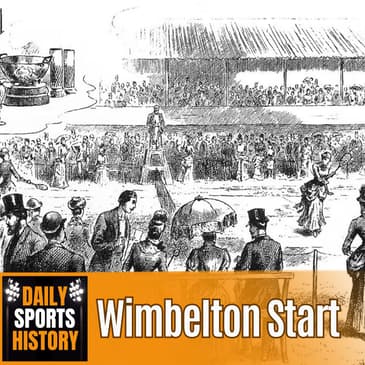
Step back to July 9, 1877, and witness the birth of a legend—the inaugural Wimbledon tennis championship. Discover how 22 men gathered on a grass court in southwest London, competing for a silver cup and a place in history. Explore the origins of modern tennis, the key figures like Spencer Gore and William Marshall, and the Victorian traditions that shaped the world’s oldest—and most prestigious—tennis tournament. From rain delays to revolutionary playing styles, this episode unpacks the drama, innovation, and legacy of the very first Wimbledon.
Key topics:
- Origins of Wimbledon and lawn tennis
- Major Walter Clopton Wingfield’s influence
- The All England Croquet and Lawn Tennis Club
- Match details, rules, and equipment of 1877
- Spencer Gore’s historic victory
- How Wimbledon evolved into a global sporting icon
📅 Listen now! 👉 DailySportsHistory.com 📲 Follow for more daily sports history insights!
Email: dailysportshistory@gmail.com
YouTube: YouTube.com/@dailysportshistory
Twitter: twitter.com/dailysportshis
Facebook: facebook.com/profile.php?id=61551687917253&mibextid=ZbWKwL
Bluesky: https://bsky.app/profile/dailysportshistory.bsky.social
https://www.instagram.com/dailysportshis/profilecard/?igsh=OWl1MzIyYndqOGU2
Threads
https://www.threads.net/@dailysportshis
#wimbledon #tennishistory #sportslegend #onthisday #grandslam #sportsheritage #historypodcast #sportsstory #wimbledonhistory #tennis
Buy me a coffee: buymeacoffee.com/dailysportz
Newsletter: https://substack.com/@dailysportshistory?r=3en496&utm_medium=ios&utm_source=stories&shareImageVariant=light
DailySportsHistory.com
Email: dailysportshistory@gmail.com
YouTube: YouTube.com/@dailysportshistory
Twitter: twitter.com/dailysportshis
Facebook: facebook.com/profile.php?id=61551687917253&mibextid=ZbWKwL
So imagine this nice summer afternoon in eighteen seventy seven. You're in England viewing a freshly mode lawn where twenty two men in Chris flannel gather for not fame and fortune, but to play a game for a silver cup. But little did they know that they were starting a sports revolution. They were playing in the very first Wimbledon tournament that would become the most iconic tennis championship in the world. Through rivalries, rain, delays, volleys, the game was changed right there on the Wimbledon lawn almost one hundred and fifty years ago. And today we're going to dive into what happened to start this iconic tournament in Wimbledon today on Daily Sports History. Let's go. Welcome to Daily Sports History. I'm Ethan Reese, your guide because I once called a foot vault on my grandmother, So we gotta go way back for this one. In the early nineteenth century, tennis was an elite indoor game played in palaces, was only really accessible to the wealthy. Then an invention known as the lawnmower by Edwin Beard Budding in eighteen thirty revolutionized British gardening, making well kept lawns possible not only for the elite, but the middle class as well, and this led to a boom in outdoor lawn sports such as croquet, lawn bowling and tennis, and it became a popular social event in the eighteen sixties to watch lawn sports. But croquet was slow and young players wanted something more dynamic. That's when Major Walter Wingfield, a retired British Army officer, recognized the desire for a new sport, and in eighteen seventy three he introduced a game called Sheerstrike, which is Greek four skill with a ball. It had a net to rackets and rubber balls, all on an hour glass shaped court, and it became a hit in Britain immediately and it sold over one thousand kits in its first year. I mean that sound like you a lot. There was no internets and no cars or delivery services, so you had to go door to door or set up shop somewhere. It was a lot more challenging and he released his first rule book for lawn tennis in eighteen seventy three and patent the game in eighteen seventy four, and they would change the rules and make it more resemble what we know today, and there were other games that actually had similarities and they were getting experimented with, but launtiness actually began to take flight, and in eighteen seventy five Merrily Bone Cricket Club helped standardize the rules and included a now familiar rectangle court as the last court was a little hard to make and had our scoring system that we know today. And the All England Croquet Club saw an opportunity to dis grounds and attract new members and it would start its first ever Wimbledon tournament in eighteen seventy seven and they did so really to raise money. They needed money for a new lawn roller and this was their fundraiser. They announced on the Field magazine inviting amateurs to compete and they would all have to pay an entry fee in with the game. From the entry fee and fans would be what's known and it was actually a croquet lawn in Wimbledon, a small village southwest of London that would become the epicenter for world tennis. And it is interesting that a croquet club that would eventually change its name to a croquet and Lawn tennis club would choose tennis over croquet as it was surging in popularity. The original club site had four acres in the meadowlands in Wimbledon and leased it for fifty pounds a year starting in eighteen sixty nine, and the grounds featured croquete lons, but in eighteen eighty seven they converted one to tennis, and the following year they added even more, becoming more dedicated to tennis than croquet. Now, the rules for this tournament they adapted from the Mary Bone Cricket Clubs, but made some key adjustment. The court size was seventy eight by twenty seven feet, which is roughly what we had today for the singles, the net height three feet in the center and five feet at the post, and they only allowed under armed serfs, and the scoring would be fifteen thirty forty game and the balls would be hand sewn flannel covered rubber, and they would end up having twenty two men enter and only twenty one would play. And at this time no women's event existed, and it was set to start on July ninth, and they would start the day with ten matches and if the tournament would proceed over several days, with the finals actually being delayed but would end up being played on July nineteen, eighteen seventy seven, in front of two hundred spectators. Doesn't sound like a lot, but remember no stadium. People standing around two hundred ends up actually looking at a lot in that situation, and it actually felt more like a garden party feel rather than the stadiums we feel today. And they made a profit of ten pounds during this event. May not sound like much, but remember that was twenty percent of their lease fee for the year and they only put this on to get a new lawn roller and the winner would receive a silver Challenge Cup and twelve guineas in prize money. So what was this final like? Well, had Spencer Gore, a twenty seven year old racket specialist, basing against William Marshall, a twenty eight year old tennis player and architect. Nobody was pro at this time, so they were all amateurs and it was delayed due to rain and also the annual Eton in Horror cricket match also delayed it too because everyone had to go see that rather than this new matchup. So with that in all the rain, it got pushed back three days and when grass is wet, it gets slippery. Even if it didn't rain that day, the rain previous day can still be wet, and so it was a wet, slippery surface. I couldn't even imagine trying to play on it. And Marshall would start off the serve and again, it's still weird to think about just underhand serves this entire time. But Gore really took an aggressive approach. He played aggressively at the net, voling, taking a more attactic considered kind of controversial at the time, kind of unsportsmanlike. Now it's very common to be aggressive playing at the net trying to win points, but then it was not a common thing, and it led Gore to win the first sets six to one in just fifteen minutes. The third set Gore would win two three to two in thirteen minutes, and he would finish the final set the third set six to four in twenty minutes. So the entire game lasted just forty eight minutes. That's crazy. That's the entire time they played, including all breaks and everything they did in between serves. That is crazy to think about today where finals matches can be over two hours. This wasn't the only match. They actually had a second and third place match held where Marshall defeated Charles Heathcote in straight sets to win a silver prize for a second place and hearth Coat would end up in third. Now, the club profited ten pounds for this for a much needed lawn roller. So if this was just done for a run, lawer, how do we have it every year? Well, it was the world's first official lawn tennis tournament. This is the first of its kind. It was becoming popular and it needed a reason to happen. Now it's recognized as probably the most premier tennis match ever and it's happening every year because guess what, when you make a profit, you want to do it again and again. Even though it was just ten pounds of profit, you figure out way to do it better and better and make it better and get more fans and more spectators, more people involved, and tennis was growing rapidly. It overtook croquet as the main attraction for the club and by eighteen eighty two they just dropped croquet completely from the club name and were just the Tennis Club and the annual championship started to get more and more publicity and fans, and by nineteen fourteen, the original grounds could not even accommodate the demand and they had to move to a larger site which they opened in nineteen twenty two, where they still hold Wimbledon to this day and Spencer Gore's victory really changed the style. Volley play became the main style at the time, showing that there was other ways to play, and today the All England Lawn Tennis Club features over eighteen different championships throughout the year, including Wimbledon, the Grand Slam that takes place every year during the summer that we all like to see, building on almost over one hundred and fifty years a tradition. The question is this pickleball going to go through the same thing as tennis to overtake it. I want to thank you for listening today's Daily Sports History. If you'd like this, please make sure you'd like and subscribe wherever you're listening. That way you don't miss an episode. And it makes me happy to see you guys come back and listen as I put a lot of blood, sweat and tear into this and it motivates me to come back for the next one and I'll see you there