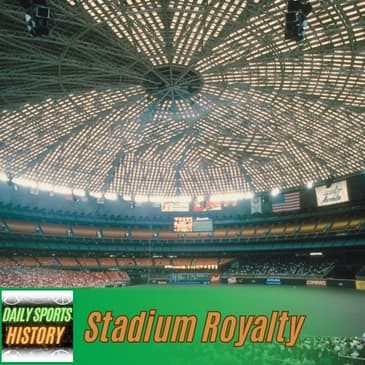
Discover how the Astrodome revolutionized stadium architecture, introducing features such as artificial turf and luxury suites that would become standard in modern sports venues. Hear tales of iconic moments and legendary performances that unfolded under its iconic roof, from World Series games to concerts by music legends.
Through concise storytelling, we capture the essence of the Astrodome's significance, not only as a sports venue but also as a symbol of innovation and spectacle. Join us as we celebrate the enduring legacy of this architectural.
We are being featured on PODCAST GURU:
https://app.podcastguru.io/podcast/daily-sports-history-1715849627
Website: dailysportshistory.com
Email: dailysportshistory@gmail.com
YouTube: YouTube.com/@dailysportshistory
Twitter: twitter.com/dailysportshis
Facebook: facebook.com/profile.php?id=61551687917253&mibextid=ZbWKwL
Tiktok: tiktok.com/@daily.sports.history?_t=8hHPnNSCqfm&_r=1
#sports #sportshistory #sportspodcast #podcast #Astrodome #StadiumHistory #SportsVenue #ArchitecturalInnovation #Houston #SportsHistory #EntertainmentVenue #IconicBuilding
Buy me a coffee: buymeacoffee.com/dailysportz
Newsletter: https://substack.com/@dailysportshistory?r=3en496&utm_medium=ios&utm_source=stories&shareImageVariant=light
DailySportsHistory.com
Email: dailysportshistory@gmail.com
YouTube: YouTube.com/@dailysportshistory
Twitter: twitter.com/dailysportshis
Facebook: facebook.com/profile.php?id=61551687917253&mibextid=ZbWKwL
On April ninth, nineteen sixty five. The world's first multipurpose dome sports stadium is built in Houston, Texas, and is known as the Astrodome, the Eighth Wonder of the World, as they called it when it was built. Here's the story behind this iconic venue today on Daily Sports History. Welcome to Daily Sports History. I'm Ethan Reese, your guide to a rapid deep dive into sports history. Every day. Sports stadiums grew up on the edges of the field, starting with a few benches, then getting some stands, and they just kept growing from there into these huge venues we have today that hold thousands of fans. One thing they always add in common until nineteen sixty five was they were always outdoors and there was no roof, so anything that happened outside with the weather was always a factor. And in nineteen sixty Major League Baseball was starting to expand and the National League agreed to two teams, one of those being in Houston, so the team would become the Houston Astros and coming to the league in nineteen sixty two, with the other expansion team, the New York Mets. Now the former mayor of Houston Roy Hoffheins was granted the franchise in Houston, but under the conditions that they have a covered stadium, as temperatures during the summer months in Houston averaged well above ninety seven degrees and the league thought that would be too hot for regular games during the summer months. This was a huge finisher as this had never been done before. Not only did it have to be covered, you needed it to be air conditioned. With those heats, you couldn't have everyone inside with no air conditioning and the players would not play. But the idea for the astrodrome actually came to Roy Way before he got a team back in nineteen fifty two. He would regularly attend the minor league baseball team games in Houston at the Buffalo Stadium for the Houston Buffs, but they would often be brained out and he just imagined how nice it would be to have an air conditioned stadium. As he was also working on the first air conditioned shopping mall called the Galleria, so he knew something large like this could be built. So he hired the Morris Architects and structural engineer Walter p who actually looked at the Colosseum in Rome for inspiration. At some points the Colosseum actually had a fabric awning that shaded the spectators from the sun. So they began to put plants together and they found a plot of land and in their design it would be eighteen stories tall, covering nine point five acres. In the dome itself would be seven hundred and ten feet in diameter, with the ceiling being two hundred and eight feet above the playing surface. And not only did they have to design the stadium to work, they needed to design a huge hole new air conditioning system as this was so much bigger than anything that had been done before. And at the time, smoking cigarettes was a regular thing and people would still do this indoors, so they needed a system that could regularly filter out the smoke and bring in fresh air as well. And the system was designed by I. A. Nammon and would move two point five million cubic feet of air every minute and would have approximately ten percent of that air being fresh from the outside. Now, the owner of the Astros not only want to have the first stadium, he wanted to be unique on the inside, and they had what was the largest scoreboard known as astrolight that cost two point one million dollars at the time and would be two stories tall, and was the first scoreboard to have animation, so when teams would score, you could see a little cartoon through the lights, and this was very unique. Now there's some unique things about the stadium itself. They actually started at first having real grass in the stadium. They had a special type up Bermuda grass that was bred for indoor use, and if you look up pictures of the stadium, they have multiple translucent panels to allow sunlight in, which would allow the grass to thrive and they could play under real grass. The problem was with those translucent panels, it became very hard to track fly balls. They decided to paint over some of those panels, but this actually caused the grass to stop growing. So they needed to come up with a plan, and they found something called chemo grass, which later became known as AstroTurf, and they slowly rolled it out onto the field, But it took so long to actually make this stuff. They actually had to haint the dirt green to make it look like a professional baseball field until they could have enough to cover the entire outfield. Then this was important because this is something that continued through multiple stadiums to come as more indoor stadiums were built. They also use a version of astro turf, which has continued to get better and better, but still grass is preferred by most athletes, as AstroTurf can leave a terrible scar called turf rash that looks like a rutburn. It's very painful. Now. The stadium was not only for the Houston Astros, it was also for the Houston Oilers of the NFL, as they started playing there in nineteen sixty five too, but they would eventually leave in two thousand and one to go to Tennessee due to issues with the stadium after being around for years and not getting funding for upgrades, and the Houston Astros eventually left in nineteen ninety nine due to similar reasons, but they were able to build minute made part in Houston, allowing them to stay in the city, so after this they didn't have a tenant regularly there, so it was left mainly vacated, but it was a huge help during two thousand and five during Hurricane Katrina, as many residents in New Orleans needed places to go, and the Houston Astronome opened up its arms to allow a place for relief, but ever since then it has become in disarray. It has been deemed uninhabitable, but it's also deemed a historical landmark, so it's not been completely demolished and still stands right next to Reliant Stadium where the Houston Texans played to this day. There have been many plans on possible renovations, from making an indoor park, to making it into a part of the Convention Center, to making luxury apartments, even part of their possible bid for the Olympics, but all of this costs hundreds of million dollars in renovations as it requires major repairs, and no such proposal has made it through completely. But not only was it a great venue for sports, it was a great venue for music as well, holding greats like Judy Garland, George Strait, and Elvis Presley. We'll always remember the Alamo and will also always remember the Astrodome. Thank you for listening to today's daily sports history. I hope you like this. Please please go tell a friend about all your listening. Word of mouth is our best way to grow, and we love to continue to grow this into a great community, and come back tomorrow for more daily sports history.