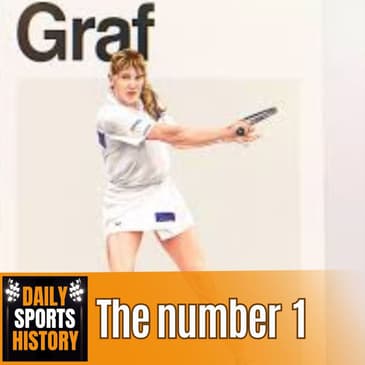
🎾 How Graf’s rise to No. 1 revolutionized tennis
🏆 Her greatest moments during the 186-week streak
📊 Why no one has come close to breaking this record
🔥 Her impact on legends like Serena Williams & modern stars like Iga Świątek Is Steffi Graf’s 186-week reign the most unbreakable record in tennis history? Tune in to find out!
🔗 Listen now: DailySportsHistory.com📌 Follow for more daily sports history!
Check out Fantastic Tennis Podcast
https://podcasts.apple.com/us/podcast/fantastic-tennis/id1535251140
Buy me a coffee: buymeacoffee.com/dailysportz
Newsletter: https://substack.com/@dailysportshistory?r=3en496&utm_medium=ios&utm_source=stories&shareImageVariant=light
DailySportsHistory.com
Email: dailysportshistory@gmail.com
YouTube: YouTube.com/@dailysportshistory
Twitter: twitter.com/dailysportshis
Facebook: facebook.com/profile.php?id=61551687917253&mibextid=ZbWKwL
On March eleventh, nineteen ninety one, Sephie Graff's streak of one hundred and eighty six weeks ranked number one as the number one women's tennis player ends, which she is replaced by mind Seals after nearly four years as a top player in women's tennis. From nineteen eighty seven to nineteen ninety one, she reigned as the undisputed number one women's tennis player. No injuries, no slumps, no challengers. But how good was she and what made her so unstoppable for almost four years and what finally ended her dominant streak. We're going to dive into Steffie Graff and her greatness today on Daily Sports History. Welcome to Daily Sports History. I'm Ethan Reees, your guide as you daily learn more about sports history, increasing your sports knowledge. Now. Steffie Graff, as you might guess, is from Germany, specifically West Germany at the time. She was introduced to tennis at a young age because her father, Peter Graf, was a former tennis player turned coach. But he had a disciplined, no nonsense approach to his training and was a foundation that helped her rise and her talent show early on and at the age of thirteen, she was already showing potential beyond her years, progressing through the ranks in the Germany Youth Tennis rank in Germany U Tennis. The world took notice in nineteen eighty two when she defeated Chris Everett, one of the top ranked players, in an exhibition match. In nineteen eighty five, when she was sixteen, she made her major breakthrough with her first WTA title at the Crimlin Cup in Moscow, and this was the real start of her rise to being one of the most elite tennis players to ever take the court, and starting in nineteen eighty six, she began to challenge the best in women's tennis, and in nineteen eighty seven, at the French Open, she showed that she could really take over the number one spot, beating one of the best in the world, Martina Navtulova, who was ranked number one at the time, to win her first Grand Slam, and she continued to move up in the standings, be getting in the top three, steadily climbing until on October seventeenth, nineteen eighty seven, which was the day she became the number one tennis player according to the WTA, the Women's Tennis Association. This was the first time in her career, overtaking Martina Navratulova, who had held it for one hundred and fifty six weeks over three years, and this would begin Grafts streak that would overtake Martina Nevertulova's and the way that Graft did this was unique. She had the graft forehand where she would jump as she hit a forehand, giving her extra power, and she was relentless on the courts as she never tired out. She was known almost more as a runner than she was a tennis player, and she used this stamina to be able to hold the number one spot for years. She created rivals throughout her career, especially with Martina Navratilova and Chris Everett, and would create a new one in Manicas Sile's. She would head into nineteen eighty eight as the number one tennis player and do something no one has ever done before and only Serena Williams, Rafael Nadal, Andre Agassi, and Novak Djokovic have done since, where she would win the Golden Slam. Now, if you don't know what the Golden Slam is is, you have the four Grand Slam tournaments, which are the Australian Open, the French Open, Wimbledon and the US Open, and then you have the Olympics. So if you win all four Grand Slams and Olympic gold, that is called a Golden Grand Slam. So rare feet you can only do it every four years, and she was able to do it with ease, winning in straight sets of the French Open, beating rival Martina and Avertulova at Wimbledon, breeding abriyel Seventini at the US Open, and beating Saventini again at the Sole Olympics to win gold. Now, it wasn't easy for her. She had challenges and one thing that's always a challenge is to be consistent. In the following year, she went on to win the Wimbledon Opened over Martina and Avertelova again. In nineteen nineties she started to fall off, losing the French Open in three sets and Monica Sille's beating her at the US Open when she was just a teenager. This would be her future rival and who would take away her number one title in the future, and Monica Casill's was quickly climbing up the rankings, putting Steffie Graff's number one seed in Jeopardy, But on March eleventh, nineteen ninety one, Monica Casille's finally caught up to Steffi Graff. We've done an episode on Monicasille's before about when she was stabbed on the court, which was actually related to Steffi Graff as a crazed Steffi Graff fan was the one that stabbed her for taking the number one position away from Steffi Graff. They will always be connected for this reason, and as we talked about in that episode, Monica Sials won eight Grand Slam tournaments in two years as a teenager. Steffi Graff was another teenage prodigy as well, but this didn't stop her from having success after this happened. Unfortunately, after Monica Seals was stabbed, Steffi Graff did take over the number one seed again and would hold it off and on for years, totally a record three hundred and seventy seven weeks at number one. That's over seven years of being the top tennis player in the world. Many pro tennis players don't even last seven years, and she was seven years as the best. Though her record would be passed on the men's side by Novak Djokovic, who has a total of four hundred and twenty eight days at number one, and for the streaks on the men's side, her record would be passed by Roger Federer, who held a record for two hundred and thirty seven weeks at number one, but she was tied by Sabina Williams, who reached the same exact total. Which is crazy to think about being that good and being that close to beating the record and not beating it, but it just shows how great they are and Seppi Graff is often talked about as one of the greatest tennis players of all time, winning nine hundred singles matches and having over one hundred and seven career titles. She won over twenty one million dollars in prize money during her career and was inducted into the Tennis Hall of Fame in two thousand and four. She also won one hundred and seventy three doubles tournaments, reaching as high as third ranked, and won the nineteen ninety eight Wimbledon Championship with her doubles partner, and in two thousand and eight she would be inducted into the German Sports Hall of Fame, and upon her retirement, tennis great Billy Jean Keane said, Steffi Graff is definitely the greatest women's tennis player of all times. Tough for debates, but she's definitely in the conversations. Not only was she great, it was consistent and you do both to become a legend. I want to thank you for listening to today's Daily Sports History. If you want more tennis, If you want to want more tennis information, check out the Fantastic Tennis Podcast, where you get a unique and high energy podcast here to make you the ultimate tennis sports fan, bringing you all you need to know about tennis every week with weekly drama, comedy, and top stories of professional tennis. We'll put a link in the description below for you to check them out and come back tomorrow for more Daily Sports History.