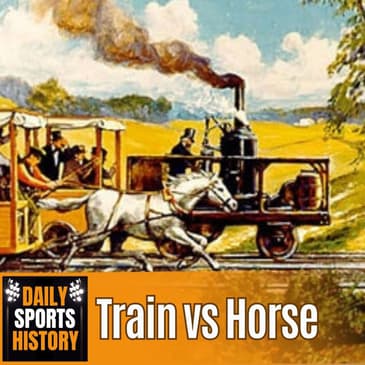
• Discover the surprising origins of the race between Tom Thumb and a horse on the B&O Railroad—yes, the same one from Monopoly!
• Learn how Peter Cooper’s ingenuity and homemade locomotive sparked a revolution in rail travel, setting the stage for steam power in the United States.
• Relive the dramatic face-off along a winding seven-mile track and find out why Tom Thumb’s mechanical mishap sealed its fate—yet marked the end of horse-drawn railroads.
• Uncover the legacy left behind: how this curious contest led to a technological boom and paved the way for coast-to-coast railways in America.
• Hear about historic replicas, museum displays, and the decades-long debate over the race’s true story
Buy me a coffee: buymeacoffee.com/dailysportz
Newsletter: https://substack.com/@dailysportshistory?r=3en496&utm_medium=ios&utm_source=stories&shareImageVariant=light
DailySportsHistory.com
Email: dailysportshistory@gmail.com
YouTube: YouTube.com/@dailysportshistory
Twitter: twitter.com/dailysportshis
Facebook: facebook.com/profile.php?id=61551687917253&mibextid=ZbWKwL
On August twenty eighth, nineteen thirty, machine finally took on nature when locomotive known as Tom Thumb based off against a horse to see who was really the better transportation in nature versus machine. Today, we're gonna dive into how this race got put together and started a revolution on daily sports history. Welcome to Daily Sports History. I'm Ethan Reese, your guide to a rapid deep dive into sports history every day. Now, before this race took place, the B and O Railroad, Yes, that same B and O Railroad from Monopoly was putting the down rails from Baltimore to Ohio in case you didn't know. B and O stands for Baltimore and Ohio. And they were laying down tracks that were originally being used by horses pulling train cars. But the company knew that in Europe they were starting to use locomotives with the invention of a steam powered engine. So in the early eighteen hundreds they sent multiple engineers to Great Britain to see how they put these together. And they came back and they actually commissioned multiple manufacturers make a locomotive. And around this same time, a businessman named Peter Cooper actually bought over thirty thousand acres of land near Baltimore in hopes that this B and O railroad system would be a hit. But there were snags to getting the locomotives built as it was a new technology and they had lots of issues. So Peter took it upon himself to make his own locomotive. Now he had some success before. He had constructed a double boiler at his glue factory in New York, and he had even put together a steam powered machine using change to help tudboats in the Erie Canal. But this system was actually rejected by the towboat companies as it would take jobs away from hard work away from workers, which is interesting as other jobs would be taken away by his future invention of the locomotive. So Cooper actually cobbled together some of his scraps and he actually used barrels of muskets as his tubes for his broiler, and he powered this by coal. And it wasn't a big fancy locomotive that we know today. It was a rectangle with an engine in the middle and pipe sticking up with railwheels on the bottom. It was a very basic lego like looking creation. But it worked. On August twenty fourth, eighteen thirty, they had their first test run where they went seven miles carrying a dozen passengers from Baltimore to Relay and it was the first American steam locomotive to operate on a commercial track in the United States. And they would continue to do these tests as the days came along. Then on August twenty eighth, completely out of the blue, not planned, his look motive nicknamed the Tom Thumb, was out on his test when a horse drawn train came by owned by Stockton and Stokes, which was a stagecoach company who were fighting to keep horses as the main means to this be and O railroad because that means more money for them, and so they challenged the Tom Thumb to a race from Relay back to Baltimore, roughly a seven mile track. Now this track isn't just a straight track. It was a unique track as there was two tracks right next to each other to face off. And also it was a windy track with lots of curves going up and down, so it was a unique experience and Peter Cooper accepted this offer. There's much like the drag races you see in the movies where the guys pull up to the stop sign of red light and look at each other read the engines exactly like that. They both come to the starting line at relay and the horse takes off. Now, horses back then roughly run between five and ten miles an hour. And mind you, these horses, the more horses you had, the faster it was. Now it said it was just a one horse with one wagon behind it, facing off against the top thumb locomotive. But even then, though, as most of us know, trains are slow to start, but once they get going they don't stop. And horses can be quick to start, but they are natural and so eventually they do slow down and wear down. And that's what happened in this race. The horse takes off and they get a good lead, and then the tom Thumb slowly churchs along, chugs along, chucks along in an average of about fifteen miles an hour. The tom Thumb quickly takes the lead from the horse, but about halfway through the course a belt on the steam engine falls off and they come to a stop and Peter Cooper has to repair on site, which takes a lot of time, and they eventually get passed by the horse who takes a huge lead. Now the tom thumb does get fixed and works on catching up, but the lead was unsurmountable and they lost this first nature versus machine race. So you would think this would be a huge win for the stage coach and horses, but it was not, and within about a year all the horses would be retired from the B and O Railroad as the tom Thumb showed that locomotives could handle the rigors of a United States railway at a much faster and consistent pace than anyone thought was possible at the time and changed the United States forever as railroads went across the US and helped usher in the industrial age of the United States and allowed goods to get from one end of the country to the other faster than ever was possible before. And this ended an industry like the stage coach industry, which is now much much smaller and more niche than it was back then where it was a huge industry. But it gave jobs to many others as you had many more options to have success around the country as you could travel across the United States. Now, shortly after this, the tom thumb was dismantled as it was just a kind of test. It wasn't meant to be a commercially used locomotive, as we'll post pictures about it, and it doesn't look anything like the trains we think of now. But it was still a major feature, and B and O hosted their centennial events and they actually made a replica of this Tom Thumb locomotive, and it's still on display at the B and O Railroad Museum, and there's a half scale model also on display at the Hudson Steam Museum in La Port, Indiana. Now, there is some controversy about this event as it wasn't talked about until thirty years after it actually happened by Cooper and a few other people had seen it, and so many say, did this really happen? Did it not? By all accounts, it did probably happen. There may have been some embellishments in it. But why would Cooper, who invented this, tell a story about his locomotive that lost the race. If he was going to make up a story, chances are his invention would win. And that is our story today. I hope you enjoyed it, as it was a unique one, a different kind of sport as racing is one of our earliest sports and it's unique and I always love to find these unique races that happened. And if you like this, please leave us a review wherever you're listening or rating. It really helps me out, It helps me feel amazing that you guys enjoy it and hear your feedback, and come back tomorrow for more Daily Sports history