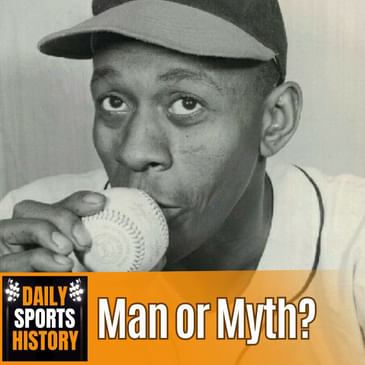
Join us on Daily Sports History as we explore the extraordinary career of Satchel Paige, one of baseball's most iconic and influential pitchers. Learn about his journey from the Negro Leagues to Major League Baseball, his remarkable pitching prowess, and the lasting impact he left on the sport. Discover why Satchel Paige remains a legendary figure in baseball history.
#DailySportsHistory, #SatchelPaige, #BaseballHistory, #NegroLeagues, #MLB, #PitchingLegend, #SportsPodcast, #BaseballLegends, #HistoricPlayers, #TimelessIcon
Buy me a coffee: buymeacoffee.com/dailysportz
Newsletter: https://substack.com/@dailysportshistory?r=3en496&utm_medium=ios&utm_source=stories&shareImageVariant=light
DailySportsHistory.com
Email: dailysportshistory@gmail.com
YouTube: YouTube.com/@dailysportshistory
Twitter: twitter.com/dailysportshis
Facebook: facebook.com/profile.php?id=61551687917253&mibextid=ZbWKwL
On August thirteenth, nineteen eighty four, mythical legendary pitcher Satchel Page pitches his very first complete game in the Major leagues for the Cleveland Indians, where they beat the Chicago White Sox five to zero. And he did this at the age of forty two in his rookie year. We're gonna dive into Satral Page and all his mythology today on Daily Sports History. Welcome to Daily Sports History. I'm Ethan Reese, your guide to a rapid deep dive into sports history every day. And today's trivia question to listen out for is how old was Satchel Page when he pitched his very last game in the major leagues. Now, Satral Page is a name that almost seems methodical. He's got countless stories that may have ever been written down or no video or nothing to confirm, but it's hard to argue that some of them may be right. And she was a successful pitcher well into his forties, and it would have been great to see what he would have done in his prime if he was able to play in the major leagues at the time. And that's part of his mythology and part of what makes him Interestingly enough, even his birth was a mystery until Cleveland Indians owner before he signed him, had to go all the way down to Alabama to try to track down his birth certificate, which it showed July seventh, nineteen eighty six, which setral Page didn't even know for sure as in when he was born. Back in the early nineteen hundreds. Unfortunately, records for black Americans weren't really kept and all they had to go off of was his mom writing down his possible birth record his birthday in her Bible, and that was all they went off of, so it was kind of a wide range of when he was actually born. But in order to sign for the Indians and for Vivek to get approval for it, they needed to know his age, and so that's when he went down to Alabama to find his birth certificate that showed July seventh, nineteen oh six. But as for many black Americans at the time in the early nineteen hundreds, life was tough. They were living very poor in Alabama and struggling to get by, and he actually was arrested as a young child as he was caught stealing multiple times to help provide for his family and at the age of twelve, he got sentenced to six years in an Alabama reform school for juvenile Negro lawbreakers. Now this was actually a blessing in disguise, as it led him to his love of baseball, and Paige often said he traded his freedom to learn how to pitch when he was a young man, and when he was released, he joined several semi pro teams in Alibia, Obama. His brother had also been playing as well, and that's where he got found and joined the Chattanooga White Sox, which was a minor league Negro Southern team, where he would make two hundred and fifty dollars a month, most of which he would send back to his mother, and eventually his contract would be sold to the Birmingham Black Bearons, which was a member of the Negro National League, where his contract jumped to two hundred and seventy five dollars a month. At this time, he was still very young and wild, and in those two seasons he had a record of twenty two and thirteen with one hundred and seventy six strikeouts, and the strikeouts was where he started to make a name for himself as he struck out seventeen in a game versus the Cuban Stars, which was more than any major leaguer had done previously, and six days later he struck out eighteen versus the Nashville Elite Giants. And due to the success he was having in the popularity Page was getting, he would start being rented out to other teams to make extra money for both him and the Baron's owner. Then, in nineteen twenty nine, Page would be offered one hundred dollars to play games for a Saint declared team in the Cuban League, where he brought multiple other players to play with him, and this really angered the Negro leagues because he was taking great players away from their teams. But he would eventually have to leave as a miscommunication due to the language barrier CAUs members of the communities to be very furious with him, including the police and the mayor of the town. He was able to get out and came back to begin being rented out to other teams, to other Negro teams, and then once the Great Depression happened, the Black Barons disbanded and that's when Page really started to kind of barnstorm on his own. He was already being rented out playing with teams here and there for a few games, and so now he was starting to do this even more, making more money than he could playing for just one team. And in nineteen thirty one he would join a Negro All Star team organ to play in the California Winter League, which included both white and black players, and throughout the nineteen thirties he was still bouncing around from team to team, but this allowed him again to play against great players in the major leagues, and it really helped usher in the idea that black players could play with the white players in the major leagues, as he was facing them every now and then as they would play exhibition games, as most of his games were barn storming exhibition games, and he actually got to face off against Dizzy Dean, who was one of the greatest pitchers in the nineteen thirties, and the two teams played for thirteen innings where Satchel Page picked every inning, where his team won one to zero and Billy Vivek, future owner of the Cleveland Indians, was in attendance for that game, saying it was the greatest pitching battle he had ever seen. And in nineteen thirty six, Page put together his own all star team that would go on to play against even more great talent. He even faced off again Joe DiMaggio in the Pacific Coast League, and it said that at this time he was making more money than any African American player and even some white players. And in the spring of nineteen thirty seven, Page was offered a chance to put a team together for the Dominican Republic, where he was able to put together a team for thirty thousand dollars, and then in nineteen thirty eight, he made his way to Mexico where they would pay him over two thousand dollars a month to play in the Mexican leagues. This was the first time he actually got injured, saying there was a huge pain that shot through his right arm that he couldn't even lift it, and some doctors even told him that he would never pitch again. But this was all he knew how to do. He didn't know anything else, so he fought his way back and he humbled himself as only one team would sign him, and it was the Kansas City Monarchs of the Negro American League, but he wouldn't even pitch the whole time. He would end up playing first space a lot because of the pain he had in his arm, but he eventually worked his way up to be about ninety percent of what he was before and continued to pitch, and after a year playing in Puerto Rico, he came back to Kansas City Monarchs, playing with them for the next seven years, where he'd play with a future baseball legend, Jackie Robinson, and on July seventh, nineteen forty eight, Billy Vveck of the who now was the owner of the Cleveland Indians, brought Satchel Paige in for a tryout for this team, now mentioned previously on the episode on Jackie Robinson. Billy was fighting to integrate Major League Baseball alongside Branch Tricky, and just a few months after Jackie Robinson appeared, the Indians debuted Larry Doby, who was the first black American league player, and Vveck actually attempted to bring Satchel Paige in as the first African American player for the team, but at the time he was thought to be too old and had arm issues. But even in nineteen forty eight at the age of forty two, which he found out by searching for his birth certificate. He signed his first major league contract for forty thousand dollars for the three months remaining in the season, and on July ninth, nineteen forty eight, he became the oldest rookie to debut in the major leagues at forty two in two days. But even at forty two, he showed great skill and he formed a great relationship with Billy Vveck. On August thirteenth, in his rookie year, he pitched his very first complete game, and he was having a successful first year with the Cleveland Indians, as he had a record in the final half of the season of six and one with a two point four to eight ERA, with two shutouts and forty three strikeouts. But after this season, Billy Vveck actually sold the Cleveland Indians and they did not want to re sign a forty two year old rookie and they released Page, who went back to barnstorming to Macon's meet. But his good old friend Vivek bought the Saint Louis Browns and signed Page right after that in nineteen fifty one, but he started to show signs of age as he was now forty five and ended the season with a record of three and four with a four point seven to nine ERA. But he came back the following year and had a much better outing, having a record of twelve and ten with an ERA of three point seven. For the following year, he would go three and nine and be released after not having a great season in Billy Viveck, who sold the Browns as well, and again Page went went on more barnstorming. He wasn't the pitcher that he was back in the day, but he was a great draw and a great personality and people just love to see him play. And then his good old friend Billy Viveck bought the Mirami Marlins, an international minor league team, and signed Page again in nineteen fifty five at the age of forty nine, and he would play three seasons, winning over ten games each season, but not being the powerful, dynamic pitcher that he once was, but he said he thought he could pitch for another ten to fifteen years. Even after that, and after he was released from the Marlins, he would bounce around doing barnstorming tours. But in nineteen sixty one he signed with the Triple A team Portland Beaver's, where he pitched just twenty five innings there, still trying to make ends meet. In nineteen sixty five, at the age of fifty nine, he signed a contract with the Kansas City Athletics to play in a game versus the Boston Red Sox. Now this was actually more of a publicity stunts. They wanted to have the old timers facing off against the new timers, and he was really just actually meant to sit in the bullpen in a rocking chair the entire game. But the fans eventually chanted his name and he got out there and started to pitch, where he was able to pitch a few innings and not give up a run. But it was only that one game, and that was the last time he played in the majors at the age of fifty nine, still the oldest player to play in a Major League game when he took on the Boston Red Sox. After this, he continued to pitch in barman storming tours to much smaller crowds, making much less money than he was as he was struggling to make his meet. He didn't have the career where he made a lot of money, playing mainly in the Negro leagues, only getting to play four years in the major leagues, and he actually sent in a petition to the majors to try to get them to sign him as a possibility, to get them to sign him so he could reach that five year mark to make the minimum for a pension, and the Atlanta Braves actually agreed to sign him as an advisor. But the following year, in nineteen sixty nine, they altered the requirements for the pension and brought it down to four years, allowing Page to reach that pension mark. And in nineteen sixty six, at the Hall of Fame induction of Ted Williams, he urged the writers to include the Negro leaguers into the Hall of Fame, as they were great baseball players right along them and there was no reason they should be kept out. And in nineteen seventy one Page would be inducted into the Baseball Hall of Fame for what he did in the Negro leagues and off, and for his career the short time he was able to play in the majors. Now, most of the stats that we have on Satral Page are limited. A lot of these things we have are just from him saying it. So these numbers could be way more, but what we actually have listed. He had one hundred and twenty five wins and the erra of one of two seventy five with over one thousand strikeouts. He made two Major League Baseball All Stars while winning a World Series his rookie year with Indians, and won a Negro League Championship in nineteen forty two. Is included in the Cleveland Indians Hall of Fame as well as the Major League Baseball Hall of Fame, and is still the oldest player to ever play in a Major League game. Now, there are many stories that go around Central Page. One thing we never know is how fast he actually pitched because of how long ago it was, but estimated he was one of the first pitchers to pitch over one hundred miles an hour, as many of the major league players that faced off against him said he was the hardest throwing pitcher they had ever faced, and in time when pitchers did not pitch as fast as they do now, and Page will always go down as the one of the underrated pitchers of all time due to not getting the chance to play in the majors when he did, he was really forced into the Negro leagues and he really upset them with all the born storming that he did on his own. So he doesn't have the stats that many players have, but he's still ranked number nineteen in nineteen ninety nine as of the greatest baseball players of all time by Sports News, And in two thousand and six there was a statue Statchel Page unveiled in Cooperstown, commencing his contribution just to the game of baseball in the Negro leagues and overall. Now, sadly we lost Statchel Page in nineteen eighty two due to heart attack, and it's one of those things that he he was born in the wrong era at the wrong time. I wish we could have seen him in today's game. We would have had all the opportunities given to him. Maybe he could have pitched into his sixties and we would have all loved to see him dominate the game today. He didn't go into every detail, and I'm trying to hit the ones that we actually knew about. He tells great stories. There's great miss and stories that go round about him, but we try to stick to what we could somewhat prove. If you like that, please leave us a rate and review wherever you're listening helps us out so much, and come back tomorrow for more daily sports history. And did you catch the answer to today's trivia question? When did Satchel Page pitch his last game in the major leagues. It was in nineteen sixty five with the Kansas City Athletics, where he was fifty nine years old on a one day contract, facing off against the Boston Red Sox at the age of fifty nine, a record for the oldest player to play in the major leagues that he still holds to this day.