We are being featured on PODCAST GURU:
https://app.podcastguru.io/podcast/daily-sports-history-1715849627
Website: dailysportshistory.com
Email: dailysportshistory@gmail.com
YouTube: YouTube.com/@dailysportshistory
Twitter: twitter.com/dailysportshis
Facebook: facebook.com/profile.php?id=61551687917253&mibextid=ZbWKwL
Tiktok: tiktok.com/@daily.sports.history?_t=8hHPnNSCqfm&_r=1
#sports #sportshistory #sportspodcast #podcast #MonacoGrandPrix #Formula1 #MotorsportHistory #RacingLegends #Monaco #GrandPrixRacing #AutomotiveHeritage #RacingCircuits
Buy me a coffee: buymeacoffee.com/dailysportz
Newsletter: https://substack.com/@dailysportshistory?r=3en496&utm_medium=ios&utm_source=stories&shareImageVariant=light
DailySportsHistory.com
Email: dailysportshistory@gmail.com
YouTube: YouTube.com/@dailysportshistory
Twitter: twitter.com/dailysportshis
Facebook: facebook.com/profile.php?id=61551687917253&mibextid=ZbWKwL
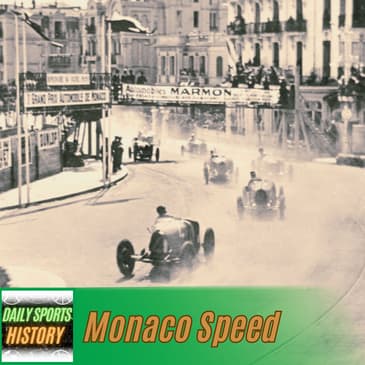
On April fourteenth, nineteen twenty nine, William Grover Williams driving a Bugatti Type thirty five B. When's the very first Monaco Grand Prix. Here's the story behind this first iconic race today on Daily Sports History. Welcome to Daily Sports History. I'm Ethan Reese, your guide to a rapid deep dive into sports history every day now. The idea for the Monaco Grand Prix came from Anthony Knaggs, who had already helped create racists such as races such as the Raleigh Monte Carlo in nineteen eleven, and with the help of the Automobile Club des Monico, a motoring club based in Monaco, they helped create the very first Monaco Grand Prix, which has gone on to become one of the most iconic automobile races in the world and part of what is commonly known as the Triple Crown of motorsports, which is the NY five hundred, the twenty four Hours of Les Mond and the Monaco Grand Prix, and it is the only Grand Prix that does not adhere to the FIA's mandate of a minimum of one hundred and ninety mile race for F one races. And this is a unique race that is actually held on the streets of Monaco, with different elevations and tight corners and tunnels, making it a very demanding circuit with many stops and very very tight turns. And the courses remained pretty much the same as it was put together in nineteen twenty nine, making little tweaks here and there, but the course is pretty much the same. And that first race was a invite only race where they invited sixteen participants for a grand prize of one hundred thousand French franks and the race would have one hundred laps equally to about one hundred and ninety seven miles. Of those sixteen racers, there were seven Bugatti cars using either the Type thirty five C or the Type thirty five B car. Now, these cars looked very much like a twoe. The wheels were outside of the car, with a twoel like structure that tempered in the back and was flat in the front, consisting mostly of the engine where the driver sat behind it, and was open like the indy cars are today, but even more so open as the driver could just jump out very easily if needed, and had a very small windshield and most drivers wore a helmet and goggles as well as gloves, and that was about all the protection they had. The other cars featured were Maserati, Mercedes Bins in Alfa Romero. And what was unique about this race was there was no qualifying run to dictate the order of the start line. Instead, it was all hands drawn and they would start the race in lines of three, so there would be three in the front, then three behind them, and so on so forth. Well in Grover, the future winner of the race, started in the second row. And what's interesting is how he got to this position. In his early twenties, he had taken a job as a chauffeur for a well known British painter, and that painter let him race his cars when he wasn't chauffeuring him around, and that's how he got into racing and developed relationships with the Bugatti company to help run their cars. And what made Bugatti cars very different than other cars of the day was they focused on being lightweight. Their cars out of a lightweight aluminum compared to the other cars that were using different metals that were much heavier. In the car he drove, which was seven hundred and fifty kilograms in about sixteen hundred pounds, topping out at a speed of one hundred and fifteen kilometers per hour or one hundred and thirty three miles per hour. And at this time Bugatti was known as the ultimate winning car and they have won over two thousand races in the nineteen twenties, making it Bugattis Golden Decade, one of the most successful times for a car company in racing ever. At the start of the race, William Grover better known as Williams, takes over and quickly jumps to the second place and the field quickly thins out as only three cards finished the race on the lead lap. Pit stops were huge as these cars were big on fuel and the tires were needed as the asphalt was very hot. And these pit stops were not as fast as the ones we know to day, as they took more time to actually replace the tires and fill up the car, and every time when the drivers would stop, they were likely to lose their lead position. But the race came down to Williams in a Bugatti, George Banniero also in a Bugatti, and Rolph in a Mercedes Binz. Despite losing the lead at lap forty nine after taking a pit stop. It was the last time Grover would lose the lead. He would eventually overtake Garacolia in the Mercedes Bins, as with fresh tires he was able to get through their turns much faster, and he also had something they had, a newly patented brake system, which allowed his brakes to cool down much faster and allowed to perform much better. This was the time when cars were very different and mechanical advances like this were able to help you win races even more than your racing ability. And Williams passed the finish line after his one hundredth lap at three hours, fifty six minutes and eleven seconds, beating George Buranio by a full minute in seventeen seconds, and Carcolia and the Mercedes Bins finished another minute behind that and only nine other racers finished the race, but none of them finished on that lead lap, and everyone else either was in an accident or had mechanical issues, as this was still early in the automobile phase. The fastest lap took two minutes and fifteen seconds, which was done by William Grover, and during the race he averaged almost eighty five kilometers an hour, which is about fifty two miles an hour, and in twenty twenty three the fastest lap was one minute fifteen seconds and they had an average speed of one hundred and ten kilometers about sixty eight miles per hour, so not actually that much faster than almost one hundred years ago. Just shows you the challenge and uniqueness of this race and why it is so popular in the world. Thank you for listening to today's Daily Sports History. I hope you enjoyed it. If you did, feel free to lea give us a rating or review wherever you're listening. We'd love to see those. It makes us really happy and smile great big smiles every time we see one. And come back tomorrow for more Daily Sports History.