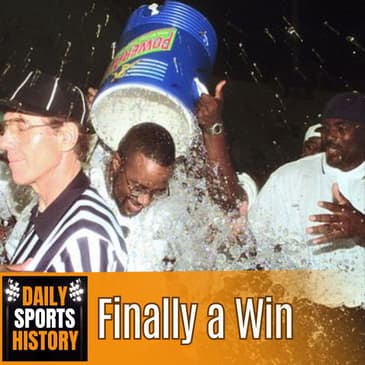
Join us on Daily Sports History as we dive into the story of Prairie View A&M's infamous 80-game losing streak in college football. Learn about the challenges the team faced, the perseverance of the players, and how the program eventually bounced back from this historic low point. Discover the lessons learned from one of the longest losing streaks in sports history.
Check out FCW Nation Podcasthttps://www.fcsnationradio.com/
#DailySportsHistory, #PrairieViewAM, #CollegeFootball, #LosingStreak, #FootballHistory, #SportsPodcast, #HistoricStreaks, #PerseveranceInSports, #FootballComeback, #SportsStruggles
Buy me a coffee: buymeacoffee.com/dailysportz
Newsletter: https://substack.com/@dailysportshistory?r=3en496&utm_medium=ios&utm_source=stories&shareImageVariant=light
DailySportsHistory.com
Email: dailysportshistory@gmail.com
YouTube: YouTube.com/@dailysportshistory
Twitter: twitter.com/dailysportshis
Facebook: facebook.com/profile.php?id=61551687917253&mibextid=ZbWKwL
On September twenty sixth, nineteen ninety eighth, Prairie View A and M does something they had not done in nine years. After losing eighty straight games, Prairie View A and M wins wins a game fourteen to twelve, and this would be the beginning to change their fortune. Today, we're going to dive into how a team loses eighty games in a row on Daily Sports History. Welcome to Daily Sports History. I'm Ethan Reeves, your daily guide into sports history helping you daily. And today's trivia question to listen out for is how many national championships did Prairie View have before the end of the Jim Crow Laws. Prayriview A and M's football team had been around since nineteen oh five, and currently they are part of the SCS and part of the South Athletic Conference better known as the SWACK, which is made up of historically black colleges, and in the fifties and sixties they actually were one of the best HBCU colleges out there, winning eight SWACK Conference titles and five Black College National championships, led by Billy Knicks, who was known as the Bear Bryant of college football. And legendary Grambling coach Eddie Robinson would say he dread playing against prairie View as they were that good. And Prairieview would actually be the first historic black college to play in a postseason bowl game, as they put together their own bowl game, the prairie View Bowl, that would play from nineteen twenty nine to nineteen sixty one. Now, an unfortunate side effect to the Jim Crow laws being abolished was that the historic black colleges lost a lot of their talent as they would go to these bigger football programs, and it made it harder for Prairie View to really compete at the level they were competing before, not only because Bill Nicks ever retired a new coach, but just because the talent pool was less and the game was starting to change. And the nineteen eighties really win the downfall, as they had winless seasons in nineteen seventy four, seventy nine, eighty three in eighty four, including a twenty eight game losing streak from eighty two to eighty five. But the real issues started when they hired head coach Hainey Catchings in nineteen eighty seven. He initially was the interim coach who finished the final seven games in nineteen eighty seven as the previous coach was fired. But in nineteen eighty eight he put together the first non losing season for the team in thirteen years, going five to five. But the problem was how he did this, as he regularly was trying to force his players to abandon their studies, and Catchings would withhold textbook and financial aid until players would quote prove themselves on the field and some would get their books until the middle of the semester. As a result, forty three of the fifty five man roster had great point average below the NCAA minimum of two point zero, which is a C average, and the players actually demanded that catching be fired, and as they boycotted the team when their demand was not met by the administration, Catchings was eventually fired, but not due to what he had done to the players. Instead what he had done to the university as he misreported financial information and there was more than one hundred thousand dollars missing from the athletic department count as Catchings was filling out fraudulent expense reports, and he actually pled guilty to felony and misdemeanor charges due to this, and had to serve five year probation and pay over fifteen hundred dollars in fine and restitution. Following the nineteen eighty nine season, they would disband the team as they didn't have the money to support a team and give out scholarships as well as fix up the field in the track to serviceable standards, but they did decide in nineteen ninety one to return, but to do so without scholarships. Now, I previously coached at a Division III school that doesn't have scholarships. That went from an NAI school that has scholarships to a Division III school. It is beyond my comprehension to play schools that have scholarships versus a school that does not. You're asking players to pay to play, which is very difficult when you're facing another guy who's getting offered at least a little bit of money to play, and that makes them feel like something, and so they're gonna take that. So recruiting is harder. You have less talent, you have less budget, and throughout the nineteen nineties they lost as they could not afford scholarships. They would eventually ask alumni to help support possible scholarships, but the most they could get was for a total of nine scholarships, and to do that facing against schools who have regularly over sixty players of scholarship, it's a daunting task and they would lose by huge amounts and they would have six straight winless seasons. So by the time in nineteen ninety eight, nobody on the team had won a game. But luckily the team started to realize maybe we should play some different teams and they started to play some lower level competition, but they still had to play their conference games, which were all scholarship teams. But they did play Howard Payne, who was a Division III school, for the second game of the season and they lost fourteen twenty two, and coming into their fourth game of the season, they were three to zero and had lost eighty games, but they were facing Langston College, who was an Innaia school. If you heard our previous episode about how the NAII started, you know that they do have scholarships, but it's only twenty four compared to the sixty three at FCS and the eighty at BS, which is changing. So Langston University did have scholarship players, but is much less than who was in their conference. So they were playing Langston on September twenty sixth, nineteen ninety eight, at home, and they were able to get the lead going into the fourth quarter fourteen to six in front of nine thousand fans, hoping for the first win in the decade in the nineteen nineties, But Langston drove the length of the field and scored a late touchdown in the final minutes, making the score to twelve, and Langston went for two to tie the game. Now, though this would technically end the losing streak, a tie would end that, they did not want end that way, and they held a defensive stand and stopped the two point conversion, which led them to win score to twelve, ending their losing streak. Now, that was still their only win that season, although they did come within three points facing another NAI school, Oklahoma Panhandle State. In the next five years, they would only win eleven games. But things started to change as Prayer Views started to gain a little bit more financial backing and were able to start offering scholarships again, and due to this, it changed the fortune around when you start to get scholarship players, because when you start to get a scholarship player, your team can start facing scholarship players with more equality and have better chances of winning. And in two thousand and nine they finally won another conference title, going nine to one, winning the SWACK title, becoming a great school again. And in twenty fourteen they actually broke around on a fifty million dollars stadium in Athletic Fieldhouse, showing that they were back to being a school that prioritized football and had the money to support a FCS school and a lot of times that's what you need to really compete. And if you want to learn more about the FCS, check out FC Nation where they go through the biggest games in the FCS, breaking down what happened about the Football Championship Series so that you can stay on top of what is going on in the FCS. We'll put a link to their description below. This now is a great time to listen as conference players starting to pick up and you get some of the best rick in the FCS. And if you enjoyed today's episode, please let us know by leaving us a review wherever you're listening, and if you want, leave us your name and a topic you want us to cover and we'll do that episode just for you and come back tomorrow for more Daily Sport's history and the answer. Today's trivia question is how many national championships did Prairie View have before the end of the Jim Crow Laws. Prairie View had five black college national championships before the Jim Crow Laws were abolished and national championships were now open to everybody.