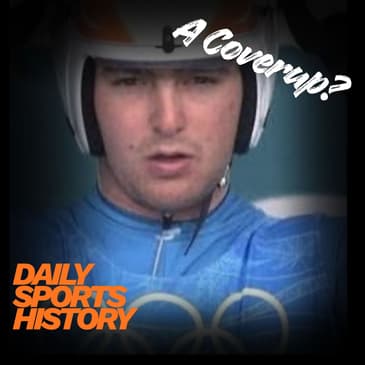
His fatal training run stunned the world, shook the Olympic movement, and forced an entire sport to confront the price of speed and spectacle.
In this episode, we travel from the snowy hills of Bakuriani, Georgia, where Nodar grew up in a luge family, to the towering ice walls of the Whistler Sliding Centre, a track already whispered about for its terrifying speeds.
We unpack how a young athlete chasing his first Olympic dream ended up on a course many insiders feared, and how one catastrophic mistake in Curve 16 changed everything.
Buy me a coffee: buymeacoffee.com/dailysportz
Newsletter: https://substack.com/@dailysportshistory?r=3en496&utm_medium=ios&utm_source=stories&shareImageVariant=light
DailySportsHistory.com
Email: dailysportshistory@gmail.com
YouTube: YouTube.com/@dailysportshistory
Twitter: twitter.com/dailysportshis
Facebook: facebook.com/profile.php?id=61551687917253&mibextid=ZbWKwL
It's February twenty ten in Vancouver. Everyone is excited for the Winter Olympics. They're just about to begin and have the opening ceremony. But if you didn't know, a lot of Olympians actually come ahead of time to practice and get reps before, especially the ones that happened that very first week. And that's what happened with the Luche, which is a very popular event, but it's also one of the most dangerous and we learned that the day before the opening ceremony for this Olympics, when Nadar Kumar tash Veeli from the country of Georgia is running a practice run. Unfortunately, is thrown from the track. It's a steel pole. This is essentially killed on impact. We love these sports, but a lot of them are still very dangerous. We forget that a lot, even though that's a reason we love the sport. We don't ever want to see someone pass away or get severely injured. But the sad thing is how it was handled afterwards too. Join us today as we dive into Nadar his life, what happened and the cover up of what really happened. I don't know the Olympic committee may have just covered this up today on Daily Sports History. Welcome to Daily Sports History. I mean than resee your guide because I feel like the one sport I could possibly do in the Olympics is the luge. So, Nadar Kumar Tashva Ali, I'm sorry, Nadar and your family. I'm not going to pronounce your last name anymore. It is so many letters that my brain struggles to even put it together. My heart goes out to you having to put up with that name. But hopefully in Georgia it's like the name Smith here. But their family was actually huge into luge. His grandfather elet Go last name, introduced the lou to Georgia while training in East Germany during the USSR time. Yeah this was long ago, and he helped put together the first louse track in Georgia and it would later be finished by the Soviets as they wanted to get into the sport as well. And then his uncle and coach Felix served as the head of the Georgianian lou Federation and his father on the USSR youth championship and was part of the Soviet Union team and he won three championships, once with the two man Men's bob sled and twice as a louche, and his cousin Saba would later compete in loose in the twenty twenty two Winter Games. So it's one of those things that is a little unique. There are families out there that are huge, is like the Forced family in drag racing. They're huge in drag racing, but if you're not into drag racing, you probably never heard of them. There's these niche sports is where families kind of take over. And that was Nidar's family. I'm not gonna try to say the last name, but he grew up in Georgia where they're actually known for their skiing slopes, and he enjoyed lots of winter sports, and he started doing luge at the age of thirteen. Though he enjoyed louse and it was part of his family. He also went to Georgian Technical University, where he graduated with a degree in economics. Now, despite this, his family actually struggled economically because LUs is expensive to be a part of and it doesn't pay very well. Can you name the top earning leisure or the number one loisure in the world, or the number one losure even in America probably not. I even watched the luge competition this year and I don't even remember who won or who was part of the USA team. It's easy to forget about, and it's a sport that's kind of fringe, so money is a little tight. But despite this, he continued to compete. In two thousand and eight, he began to compete in the Luge World Cup. Now he finished in the bottom of the pack, fifty fifth out of sixty two competitors. And then he continued the next year and he did a little bit better, finishing twenty eighth, and he would kind of bounce between the back of the pack. He would be ranked forty fourth heading into the Winter Olympics in the world. Now that's not bad. Imagine being the forty fourth best person in any sport in the world. It's actually very impressive when you think about it. So he was excited. He made the team to go to the Olympics. He qualified for it, he did everything. He'd been losing his entire life. So he goes to Whistler Sliding Center. That's where they had to lose for the twenty ten Vancouver Olympics. And this lose was actually designed in two thousand and four specifically for this offense, but they also wanted to make it something they could use after so they put it in a unique location that you usually wouldn't put a loge, and it actually ended up making it faster for a steeper downhill, and it was supposed to by their calculations, to reach a maximum height just under eighty five miles an hour, which is the craziest part. These athletes only former protection is a helmet. They wear a skin tight suit to reduce and that's all they have. It is a crazy sport and it's crazy dangerous. It was a lot more dangerous back in the day, but it has gotten better as they design these better and take certain precautions to try to make it safe that you can't fly off. So they go ahead and build it to the specifications, to the design, and they do their homo elation process, which is basically a certification making sure it's okay, and they found that it was actually getting six miles an hour more than it was supposed to, so people were going over ninety miles an hour than it was supposed to. Now that doesn't sound like much. You imagine going eighty five on the highway, then you go ninety or you're going to really see a lot of difference. You're probably not, but when you're going this fast with just a sled under you and helmet, it can make a huge difference because maybe it's not safe enough to go. And they actually recorded a record speed there of ninety five point six miles an hour, which you set a record, that's amazing, but it's scary and a lot of people were scared that this was too fast, and they said that the increased speed was due to sleds and better equipment and that's where the speed came from after they designed it and put it together. Now that could be, but the thing is when there's worries something like that, when you bring up things like that, just going fast doesn't mean like it's a warning that things are wrong. It's going faster than we expected. That means it's more dangerous than we expected. And on February twelfth, twenty ten, Nadar was doing his practice runs. He had done twenty five previous practice runs. And Luja actually is kind of like golf. They have a women's start and a men's start. The men's start a little higher, so they go a little faster, and of those twenty five attempts, he had done fifteen of those from the men's start. So he has been doing this his whole life by this point, almost ten years, which may not sound a lot like, but he was only twenty one years old and he had a family about it. He knew about louse, all the dangerous things. But on his twenty sixth attempt, something happened at the very end of the run. It was the last turn, turned sixteen of the course. Basically, you make that turn and then you go down the straight away across the finish line. Almost done, he comes out of that turn and ends up hitting the wall as he comes out with a violent hit that then shoots him into the air. At this point he is going over almost ninety miles an hour as he's flung through the air. Now, if this was open area into snow, maybe he could survive that, but going ninety miles an hour with just a helmet, that's almost a death sentence no matter where you land. The sad thing is there wasn't anywhere to land down that straight away were multiple support poles made of steel, and he gets thrown and runs directly to the steel people that are there immediately start giving him medical attention that they can as much as they can. He is airlifted to the local hospital, but essentially he dies on impact. They do his best to sustain him, but he is gone. This is the first death in organized luge since nineteen seventy five. Lose was dangerous when it began, but got safer, and this was supposed to be a safe race, designed to be safe, and this was the fourth death when athlete participating in the Winter Olympics. There's a British loser who again has a name that's unpronounceable, an Australian skier and those both died in nineteen sixty four. And then there was a speed skater. There's a speed skater from Switzerland that died in nineteen ninety two. It was a sad moment and it just happened right before the opening ceremonies. And what's even worse is there was footage of this. If you go on line, you can see what happened. I warn you it's violent. It happens so fast because he's going so fast that it's amazing that they're able to even show it. But you can find clips of it. If you really want to, I encourage you not to watch it. I didn't want to, but sadly I did my research. The Georgianian team, who were wearing black armbands, who only had seven members remaining after this, and they put a black ribbon on their flag as they walked through the ceremony, and the opening ceremonies held a moment of silence for their lost competitor. But then after this is where it gets a little creepy. I don't know how I feel about it. So after this, of course they want to make sure that's safe for the Olympics. What they do is they change and they moved the men up to the women's start. And what this does is it says about five miles an hour that was over the designed speed. And they also put some padding up in a wall up where it was that he fell. It's a good reactive thing, but honestly, a padding on a steel pole is not going to still he still would have passed away. Maybe wall would have kept him sliding down the track and he could have lost speed, would have been probably really injured, but maybe still alive. Then later on that year, the IOC had a final report saying that this was user air is what the issue was, which is a little crazy considering they knew it was too fast and at the time he was going faster than the design speed limit for the track. They knew this, They knew this was a problem, and they didn't do anything about it, and instead they put the blame on a dar whose family was flabbergasted by this because they are a lose family. He had been around Lose his entire life. He'd been doing it for years, ranked in the world, he had gone down this run twenty five times without an issue. He knew this run there was more than user error. They just tried to cover it up. And a professor at the University of cal actually looked who was a mechanical aerospace engineer, looked into what actually happened in the grass and what probably actually caused it, and he said it was caused by a filet or joint between the lower edge of the curve and the vertical wall. So when you come from the curve to a flat surface, it's not a smooth transition, a little piece that kind of junts out and he said that caught the right runner of his sled, the right blade, and that is what flung him to the air. Based off the video and the math and the science, I'm not going to try to guess that, but it was shown that it was not a user error. It was the error of allowing this course to be run like this. They could have just ran from the women's start the entire time, which would have gotten them closer to the design speed that it was for, but instead they kept it going fast because, as Ricky Bobby says, I want to go fast and other people do too, and sadly it's just been forgotten ever since. Yeah, she just said, no, you're wrong. And what's funny is the designer of the track actually said that this study from this professor was wrong, it was flawed, even though he himself didn't calculate the right speed for his design. Sadly, sometimes we don't control our destiny. We want to be in these sports, but other people control it and we just have to live in it. And I feel bad for Nadar and his family. I wish them the best, and I hope that we can continue to look to safety in all that we do in sports. I want to thank you for listening to Today's Daily Sports History it means a lot. I want to ask you please to follow us on social media. I'm doing these videos where I talk about a random sports record that you may have not heard of. I would love for you to follow us on YouTube, Instagram, Facebooks where I'm posting them. The links are in the description, or you can just go to our website and click on the links there. Please check it out. I think it's fun. Give me some advice, leave a comment. I want to hear from you, and we'll see you on the next one.