Website: dailysportshistory.com
Email: dailysportshistory@gmail.com
YouTube: YouTube.com/@dailysportshistory
Twitter: twitter.com/dailysportshis
Facebook: facebook.com/profile.php?id=61551687917253&mibextid=ZbWKwL
Tiktok: tiktok.com/@daily.sports.history?_t=8hHPnNSCqfm&_r=1
Buy me a coffee: buymeacoffee.com/dailysportz
Newsletter: https://substack.com/@dailysportshistory?r=3en496&utm_medium=ios&utm_source=stories&shareImageVariant=light
DailySportsHistory.com
Email: dailysportshistory@gmail.com
YouTube: YouTube.com/@dailysportshistory
Twitter: twitter.com/dailysportshis
Facebook: facebook.com/profile.php?id=61551687917253&mibextid=ZbWKwL
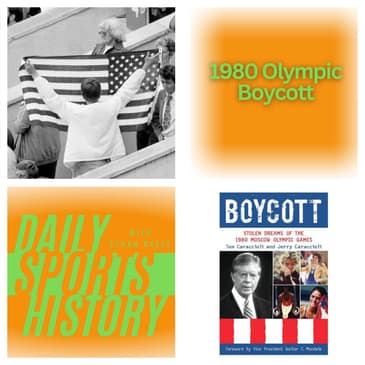
In nineteen eighty, the US, along with many other countries, took a stand against the Soviet Union, who had recently invaded Afghanistan, and a boycotted the Olympics, showing how powerful sports can be in the world. Here's the story behind this iconic event. Welcome to Daily Sports History. I'm Ethan Breeze, your guide to a quick deep dive into sports history every day. In the winter of nineteen eighty, the world was on the brink of a dramatic showdown. The nineteen eighty Summer Olympics in the winter in Moscow were supposed to be a global celebration of unity and peace, but it became the center stage for or fierce political battle that would shape the fate of the games. It all began on a cold December day in nineteen seventy nine, at a meeting of NATO representatives. Western governments contemplated of radical decision boycotting the Olympics. The reason Soviet Union had invaded Afghanistan, a violation of human rights that could not be ignored. In the mid seventies, whispers of the Olympic boycott had already spread among human rights activists, but it was until a courageous Soviet nuclear scientists dissented named Andrei Sakharov called for action that an idea to gain momentum. Then, on that faithful day in January twentieth, nineteen eighty, President Jimmy Carter himself joined the call for a boycott, setting a deadline for the Soviet Union. As the days passed, that deadline drew near and tensions escalated, Carter pushed the U S allies to pull their Olympic teams from the game, leaving the International Olympic Committee in a precarious position. The IOC protested, claiming the boycott was an inappropriate means to achieve a political end. West Germany Council Hamlet Schmidt voice tis concerns, but even West Germany eventually joined the boycott at an April nineteen eighty Builderberg meeting. Opinions were divided. Some saw the boycott as a cinema protest, while others believed with a powerful symbol visible to those within the Soviet Union. Muhammad Ali embarked on his mission to convince leaders in Tanzania, Newlwaga and Synagogue to join the boycott. His efforts bore fruit in Kenya, many countries heated the call. In Japan, West Germany, China, the Philippines, Chile, Argentina, Norway and Interial all boycotted the Games. The UK, France, and Australia supported the boycott, but left the final decision up to their athletes. Spain, Italy, Sweden, Iceland and Finland represented West Germany at the Games. Some participated under neutral flag. Even Iran, an adversary of the United States, joined the boycott. The Games went on with modifications, and the Olympic anthem replaced the national anthems. The world watched athletes compete without familiar symbols of their nation. The nineteen eighty Moscow Olympics became a symbol of protest and a dramatic stand of human rights, and a turning point in the history of the Games. Thank you for listening to today's daily sports history. If you like this, follow us on our socials, Twitter, Instagram, Facebook, and TikTok, where you can get videos and pictures of today's story, and come back tomorrow for more sports history. Every day.