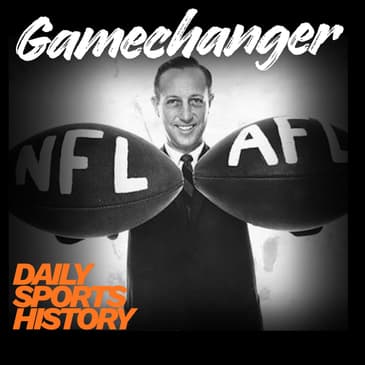
Discover how Rozelle’s “league-think” revenue sharing and centralized TV contracts catapult per-team payouts from $330K (1962) to $14M (1980s), birth the Super Bowl as a cultural juggernaut, engineer the AFL merger, and pioneer Monday Night Football—while navigating labor wars and owner rebellions.
From fragile regional sport to billion-dollar spectacle: average attendance jumps from 40K to nearly 60K per game, Super Bowl viewership hits 400 million globally by 1989, and player shares soar from $5K to $64K—numbers that prove Rozelle didn’t just save the NFL, he reinvented it.
Why it matters today: Every shared TV dollar, merger-born rivalry, and Super Sunday ritual traces to that 1960 compromise candidate who made football national theater.
#PeteRozelle, #NFLCommissioner, #SuperBowlHistory, #NFL1960, #RozelleEra, #FootballOnTV, #AFLNFLMerger, #MondayNightFootball, #SportsBusiness, #DailySportsHistory, #NFLGrowth, #Miami1960
Buy me a coffee: buymeacoffee.com/dailysportz
Newsletter: https://substack.com/@dailysportshistory?r=3en496&utm_medium=ios&utm_source=stories&shareImageVariant=light
DailySportsHistory.com
Email: dailysportshistory@gmail.com
YouTube: YouTube.com/@dailysportshistory
Twitter: twitter.com/dailysportshis
Facebook: facebook.com/profile.php?id=61551687917253&mibextid=ZbWKwL
So it's nineteen sixty in Miami Beach, Florida, and a group of twelve NFL owners are glaring at each other, exhausted at a nine day straight grind, trying to decide who will become the next NFL commissioner after the unexpected death of Bert Bell. Names have been written on an easel and crossed out over and over again. They cannot agree on anyone until they come across possibly the youngest candidate they could have come across, a thirty three year old kid who is the GM for the LA Rams and everyone liked him. On the twenty third vote, they all agreed and named Pete Roselle as the new NFL Commissioner, a decision that would change the NFL forever, leading a league on the verge of bankruptcy to be one of the most valuable sports leagues in the world. Join us today, who learned how Pete Roselle became the NFL commissioner and what he did to change the game forever today on Daily Sports History. Welcome to Daily Sports History. I'm Ethan Reese, your guy because I can spell pete, but I can't spell commissioner. So if you know Pete rosel at all. You know that he is straight out of Compton. No, really, he actually graduated from Compton High School. He ended up going to Compton Community College and. That's actually where he got his big break. See, the basketball coach from the San Francisco Dons came to scout a player at Compton Community College, and Pete Roselle was not a player. He actually worked for the PR team in the athletic office for the Compton College and he was so good at that job that the coach for another school's basketball team recruited him and offered him a full ride scholarship to do. The same position at his school. This is not normal. You don't go on. A recruiting trip for operations people. No, no, no, no, this was unusual and he did great. He actually got the Dons basketball and football team national exposure and really proved himself in that role. Now, while he was at Compton College, he actually worked part time with the La Rams in their public relations as an assistant. So after he was done with the San Francisco Dons, he actually went back and rejoined the La Rams as. A PR specialist. After working there for a while, he actually went to help market for the nineteen fifty six Olympics and then came back to the Rams, who were disorganized, unprofitable, and losing growth in the LA market, and he came in as their general manager. Now, we normally think of general managers as the person that brings in the players for the team, but he did more than that. He actually was part of the business as well, in pr and other stuff as well. So that's where he was when Bert Bell, the commissioner at the time of the NFL, suddenly passed away. Bert was the second commissioner of the NFL and had been leading them for thirteen years through a really difficult time coming out of World War Two, and he had led them into a good area, but they were still struggling. So they made it through that final season, kind of patching together the owners to kind of get through the season so they could really make a conscious choice of who should be the next commissioner. And so the twelve owners got together in a room in Miami. This is what they still do to this day. They call it the Winter Meetings, where they decide rules and changes to the league and things like that, and so they work together and this went on for days and days and days they couldn't agree. You're getting twelve powerful men, twelve men that own franchises to try to agree on one person to control them. That's a difficult task. And so they voted and they voted and they voted. They got up to twenty two times and could not come to a consistence of who they wanted to be the commissioner. And then on the twenty. Third ballot, they all came to Pete Rosel. Now why did they pick Pete Rosel when he was a charismatic, likable guy. No one really was upset about him, no one disliked him. He was a good guy. And also he was only thirty three years old, very young compared to all these businessmen. And so they thought, hey, if we're gonna have someone that has to control the league, at least we have a young guy that we can control. Unfortunately, that would not be the. Case, but they didn't know that at the time. The funny story is Pete Rosel was in Miami to do his job, and he was in the bathroom when someone comes and knocks on the stall and goes, hey, Pete, you're the new commissioner. A unique place to learn that your life has forever changed, as you are now the commissioner of a professional sports league. Although at the time. It wasn't the biggest league, it wasn't the most well known league, but it would go on to be the biggest sport in America because of him. So one way he really got this job is he pitched the owners on the fact that they need to work together, kind of a socialist style, that they needed to work. If they keep working separately, they will fail, but together they can be strong. There was twelve teams and there were small markets like Green Bay, and they struggled with TV contracts. At this time, TV contracts were given to individual teams, so the Giants were really big because they had New York. The LA Rams were kind of. Big because they had Los Angeles. But there was other places that. Didn't have these revenues that they could get. And he said, we can get a bigger contract, more money if we get one contract together and we share the revenue. We share everything. He said, you can have good success by yourself, but we can have great success together. And television was the biggest thing about this that changed everything, because in nineteen sixty two, Pete Roselle was able to negotiate a major TV contract with CBS that would pay the league four point six million dollars annually. Now you divide that by you divide that by twelve. Yeah, that's less than a million dollars. Okay, it's not that much. But this was really important because they needed to be the face of the world because the American Football League was coming for them. They were begetting bigger and bigger and starting. To steal players, and they had a TV deal as well, and if they got in front of America first through TV, they would win. So it was like an arms race to see who could get their league on TV first. And this is a big moment because these two leagues were clashing, the AFL in the NFL, battling out for players, battling it out for TV rights, and if these two leagues kept battling each other, they were gonna lose out. So Pete organized a merger, not an overtake, a merger. It was announced in nineteen sixty six that they would merge to be under the NFL name, and this would expand the teams to twenty four. In nineteen sixty when he took over, it was twelve. Now They're at twenty four teams within just a few years, and by nineteen sixty nine they would have twenty six teams. By nineteen seventy they would have twenty eight teams. Just to put that in perspective, we're at thirty two now and it's been almost fifty years. We've added just a few franchises. But it was a huge turning point because now they weren't battling each other for players and things to have success for their own leagues. They were battling each other to have success in their same league. And this also led to the Super Bowl the biggest championship in America, but it wasn't at the time. It slowly got there through building, and TV was a major factor. I mean, just to give you an idea, two networks, CBS and NBC both broadcast the Super Bowl the first time because it wasn't exclusive at the time. Now it bounces around to different networks every year because they're paying lots of money for it. Another TV thing that Pete Roselle did was he brought in Monday night football and bring football into primetime before it was mainly just played on Sunday at one o'clock. We're used to that. And then they went to four o'clock, and then they went to Sunday Night, and then they went to Monday night. Monday night was known as Primetime. That was for all the sitcoms and the dramas that everyone watched. Because remember there was only like five stations at the time. You didn't have. Really that much cable opportunity. You didn't have all the options. That we have today to watch. You had limited choices, and to take up an entire night of TV for football was thought to be crazy. No one thought it would work except for Pete Roselle. And families tuned in. People wanted to see this. It was a special moment. Night games feel more special having the whole world watching feel special. The next day everyone saw the same game. It could talk about that one game. It was a special moment and it was very popular and it still runs to this day because of Pete Roselle taking a step out and going the extra disc. It's safe to say he knew what people wanted on TV and that's really what helped him. He would go on to retire in nineteen eighty nine due to health complications. He was an avid smoker, and unfortunately got cancer because of it, although he tried to hide it for as long as he could. Unfortunately, he did pass away in nineteen ninety six at the age of seventy. But just to put an idea on what changed during his thirty years as commissioner. They started with thirteen teams when he started, twenty eight teams when he finished. More than double the teams. The annual attendance when they first started was three million. In nineteen eighty nine, he was seventeen million. The average attendance to games went from forty thousand per game to almost sixty thousand per game. He increased the gameplay from twelve games a year to sixteen games a year. That first contract they got, teams got three hundred and thirty thousand dollars. By the time he retired, teams were getting seventeen million dollars a year. The Super Bowl from being just a. Championship game into being almost like a holiday in our culture in America. To just give you an idea, Before he started, the Dallas Cowboys weren't a team. The Minnesota Vikings were not a team. The Falcons, the Saints, the Buccaneers, the Seahawks all came due to part because of Roselle. By the time he was done being commissioner, the NFL was the number one pro sports league in America, pushing to be the number one in the world, and it has continued to grow based off his legacy. People looked at the commissioner being more than just a rule maker, but being someone that could grow the league with TV deals and sponsorships, and that's exactly what it is now. NFL games are on almost every network or streaming. It has gotten a little out of hand in honesty, but it all harkens back to Pete Roselle, and it's because of him. That most of us became fans. We were able to watch the games easier and watch our favorite teams east year, and that in large part is due to Pete Roselle, the guy who changed the NFL. I want to thank you for listening to Today's Daily Sports History. If you like this, please help us grow, and that's the best way to do that is by word of mouth or leaving a review or rating wherever you're listening. Being positive about our podcast to your friends and online is the best way to help us grow. It means a lot to me and I will see you on the next one.