#SportsHistory #BasketballLegends #ABL #HoopRevolution #ForgottenLeagues #ConnieHawkins #JerryLucas #ThreePointShot #NBAHistory #PodcastEpisode #DailySportsHistory
Buy me a coffee: buymeacoffee.com/dailysportz
Newsletter: https://substack.com/@dailysportshistory?r=3en496&utm_medium=ios&utm_source=stories&shareImageVariant=light
DailySportsHistory.com
Email: dailysportshistory@gmail.com
YouTube: YouTube.com/@dailysportshistory
Twitter: twitter.com/dailysportshis
Facebook: facebook.com/profile.php?id=61551687917253&mibextid=ZbWKwL
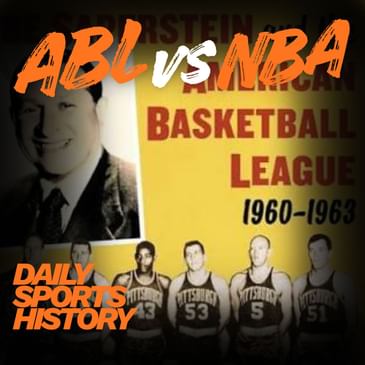
So imagine you were promised something amazing, life changing and then they took it all away. That's exactly what happened to Abe Sapperstein when he was promised an NBA team and the NBA said sorry, and so he got his revenge by trying to start his own league in the American Basketball League, creating innovations in nineteen sixty one that changed basketball forever. But you've probably never heard of it. It only lasted for two years. Sadly, money, as it always is, was the issue. Join us today as we dive into the history of the American Basketball League in nineteen sixty one today on Daily Sports History. Welcome to Daily Sports History. I'man Theores, your guide because my best basketball shot is a behind the back three pointer. So the American Basketball League was actually officially started back in the early nineteen hundreds. It's one of the first professional basketball that he's ever started. But as the Great Depression does, they folded because of money. During the name Actually, apes Aperstein did something quite amazing. He started a Harlem Globetrotters and little by little they became the greatest barnstorming basketball team ever and still to this day one of the most entertaining basketball you can watch, and Abe was the founder and promoter of that team and actually had that team beat NBA teams in the day. So he had a connection with the NBA and he was promised after the Globetrotters did multiple double headers for the NBA and that goodwill, he thought would give him an NBA team in Los Angeles. Unfortunately, NBA execs allowed the Minneapolis Lakers to relocate to Los Angeles, and because of that, apes Aperstein's application was denied. Obviously, he felt betrayed and instead of trying again for another team, as at that time the NBA had eight teams, it was hard to get a team, he decided, why not just start my own league. The NBA is not too big. I can't beat him. In fact, his Globetriters had beaten the NBA before, so that's what he did. He started to think about this new league in nineteen fifty nine, working with the National Alliance of Basketball Leagues owner Paul Calhoun and George Steinberder. Yeah, that George Steinbreder, who had an AAU championship team called the Cleveland Pipers, and they together assembled more leadership groups to start teams and raise some money for some competitive salaries, because if the salaries were competitive, they may be able to attract some big name players. And Abe knew about how to get players. He was able to get great players to play for the Globetriters because the NBA had strict rules. He had to play four years in college to be able to play in the NBA. Well, one way you ran that is you don't have college requirement rules. Instead, you take anyone who wants to play, and this really opened up the gates and they decided to launch with eight franchises in the EA East and West, really showing that they could compete with the NBA, who also only had eight franchises at the time. Those franchises were the Chicago Majors owned by Abe sapristein, the Cleveland Pipers owned by George Steinbrenner, the Pittsburgh Grins, and the Washington Tapers. For the West, they had the Hawaii Chiefs, the Kansas City Steers, the Los Angeles Jets, and the San Francisco Saints. Now, what their plan was was that ABL would build with local promoters, so it would have business owners and people that were from the area to really boost the team up because they knew the area, they knew the other businessmen, they knew how to get sponsors and recruit locally and attractive veteran NBA talent to get fans to respect the league and want to come see them. And Abe Saberstein appointed himself the commissioner of the league, and he held substantial influence over the rules in the direction. And he also owned the Chicago Majors, which meant he had an end to push out the Chicago Packers, the NBA team in Chicago at the time, from their venue of the Chicago Stadium. So the American Basketball League held their opening press conference, and he declared the league would advance basketball in ways the NBA would dare not do. It would be the future of the game. They were focused on speed and scoring, and one way to do those two things was wide in the lane, allowing big men to have to step out from the paint more and allowing shorter guards and forwards to get in the paint and score more. And also the innovation of the three point shot. They said it at twenty five feet and this shot would be worth three points, allowing shorter players to score more. And the score to be higher, and this one innovation would stick around and be the legacy of the American Basketball League. Though many saw these changes as gimmicks, but Abe knew a quicker, more fun game from playing with the Globe Drivers would lead to more and more fans joining. So now they had their teams, they need to get some players. Now. Abe didn't have the financial stability at the NBA at the time, so he was trying to be very strategic in his players. Now, at the time, NBA players are making roughly fifteen thousand dollars a year, which is roughly one hundred and fifty thousand dollars a day now allary cap for the American Basketball League, and teams could pay whatever they were willing to pay, and sometimes it was even higher than the top NBA talent. Although we don't have the exact numbers, they were able to attract some pretty good players. Some of the key players that they were able to attract were Connie Hawkins, who wasn't in the NBA at the time. He was actually banned due to being involved in a college gambling scandal, and he would actually go on to excel, winning the MVP the first year and would later be able to join the NBA after winning a title with the ABA, and would join the NBA and become a Basketball Hall of Famer. Then there was Jerry Lucas, who signed with the Cleveland Pipers when the top college and Olympic stars who joined before He became an NBA All Star in Hall of Famer as well. There was Bill Bridges who played for the Kansas City Steers who went on to have a successful NBA career after this too, and many others would eventually make the lead from the American Basketball League back to the NBA shortly after it folded. Now, to get these players, there was actually not a normal draft. This was a localized draft. You would get two territorial picks, enabling them to spotlight local college players and blacklisted talent, packing the roster with great athletes that were from the area that the area had already followed when they were in college, and then they would go for players that had been in the NBA or were fringe NBA players to join their league as well. And their draft actually took place in Chicago March nineteen, nineteen sixty one, over one week before the NBA, and this actually proved as a helpful strategy as they would get the first crack at some of these players now. So the winner of the East Division was the Cleveland Pipers, who won forty five and they would go on to face the winner of the West Division, the Kansas City Steers, who won fifty four games that year, and they were able to have the first two games played in Kansas City, and they would win those first two games by a wide margin, winning by twenty five points in the first game and thirty six in the second game. Many thought the series was over as it was a five game series, but they headed back to Cleveland where George stibrend got his team ready and they won the next two games before heading back to Kansas City. Except George Steibretterer was mad and he actually had the team not show up for Game five and had them reschedule for the next night at a college venue because he thought the game should have been played in Cleveland. But he relented and did play the next night, and the Pipers clawed their way back and thrilling comeback to defeat the Kansas City Steers one six to one O two, winning the first championship and only championship in the iteration of the American Basketball League because the American Basketball League struggled financially. If you've looked at any league that started ever they struggled their first year. They almost always lose money. It's hard to make money in this industry, especially if you don't have TV rights, which wasn't very common back in the day. So without TV deals or anything, they lost over a million dollars at the time, which would be well over ten million dollars a day. And they began the next season and they would go on to lose two hundred and fifty thousand dollars playing only half a season as a folded halfway through the season on New Year's Eve nineteen sixty two, and the Kansas City Steers had the most wins at the time and were named the Dispacto Championship of that season. So, after losing millions of dollars, the ABL was no more, But that didn't mean George Steinbrenner would stop trying to be his team. He took this Cleveland Pipers team from an AAU team all the way to a professional team, and he was ready to try to get them into the NBA. He contacted the NBA showing that they were a good team, they won the American Basketball League Championship. They were ready to go. They had young future NBA players on their team, but sadly, the NBA did not go for it and they declined to let him merge into the league as they didn't want to expand the league until the ABA came along forcing their hand, so they shut down everything and when nineteen sixty three started, players, staff fans were shocked and had to find new opportunities. Some were able to find opportunities in the NBA or other semi pro leagues. Others had to just end their professional careers. It was a short two year window, but it showed the success of the three point line and the scoring that it allowed. And the ABA had the three point line when they merged with the NBA, and when they completed the merger, they decided to add that in as it was a good innovation for the game and today the NBA would be nothing without the three point line. It has changed the game tremendously, giving us it way more scoring and allowing shorter, skilled guards to have great opportunities and allow big men to step out and learn how to shoot. It's been a fun iteration of the game, and it all goes back to the American Basketball League in nineteen sixty one, whose impact will always be felt on basketball due to this one rule change that will always be with the NBA. I want to thank you for listening to today's Daily Sports History. If you'd like this, please share this with a friend. Tell them check out this, learn about the ABL so you guys can be basketball historians together, and come back tomorrow for more Daily Sports History.