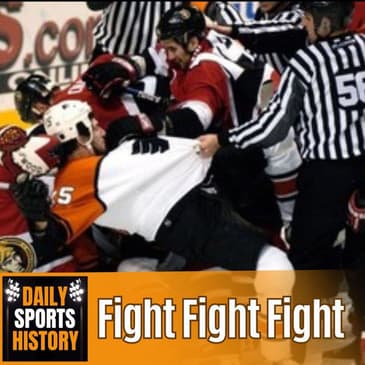
- Record-breaking penalties: A total of 419 penalty minutes was racked up in this unforgettable game.
- Enforcers clash: Key players like Chris Neil and Donald Brashear led the charge in a historic brawl.
- The breakdown of order: Multiple major fights, a line brawl, and misconducts led to total chaos.
- The legacy: How this game impacted the NHL and its approach to violence in the sport.
- Player highlights: Key figures from both teams, including Zdeno Chara, Mike Richards, and Jeremy Roenick, who played critical roles in the fracas.
Buy me a coffee: buymeacoffee.com/dailysportz
Newsletter: https://substack.com/@dailysportshistory?r=3en496&utm_medium=ios&utm_source=stories&shareImageVariant=light
DailySportsHistory.com
Email: dailysportshistory@gmail.com
YouTube: YouTube.com/@dailysportshistory
Twitter: twitter.com/dailysportshis
Facebook: facebook.com/profile.php?id=61551687917253&mibextid=ZbWKwL
On March fifth, two thousand and four, the Ottawa Senators and the Philadelphia Flyers faced off in a game that would become legendary. But it wasn't for how many goals were scored. Instead, it was for the record shattering night they had in the penalty box, with a night of chaos and fights in a total of four hundred and nineteen penalty minutes, the most penalty minutes in NHL history in a game that spiraled into madness. In this one game led to change the game forever. Today, we're going to dive into the penalty box. That was a break down most penalty minutes in a single NHL game today on Daily Sports History. Welcome to Daily Sports History. I'm Ethan Reese, your guide as you daily learn more about sports history, increasing your sports knowledge. In today's trivia questions, listen nowt for was what was the previous record for the most penalty minutes in a single game. Listen throughout the episode to hear the answer, and if you miss it, I will give it to you at the very end. There are multiple types of penalties, so we're gonna briefly break them down. There are minor penalties and these are the most common and they're small infractions like tripping, hooking, holding, slashing, roughing, high sticking, eboeing, boarding, and charging, and these give players usually a two minutes in the penalty box, and while the player is in the penalty box, their team has to play shorthanded and the posting team gets a power play, and then if the team scores while in that power play, the penalties player comes back to the ice. Now there are major penalties, and these are more severe infractions, more for like fighting, and these infractions give the offending player five minutes in the penalty box, but they do not return if the team scores, giving them an even longer power play. There are misconduct penalties that result in ten minutes in the box and these are a reserved for you abusive language towards the ref, continuing an altercation after it's been broken up, and unsportsmanlike behavior, and these can give a player ten minutes. However, the penaltized team can substitute a player so they don't have to play short handed that long into the game. And then there is also a game misconduct penalty which can result in ejection from the game, though they can't substante though the team can substitute the player, and this is also given to continuous abuse of the official gross unsportsmanlike conduct and certain extra violent fighting and violent conduct. And there are instances where there are penalty shots that are usually not connected to penalty minutes, but there are anything that disrupts the game itself. The penalty shot is not so much related to penalty minutes. And we mentioned before in case you didn't know, a power play is when a player is in the penalty box and the other team has the advantage because they have more players on the ice versus the other team. Now there are five players besides the goalie on the ice at one time, and so normally you have a five on four advantage, and the most you can have is a five on three advantage if you have two players on the same team in the penalty box, and this gives a huge advantage. And this can also gain even more by pulling your goalie and having six attackers versus the three defenders. In certain situations, it's giving you a six to three advantage. And then if a player is in the penalty box and they have already the maximum players in the penalty box, then and another penalty is given. That penalty accrues to the players that are already in the penalty box. So it's a unique structure and it makes hockey very exciting because you're gonna have these fights happen all the time in hockey. Hockey is a rough sport and it's a unique way of doing things. Just imagine if you took basketball players off the court if they got a foul, it'd be a completely different game and be fun to watch. I'd love to see kind of that mixture of the two sports if possible, but that's for a different episode for now. Let's dive into what led to this game being a record setting night. So coming into this year, Ottawa had just come off a great season where they made it to the Eastern Conference Finals only to lose out to the eventual champs in the New Jersey Devils, and their coach Brian Murray was leading one of the most dangerous offenses in the league and the team came in with only one goal this season to win that Stanley Cup. And the Flyers came in as an up and coming team led by coach Ken Hitchcock. They were one of the most physical teams in the League and would downright intimidate most teams with their aggressive nature with hard hits and no hold bar's style of play. They had finished fourth in the East the previous year, getting knocked out in the first round, and were ready to try to make a bigger splash. And there was a growing rivalry between these two teams, and we're battling it out to not only make the playoffs, but get home ice advantage in the Eastern Conference. And by this time the NHL had an issue where penalty minutes were actually on the rise, and more and more games were getting more physical and there were more fights. Now, someone argue, yes, everyone loves the fights, but it does take away from the game. Hockey is a physical nature, and you're gonna have fights, and people get upset, and there's gonna be injuries, and there's gonna be enforcers. That's just how hockey is. But the more you have it, the more the flow of the game is stopped with every single fight. And even though fights are fun, offense in every sport is more fun than just the fights. If you want to see a fight, you can watch boxing or mma. You watch hockey because you want to see these great athletes do amazing things on the ice that most of us can barely walk on the ice, let alone go at these speeds that these players go at. And in the two thousand and three season, there were multiple times when Ottawa and Philadelphia had broke out into fights and had altercations, and it just kept building up more and more. The more they battled in the standings and battled each other in every game they had, and as a playoffs being closer and each team came into the game with thirty five wins, they were each looking for an edge in the playoff fight. But when the puck dropped on March fifth, two thousand and four, no one knew the records that were about to be broken. From the first face off, you saw the two teams different styles, as the Flyers were known as the Flyers took their hard nosed, physical approach and wasted no time trying to establish their dominance. But despite Ottawa being known as the offensive juggernaut, they weren't backing down from a fight. Scoring just four minutes into the first period. Chris Neil of Ottawa opened up the scoring, giving the Senators the lead, but the Flyers took back the lead with Claude Lapointe and mark each scoring back to back. Then Danny Markov added a third goal for Philadelphia, giving them a two goal lead, and the only penalty that was assessed was a holding against the Flyers in that first period. Now both teams. In the second period, an early tripping penalty was called against Ottawa Mike Fisher, putting the Flyers on a power play, and during this Kim Johnson extended the Philadelphia's lead four to one. Now Ottawa had high flying offense and they were trying to fight back, but they received another penalty less than a minute later, sending Todd Simpson to the penalty box. But then the Flyers got a slashing penalty and gave the power play to the Senators where they scored another goal, making it a two goal gap. And in the third period, Alexis Zahamnoff notched the fifth goal for the Flyers, giving them a five to two lead in the game. But shortly after, the Flyers were given nine minute penalties for roughing and later had two players get three minute penalties for roughing as well. Now these are roughing is just an altercation between between two players. It's kind of like a shove or a punch but not dropped out and fight where the players are actually have their hands up to each other, and the Flyers actually got another penalty when they had too many minutes on the ice, and then with just one minute and forty five seconds left to go in regulation, the enforcer for Ottawa, Donald Brushier, hit Robert Ray, the enforcer for the Senators, igniting a fight between the pair, and this seemed to be repribution for the last game when there was an unnecessary slashing penalty that they took offense to. Now Brasher seemed to win the fight, as Ray was left bloodied and Brasher was escorted off the ice, and doing so, he exchanged blows with two more Ottawa players and this led to an outright fight on the ice where different players were pairing off to fight each other, and even the Goldies came out to the center ice to fight each other. This just looked like a knockdown street fight and eventually they settled everything down and there were two new goalies put into the game and the Senators were on a power play. But within three seconds of the game starting again, another fight broke out and there were multiple fights going on at the same time, and each time they would restart, there'd be another fight that would start, so much so that the fans started to boo the game. Fighting was fun for a little bit, but it was just not fun at all during this game because it stopped the game entirely, as even though the Flyers were in the lead and looked like to win the game, they just would not have the game in with all the fights. Now, with just under a minute left, they were able to get everything settled down and in the game without another fight, with a score being five to three, with the Flyers winning the game, and after the game, Jason Spiza of Ottawa received the most penalty minutes with thirty five, with the Flyers Donald brash Are getting thirty four, and the Senators rable score a final goal with just thirteen seconds remaining on a power play, ending the game at five to three, and it took the officials ninety minutes to allocate all the penalties that had been given to each side after the game. In total, it ended up being four hundred and nineteen total penalty minutes in NHL record, bringing the previous one of four hundred and six set in nineteen eighty one when the Boston Bruins faced off against the Minnesota north Stars, with the Philadelphia Flyers getting the most with two hundred and thirteen penalty minutes, which was a new record, and there were four hundred and nine penalty minutes assessed in just the third period. It's crazy. In the entire game there were just ten penalty minutes prior to the final period. Just goes to show you everything built up and everything just exploded at the end. And this wasn't the last game these teams would face off. They were face off one more time the season. In the next game, the Senators won and there was only six minor penalties that entire game, as both teams had shaped up and were really fighting for the playoffs and focused on that instead of the rivalry they had between each other. Now, this was a record that the NHL did not want. They knew scoring and offense sold more tickets and got more people to watch. The fans booed even though there was a ton of fights in this game, because they just wanted the game to play, and they changed rules that the following year mainly because of this game to manage the violence that was on the ice, and the next year they would test out a new role where the instigator. If a game is conduct penalty received five minutes in a one game suspension could also be fined as well. This was hoped to curb the fighting and it has had a lot of success. Fighting is still a part of hockey, but it is less so and mainly because of this game. In all sports, violence happens, and most sports started out more violent. When football first started, players died. Hockey had similar issues. Basketball was a lot rougher than it is today and over time, with safety and concerns and just the joy of watching the game, violence has shifted away from sports, which I think is a better thing because we get a more pure sport to enjoy for years to come. I want to thank you for listening to Daily Sports History and if you want more hockey, check out the Empty Betters podcast where they provide you all the hockey news coming up and it is a great source to better your income through hockey bets. And if you enjoy today's episode, please follow us on our social media on Twitter, Instagram, Facebook, Blue Sky and threads. We'd love to connect with you and there you can see pictures and videos from our episodes and Come back tomorrow for more daily sports history. And did you catch the answer to today's trivia question. What was the previous record for the most penalty minutes in a single game. It happened in nineteen eighty one when the Boston Bruins took on the Minnesota north Stars, where they had a total of four hundred and six penalty minutes.