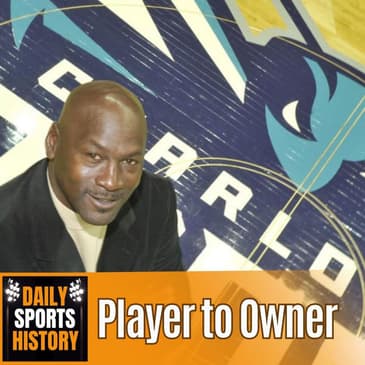
🏀 Jordan’s transition from player to owner and the challenges he faced.
📉 The highs and lows of his tenure, from the worst season in NBA history to rebranding the team as the Hornets.
💰 How he turned a $275M franchise into a $3B powerhouse and reshaped athlete ownership.
🔥 The impact of Jordan’s ownership on the NBA and the future of athlete-driven investments.Listen now and discover how MJ's business moves changed sports ownership forever!
Buy me a coffee: buymeacoffee.com/dailysportz
Newsletter: https://substack.com/@dailysportshistory?r=3en496&utm_medium=ios&utm_source=stories&shareImageVariant=light
DailySportsHistory.com
Email: dailysportshistory@gmail.com
YouTube: YouTube.com/@dailysportshistory
Twitter: twitter.com/dailysportshis
Facebook: facebook.com/profile.php?id=61551687917253&mibextid=ZbWKwL
On March seventeenth, twenty ten. Michael Jordan didn't just change the game of basketball. He changed what a former player could do when he became the first ex player to be a majority NBA owner when he paid two hundred and seventy five million dollars to buy majority stake in the Charlotte Bobcats, taking his greatness that he had on and off the court to support a franchise to try to win another NBA championship and redefine what is possible for a player to come from nothing to become an owner in one of the richest leagues in the world. Today, we're going to dive into how this happened after his legendary career on Daily Sports History. Welcome to Daily Sports History. I'm Ethan Reese, your guide to a rapid deep dive into sports history every day. And today's trivia question is who was the very first black owner of an NBA franchise? Listen throughout the episode to catch the answer. If you miss it, I will give it to you at the very end. Now, this wasn't Michael's first step into ownership or even into a non player role on a basketball team. See after he retired in nineteen ninety eight. He was looking to get back into basketball somehow, and that's when in two thousand, that's and that's when in September twenty fifth, two thousand, he was named president of basketball Operations by the Washington Wizards. This was a groundbreaking move as he was one of the greatest players of all time, but it's also a move that has become more common nowadays. Now we see Danny Ainge, who transformed the Boston Celtics and kicked off the Big three type of super team when he got Ray Allen, Kevin Garnett, and Paul Pierce together with the Celtics. But there's been others like Mitch Kupchek, former player who had success rebuilding the Lakers after Shaquill O'Neil departed. And there's been Jerry West helping with LA teams, and Larry Bird helped pay the way for the Pacers as well to be a contender again in the East, and Joe Dumars helped lead the Pistons to a championship in the early two thousands. These are just a few of the players that stepped into roles and had success after their playing careers, but Michael who's one of the best of all time. They thought his legendary basketball IQ would have success off the court, and he took immediate responsibility rebuilding the roster with draft picks, trades, and player development, including one of his major moves selecting Kwame Brown as the number one pick in the two thousand and one NBA draft. A high school kid who had all the tental in the world, but sadly not confidence and was able to develop in the NBA is now known as one of the biggest busts in NBA history. But being this involved in the game made Jordan want to return to the court, which he did on September just one year after taking the position with Wizards, and he signed a two year contract at the age of thirty eight, and he donated his tire first year salary to the nine to eleven Relief Fund. And despite his advanced age, he still was able to average over twenty two points a game, five assists, and five rebounds before having to shut it down due to a knee injury, and the next year he came back and again scored over twenty points, six rebounds, and three assists, playing in all eighty two games. Becoming the first player to score over forty points in a game at the age of forty or older. But he would retire after this third time, ready to return to his executive role, but the Wizards had other ideas and due to relationships strains and franchise lack of progress, and they fired Jordan and Jordan realized he needed full control of a team and to do so, he needed to become an owner of a team. And Michael actually did pretty well for himself while he played in the NBA, making a total of ninety million dollars from his salary in the NBA, which would give most people a great living for the rest of their lives. That's not all he did, as we all know, he started the Michael Jordan brand with Nike, and he had other huge sponsored endorsement deals with Gatorade, Hines, McDonald's, and many more. And it's estimated that he has had over two billion dollars worth of endorsements in his career and is continuing to earn more every year than he ever made in the NBA, which puts him at a unique experience where he has more money than any other NBA player that had played the game before This would be the first time a former NBA player became an NBA owner, breaking that barrier between ownership and player, which is a which is something that has never been broken before and is always at odds. We always hear about the collective bargaining agreement or the strikes that they have in the NBA and other sports. These are ownership fighting against players making deals of how much is going to be paid. So this was a major point in NBA history. So in June two thousand and six, he made his first step forward in purchasing a minority stake with the Charlotte Bobcats, the newest expansion team founded in two thousand and four. Now he may wonder why he joined these teams, the Wizards, the Bobcats, and Charlotte and not the Bulls, his team that he had been with forever. Well, it's because of where he's from. He grew up in North Carolina. He played at North Carolina at UNC where he won a championship, and so he still lives in North Carolina. Chicago was his home when he played, but wasn't his real home, and so he wanted to be closer to Charlotte. And not only was he man at Jordi owner, he took over the basketball operations role, which is mainly the person that decides who's on the ross, who they draft, all the trades they make, and he struggled. His first draft pick was Adam Wirison at number three in the two thousand and six draft, who became a bust due to injuries and only averaged seven points a game in his NBA career. And then he made a change in two thousand and seven after they had one of the worst NBA records ever, only winning twenty six games the previous year. He hired Larry Brown, who was an experienced NBA coach who has won at both the college and NBA level. But this still wasn't a match made in heaven. Although they did improve making the playoffs, they still struggled to really be a dominant team. Then, on March seventeenth, twenty ten, was a day that changed everything when Bob Johnson sold majority ownership to Michael Jordan for a total of two hundred and seventy five million dollars. Now, this was also important because Bob Johnson, who we probably recover in a future episode, was the first majority black owner of an NBA team, which was a game changer in giving the reins to Michael meant that there was still a black owned team. Then in April that year was the first month was when the Bobcats made their very first playoff appearance in franchise history, winning forty four games that year. Michael Jordan's presence increased ticket sales, gave them national attention, and provided sponsors for the team, making them more successful, but the team wasn't more successful on the court. They did have their moments, but during the twenty eleven lockout season, where they only played sixty six games, the Bobcats struggled, winning only seven games. Now only there was a shortened season, that's why it was so low. But their winning percentage was ten percent, the worst winning percentage in NBA history, worse than the nine win seventy six ers in the nineteen seventy two season, and the team closed the season losing twenty three consecutive games. The reason was they struggled with talent. They had Kimba Walker, who was a rookie that year but would later on become an All Pro. Corey mcgetty, a rotational player throughout his whole career, was their team leading scorer at fifteen points. Due to this, they were hoping to get the number one pick in the twenty twelve draft, but due to the lottery system, they did not win that pick and they got number two. Number one that year was Anthony Davis, a guy that went on to become All Pro in the NBA. Champion said they drafted his teammate out of Kentucky, Michael Kidd Gilgris, who never became a star or anything. This continued poor drafting made it very hard for this team to have success as they weren't a major market and they could not attract high profile talent. But then some positivity came back. Now the reason why the Charlotte Bobcats had that name because previously they were the Charlotte Hornets, but the Hornets moved to New Orleans and played it in New Orleans under their Hornets name for a few years and then changed their name to fit more of a New Orleans theme, and the name Hornets was given back to Charlotte, giving back to their more glory days when they had a lot of success in the nineties with Larry Johnson, Muggsy Bogues and Alonzo mourning, and in twenty fourteen, they officially rebranded the Bobcats to the Charlotte Hornets, and it was overwhelmingly positive. Merchandise sales skyrocketed and attendance increased, and they showed signs of life. The previous year, they signed Al Jefferson, who became an All NBA selection, and this duo between Al Jefferson and Kimba Walker helped lead them to the playoffs with the best record in franchise history under Jordan with forty eight wins, winning their first games in playoff history, pushing the Miami Heat to seven games in the first round, but eventually losing. Now, as an actual NBA owner, Michael Jordan was great, was a great name for the league, was a drawl for many players and many fans. He helped grow their wealth and success. In twenty ten, when he bought the team for two hundred and seventy five million dollars, it was one of the cheapest teams in the NBA, but in twenty twenty three, the franchise value had skyrocketed to over three billion dollars. This is due to broadcasts due to increase TV revenue as the NBA broadcast deals have skyrocketed as well as sponsorship, and the rebranding of the Nets helped increase ticket sales as well, but over time they still struggled to put a good team on the court. They eventually let Kima Walker go to another team, leaving them without a star, and in twenty twenty they drafted the Mellow Ball, who has shown promise as a young star, but they still lack successful pieces around him, and after thirteen years of ownerships, Jordan decided to sell his controlling stake in the team, selling for three billion dollars to a group led by Rick Schnall and Gabe Platkin. However, he would retain minority stake on the owner minority stake in the team, but this also meant he would also give away his role as the president operations, showing sometimes a great player does not make the greatest valuation of talent. Some have done great. Danny Inge is known as one of the greatest traders in NBA history, so much showed that teams don't even want to trade with him as they feel like they're gonna get fleeced somehow. So there are former players that have had success at the front office, so Michael Jordan has had as much success as others, but he's still involved in the game, taking a struggling small market team to a huge evaluation and gave a city its basketball identity back. But maybe now that he's stepped away, they have a chance to become an NBA champion. It's also led the way for lots of other athletes to become owners in other leagues. Lebron James has a minority ownership in Boston Red Sox in the Liverpool soccer team. Shaquille O'Neal has a minority ownership in the Sacramento Kings. Dwayne Wade has an ownership stake in the Utah Jazz. The list goes on and on. These players are making more and more money outside of the game, which is great for the game and great for them and is allowing them to have ownership in these teams, which was something that was unheard of in them previously, as these teams are normally older teams that have been around for years and years, and to buy into them takes millions and now billions of dollars, But these players are getting close. More and more players are becoming billionaires and having a chance to have ownership stake in some of their favorite teams. And this is all thanks to one of the greatest players of all time. Even though he wasn't the greatest front office man, his ownership ability changed the way for athletes to jump into ownership of their own after they step away from the game as well. I want to thank you for listening to today's Daily Sports History. If you liked this episode, please let us know, leave us a review wherever you're listening, or send us an email at Daily sports Hisstory at gmail dot com. Let us know what you like, what you think we can do better, and come back tomorrow for more Daily Sports History. And did you catch the answer to today's trivia question, who is the very first black owner of an NBA franchise? The answer is Robert Johnson, whom Michael Jordan bought the Charlotte Bobcats from.