Check out UndeBeatable
http://theundebeatables.com/podcast
#DailySportsHistory, #JerryHarkness, #BasketballHistory, #FullCourtShot, #SportsLegends, #BuzzerBeater, #HistoricShot, #SportsPodcast, #BasketballLegends, #UnforgettableMoments
Buy me a coffee: buymeacoffee.com/dailysportz
Newsletter: https://substack.com/@dailysportshistory?r=3en496&utm_medium=ios&utm_source=stories&shareImageVariant=light
DailySportsHistory.com
Email: dailysportshistory@gmail.com
YouTube: YouTube.com/@dailysportshistory
Twitter: twitter.com/dailysportshis
Facebook: facebook.com/profile.php?id=61551687917253&mibextid=ZbWKwL
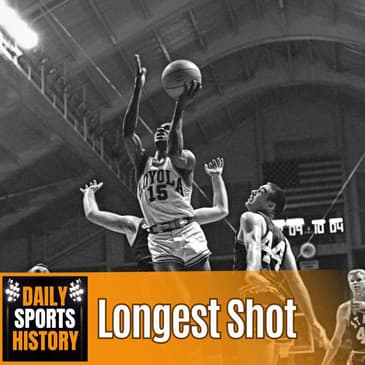
Nineteen sixty seven, the Indiana Pacers were taking on the Dallas Chaparrals in an aba clash and with one second left on the clock, and the Pacers were down one sixteen to one eighteen, and they took the ball to Jerry Harkness who gave a last second heave from ninety two feet away seeking the shot, giving the Pacers the win one nineteen to one eighteen. Today, we're going to dive into how this happened and how hard is it to make these full court shots? Why this record I will never be broken? Today on Daily Sports History. Welcome to Daily Sports History. I'm Ethan Reese, your guide as you daily learn more about sports history, increasing your sports knowledge. As today we learn about the full court shot. And today's trivia question to listen out for is what is the longest shot ever made in an NBA game? So to start this topic, we first need to know about the dimensions of the court. Now, the dimensions of a professional basketball court are ninety four feet long and fifty feet wide. Now that's the same in the NCAA, but high school is about ten feet shorter but the same width across. Now, when basketball was first created by James Nasmith. He didn't put in any of the rules how big this size needed to be. If you know anything about his rules that he first created. It didn't matter how many players were on the team, didn't matter where you played, just that you had a hoop and a ball. Those were the main basics, so you could play this game anywhere. He played outside, he played inside, and you have a short ceiling, the tall ceiling, it didn't matter. It was just to play. But as the game continued to grow, in nineteen twenty four, they officially named the size of a court to be a maximum of ninety feet by fifty feet and a minimum of sixty feet. And back then they didn't have a three, they didn't have a key. Free throw lines came in later, so really the size was kind of in flux. But over the years they played around with what would be the best fit. As they went down to just five players per game and they started a key and a free throw line, they needed to be more uniform as they played, and as they started to have more leagues, and then the NBA started, then they made their dimensions standard. And when the ABA started up, they also took those dimensions, although they started with a three point line, which made it even more interesting, and this is why the Pacers were actually able to win that game against Dallas. In nineteen sixty seven see nineteen sixty seven was actually the first year the ABA started, and we have a we actually have a previous episode talking about how the ABA actually got started. In that year, the league consisted of a total of eleven teams, five in the East and six in the West, and Dallas was in the West and the Pacers were in the East, so this wasn't East versus West challenge, and Dallas was actually one of the better teams in the league, although both teams made it to the playoffs. The Pacers had a losing record that year and Dallas had won forty six games, finishing second in the West. And that season, Dallas had two All Stars on their team in Cliff Hagen and John Beasley, and the Pacers actually had three on their roster in Roger Brown, Mel Daniels, and Bobby Nittoliki, although in this game, mel Daniels would not play and the Pacers leading scorer was Freddie Lewis, and coming into this game, the Pacers were actually a very strong team, as they were twelve to three, but with the injury to mel Daniels, it caused them to have a tougher later part of the season and Dallas was only four and the game pretty much was dominated by Dallas, Cliffhagen, and Bobby Varga, who he scored over thirty points in this game. But the Pacers were able to keep it close as every one of their starters scored in double figures. But it was a guy off the bench that would make history on this day, and that was Jerry Harkness, who was born in Harlem but showed great promise in basketball as New York was a great basketball scene back in the day, and he was able to join the Loyola Chicago basketball team, where he was an All American and a captain when they won the national championship in nineteen sixty three. And they actually win and this team actually went up against Mississippi State was known as the Game of Change because Loyola started four black players against Mississippi State, who was a segregated team and wouldn't even play a game against black players until this moment. And there's actually a famous photo of Jerry shaking the hand of Joe Dan gold. Now, this was just the second round of the NCAA, so it wasn't the championship, which is why Texas Western gets more of the publicity because it was for a national championship and it was against the powerhouse in in Kentucky. But this was a pivotal moment as it was the first time Mississippi State was playing black players in the nineteen sixties, which is hard to fathom to us nowadays as the game has changed and the world has changed. And they eventually went against the Cincinnati Bearcats and all the starting five of Loyola played the entire championship game, upsetting the Cincinnati Bearcats and winning their first national title. After this, he would get drafted by the New York Knicks as the number tenth pick overall in the nineteen sixty three NBA draft, and Horgans played one season with them before joining the Twin City Sailors of the NABL which was a short lived NBA competitor that played for four seasons. Then after this he joined the Indiana Patriers of the ABA, where he would play two more seasons. But he was never a star on any of these teams. He was always just kind of a backup player, a guy that came off the bench to help support the team as much as he could, and that's what his role was with the Indiana Pacers. He was a backup player, but he had to play a little bit more, especially in this game without Milt Daniels. They needed some great players. They needed players to help compete, and as a game came close to an end, Jerry was out there helping lead the team and at the time, he only scored one other basket that entire game. He wasn't a huge scorer, as he only averaged seven points in his entire career, but being down two points with one second left, there wasn't very many options, and so the Pacers passed the ball into Hearken and he just threw up a hail Mary towards the goal. It hit the backboard and went in, and even though they were playing this game in Dallas, the crowd of two thy five hundred erupted as it was a crazy thing that no one had ever seen before. A shot that long. Now full court shots had happened before, but it was just a crazy moment and if they were playing in the NBA at that time, it just would have tied it, but because he was in ABA, Theria had a three point line which gave them three points and gave them the win, one nineteen to one eighteen. And this was such a new thing as the as the league was so new and the three point shot was so new, the team actually didn't celebrate that much. They were happy, they were excited, but they got together in a huddle getting ready for overtime, and then the official came over to them and said, no, the game is over. That was a three point shot. And Jerry didn't even know it was a three point shot. He was ready to go into overtime. But it was an exciting moment. And over the years as the ABA became joined in the NBA, there have been some long shots made, and there have been roughly ten shots made that were over seventy feet, so that's in the history of the NBA. It's always a last second thing, usually the end of a quarter or the end of a game, but it can still be very exciting. And the longest there's ever been was in the NBA was by Baron Davis, who was part of the Charlotte Hornets taking on the Milwaukee Bucks when he hit eighty nine yard shot which he threw like a football, and not only did he make it, it was nothing but net. It was a crazy shot that happened in two thousand and one. And the longest shot ever in an NBA playoff game was Magic Johnson where the Lakers were taking on the Denver Nuggets in nineteen eighty seven, where he hit an eighty four foot shot. Now the longest basketball shot ever made in any kind of form. Now this wouldn't be legal in the NBA because it's too long, was made in two thousand and two of a distance of one hundred and twelve feet made by Elan Bowler. And of course, in this day and age where we all love these trick shots, Dude Perfect actually holds a record for the tallest shot where they shot from eight hundred and fifty five feet up in the air to make one shot that took over four days to sync. These shots are all fun and we love the opportunity to see these shots be made, especially at the end of games like Jerry's was. It's a great honor that he has to have the long shot ever. But just like a lot of other games from the sixties, including Wilt Chamberlain's one hundred point game. We don't actually have any proof this happened other than reports and people there. There is no pictures, no film. It was just a memory for everyone there and something we just all have to imagine. If you want more Pacers content, check out the Undebeatables where they take you through everything you need to know about the Pacers, including recaps and all the news going on in and around the Pacers. We'll put a link in the description below for you to check them out so you can get all your Pacers content and maybe hit a full court shot on your next podcast selection. And if you enjoy today's episode, please leave us a rating or review wherever you're listening, and if you put a topic in that review, we will get that done just for you and come back tomorrow for more daily sports history. And did you catch the answer today's tribute question? Well, is the longest shot in NBA history and the answer is eighty nine feet, done by Byron Davis in two thousand and one,