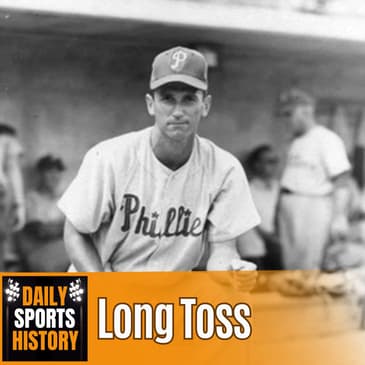
Join us on Daily Sports History as we explore the incredible feat of Glen Gorbous, who set the record for the longest baseball throw in history. Discover the story behind Gorbous' astounding 445-foot, 10-inch throw, the context of this remarkable achievement, and its lasting impact on the world of baseball.
#DailySportsHistory, #GlenGorbous, #LongestThrow, #BaseballHistory, #SportsRecords, #BaseballLegends, #SportsPodcast, #HistoricAchievements, #ThrowingRecords, #Baseball
Buy me a coffee: buymeacoffee.com/dailysportz
Newsletter: https://substack.com/@dailysportshistory?r=3en496&utm_medium=ios&utm_source=stories&shareImageVariant=light
DailySportsHistory.com
Email: dailysportshistory@gmail.com
YouTube: YouTube.com/@dailysportshistory
Twitter: twitter.com/dailysportshis
Facebook: facebook.com/profile.php?id=61551687917253&mibextid=ZbWKwL
On August first, nineteen fifty seven, Minor League outfielder and pitcher Glenn Gorbis set the record for the longest baseball throw in his Stump first team attendance. Little did he know that this record would stand for the rest of his life and long after, as it still is the record to this day. Here's a story behind all of this today on Daily Sports History. Welcome to Daily Sports History. I'm Ethan Reese, your guide to a rapid deep dive into sports history every day. And today's trivia question to listen out for is what Hall of Fame baseball player actually held the record for the longest throw at one time. Now, the first record for the longest baseball throw was set by John Hartfield in eighteen sixty five, where he threw the ball three hundred and forty nine feet and this was before professional baseball was the thing, and partly because of this, John would actually go on to join the Cincinnati Red Stockings as he was known for having the longest throw. And this was something that was measured back in the day as we didn't have radar guns or evan statistics and analytics that we have today. One of the skills done was how far can you throw the ball? Let you know if you were going to be a good outfielder, or if you could make that throw from third to first, which was a long throw and was something that was done regularly trying out in the early years of baseball. Now it's something that's not done today. As we want to keep players arms intact. We don't want to throw as far as we can throw, just like you don't want to throw as fast as you possibly can throw. You want it all to be under a controlled motion, and trying to throw as far as you can throw is often not a controlled motion. But maybe this is something they could add to the All Star event like the home run Derby at a longest throw competition as well. It'd be fun for the fans and get this back in the consciousness and allow a different type of event to happen for their All Star event which is really just mainly focused around the home run Derby, and be interest as you could put pitchers versus fielders, as many different kinds of players have held the record over the years. Now John would go on to break his record multiple times and we would eventually have the record at four hundred feet and seven inches and in eighteen ninety eight Hall of Fame third baseman Hornis Wagner threw the ball four hundred and three feet and eight inches, beating John Hatfield's record by over a yard, and it only took him three throws to beat the record, And this was again a promotional stunt which each player got paid sixty dollars at the time to participate, hoping to drive attendance to the game. Then in nineteen fifty two, Don Great of the Chattanooga Lookouts was able to throw a ball four hundred and thirty four feet, which at the time the Chattanooga team their park had five hundred and twenty feet from the center field wall to the backstop behind home plate, and it only took him three balls to throw that distance as it hit the top of the dugout where they measured it. And he would go on later to break his record throwing four hundred and forty one feet in one inch. Then we come to Glen Gerbaus, who grew up in Canada and actually grew up playing hockey as well as baseball and got noticed trying out for a Jodgers camp that they held in Cavalry and was able to make a minor league roster there. At the time, he was an outfielder and was struggling to find his way in the minor leagues, although he did top the three hundred hit mark four out of his five seasons in the miners, and in nineteen fifty five he actually was able to make it onto the Cincinnati Reds roster and played eight games before he was traded to the Philadelphia Phillies, where he'd played ninety one games. But he struggled hitting at the major league level, finishing with a batting average of just two thirty eight, and would eventually get sent back down to the miners after being traded at Saint Louis in nineteen fifty seven, where he'd play for the Cardinals Omaha team. And this is where he really took notice. As often before games, as he was warming up, trying to impress his teammates, he would throw the ball up into the lights, knocking out bulbs. So this caused the team to do two things. One, they wanted him to stop doing that so they didn't have to replace the bulbs, So they changed his position from being an outfielder to being a pitcher. As he had a very strong arm, and also they started a promotional event to see how far he could throw the ball and to see if he could set the world record, and they mentioned if he did so, he would get two hundred dollars if he broke the record, and that's all he needed to know. Making a little extra cash was more than enough for him. And on August first, nineteen fifty seven, on a hot, muggy day in Saint Louis, he took a running start and on his third throw was able to set the record at four hundred and forty five feet and ten inches. Now analysts have gone back and estimated that the velocity he threw the ball with was one hundred and fifteen miles an hour. And he was so sore that he didn't play that day's game as he needed to rest his arm as exerting yourself that much. And he got that two hundred dollars, which he blew buying beers for his team after the game. And sadly, this would be the last time that Glenn would make headlines or news, as his transition to being a pitcher didn't work out that great. Four days after breaking the record, he would make his pitching debut in a relief performance, pitching four innings, allowing just one run. But shortly after that he would make his last appearance as while pitching, they were trying to try some new things with him, and the coach asked him to maybe try a side arm pitch instead of the overhand, and when he did this, he felt a pop, and after that he shortly retired, as repairing arms back then was not what it was today, and he went on to go work for his family store up back in Canada. But he will always be remembered for what he did, throwing a baseball farther than anyone had ever done before and no one has ever done since now. Shortly after he broke the record, Don Greek, who previous actually had the record, was also in the minors and when they were going to play a game against each other and the teams got together to try to put together a match style competition to see who could throw the furthest that later fizzled out as these long throw competitions were not gaining the notoriety that the teams wanted for fans to come to the games, so they just decided not to do it now. Glenn later went on to be part of the Alberta Sports Hall of Fame. And though he may not ever been known for anything else other than throwing a ball further than anyone has ever done before, he was still a great ambassador to the game and loved the game as Sadly, a lot of these players back in this era were injured due to faulty mechanics, faulty workouts, and lack of knowledge from mechanics and workouts, and sadly we didn't have the knowledge of how to repair an arm to get back to pitching. But his name is still in the history books even after his passing in nineteen ninety following open heart surgery. And I want to thank you for listening to this episode, so please, if you like this, leave us a rating and review wherever you're listening. This one was a challenge to find information on and it was fun and I want to keep finding these lesser known information but I need support from you to help grow this so I can go off even more obscure and random sports history and come back tomorrow for more daily sports history. And did you catch the answer to today's trivia question? What Hall of Fame baseball player once had the record for the longest throw of a baseball. The answer hornis Wagner.