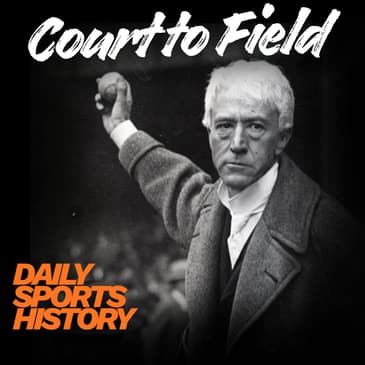
Kenesaw Mountain Landis commissioner, Black Sox scandal commissioner hiring, Judge Landis first MLB contract 1921, baseball segregation Landis role, 1919 World Series fix fallout, Landis lifetime bans Shoeless Joe Jackson, MLB commissioner powers history, National Commission dissolved, baseball gambling scandal cleanup, Landis integration petitions ignored
#KenesawMountainLandis, #MLBCommissioner, #BlackSoxScandal, #BaseballHistory, #ShoelessJoeJackson, #1919WorldSeries, #SportsScandal, #JudgeLandis, #MLBHistory, #DailySportsHistory, #BaseballCommissioner, #SportsHistoryPodcast
Buy me a coffee: buymeacoffee.com/dailysportz
Newsletter: https://substack.com/@dailysportshistory?r=3en496&utm_medium=ios&utm_source=stories&shareImageVariant=light
DailySportsHistory.com
Email: dailysportshistory@gmail.com
YouTube: YouTube.com/@dailysportshistory
Twitter: twitter.com/dailysportshis
Facebook: facebook.com/profile.php?id=61551687917253&mibextid=ZbWKwL
It's January twenty first, nineteen twenty one, in Chicago at the Congress Hotel. The lobby is ablaze with reporters as upstairs in a private meeting room, the most powerful owners of baseball are huddled around a table with fountain pins ready signing. Kinnisaw mountain landis a federal judd to become the first commissioner in any sports league in the United States, with hopes that he can change bas Ball as he has given unprecedented power to act in baseball's best interests banning players, changing rules, and making sure the game stays great. Question, Ni did he do that? Or was he as shady as the gambling men? For the reason why he was brought in joy us today as we find out about Kinnessaw mountain landis becoming very first sports commissioner today on Daily Sports History. Welcome to Daily Sports History. I'm Ethan Reese. You're a guide because I have a commissioner too, called my wife. So. Kinnesau was born in Ohio in eighteen sixty six, and he was actually named after a Civil War battle called Kenshaw Mountain where his father was wounded. It also led to just a great name if you want someone to lead an organization, and you have David Simon or Kennesaw mountain landis you're gonna go. And he was raised in Indiana and grew up an avid baseball fan growing up. But of course, as many do, they decide to go into something besides baseball, and honestly, at that point baseball wasn't what it was today. We don't know if he was any good at baseball, really, but he did love the game, and he would go on to go into politics, go to college, become a lawyer, to open his own practice, and then eventually be appointed a US district judge in Illinois by the President, Theodore Teddy of Roosevelts in nineteen oh five, and he built a reputation of a trustworthy judge. He famously fined Standard Oil, which made him a household name for being a monopoly. He was not afraid to take on these big companies. Monopolies were a common occurrence. The Sherman Anti Trust Act, if you don't know, is the Monopoly Act, and it was something not used very often, although it should have been. And this really was a landmark case, another landmark case that came to his front door and really led to him being in baseball, because even during this time, he still loved baseball. In nineteen fourteen, the Federal Baseball League brought an anti trust suit similar to the standard oil one, against Baseball, the entire Major League Baseball system, and they presented their cases, and he's like, I will adjourn and I will come back to you with my ruling. And he waited, and he waited because honestly, he didn't want to make a decision. He wanted them to figure it out. So he basically forced them to settle between themselves, and it kind of made baseball what it is today and really put him on the map of the Major League Baseball owners because they realized this guy likes the tradition of baseball. He didn't want to ruin it by making a ruling that probably actually would not have been in their favor. But it's not right after this that they go for the commissioner. No, it's still no commissioner. The league's just ran by the owners. And then in nineteen nineteen, the World Series happens, and most of us know the White Sox lost to the Reds. Well, maybe you don't know that the Reds actually won the World Series. But you remember that the Black Socks was a whole thing. Eight members of the White Sox were thought to have thrown the World Series, and a few of them were actually brought up on charges. And at this point baseball was worried, this isn't the only gambling scandal that happened. There had actually been multiple other ones, and there would be multiple ones to come after this. Gambling has always been a part of sports, and throwing fixing games is still a part of sports, as we've seen recently. And the owners of beanngjor League Baseball's teams got together and they were talking about what do we do. Do we make a committee, how do we make this better? Because they were worried they were gonna lose fans because fans thought every game was rigged, and if every game was rigged, why would you even want to go? And this was huge because these teams were starting to make a lot of money. So in doing this, they remembered, hey, do you remember that judge for the anti trust lawsuit we had with the Federal League. What if he joined us. He loves baseball, maybe he could be the commissioner and he is firm and he wants the best for baseball. So they contacted him about this, and he agrees to be a part of this, but he insists on a few things that really were actually good things to insist on. One, he wants to be the sole commissioner. Whether that's a good thing or a bad thing, that's debatable, but he wanted to be the sole commissioner. He didn't want to committee because that would delay everything and make things even harder. But he also wanted broad power to act in the best interest in baseball. So this means he could make sweeping changes, he could ban people, he could change rules, he could do anything that made baseball better. And sometimes he did, maybe sometimes he didn't. And with these demands, the owners thought these were good. They thought, that's actually easier because we don't have to find multiple people. He's the president like the United States, and giving him the absolute power also is good as long as he's acting in the best interest of baseball. So they agreed to these terms, and they offered him fifty thousand dollars a year, which is just under a million dollars today. Yeah, and you know what's crazy. He also told him he wanted to remain a judge, but he wasn't gonna take this money on top of what he was doing. So he's like, subtract my salary from being a judge, and I will take the additional salary. So his salary would be still fifty thousand dollars, which was pretty good money. It was, and he would actually take a pay cut during the Great Depression because baseball was hurting. So he officially took the position over and he made some sweeping changes. See in nineteen twenty one, those eight White Sox that were accused of fixing the game, well five of them faced trial and they were acquitted. Three of them didn't, but Kinnisall didn't care. The day after the trial, he banned all of them. It's not just a suspension band for life. And this really was a hard line in the sand about gambling. It was something that if he went soft, it could have backfired. Even though the great Shoeless Joe Jackson was arguably the best player of that series, he still took money and they don't. It was a zero tolerance policy. It's a policy that has stuck around in baseball today and led to the same policy in all other North American sports because sports. Gambling can ruin sports the same as it was in the nineteen twenties as it is in the twenty twenties. Over the next two decades, Landis would ban and declare dozens of players, owners and coaches throughout the years for gambling and other issue. But in nineteen thirty eight, he also freed seventy four Saint Louis Cardinal minor leaguers from their farm system because they were violating the rules. Now there's angered the executives of the team, but it also showed that he didn't take orders from the team. He did it for the best interest of baseball. Now his legacy would be capped. Now he would be the commissioner till nineteen forty four. So over two decades, and it was a good two decades. The league grew to the things. To the help of the likes of Babry and Luke Earricks, the league grew. It was more successful than when it started. But there was one thing that seemed early odd. He retired in nineteen forty four. The next year, Jackie Robinson signed with the Brooklyn Dodgors. During the whole time of his tenure, he kept the color line there whether it was just the status quo, or if he really thought that was the best interest in baseball. Maybe he did ignore a petition in nineteen forty two with over a million signatures from fans to lift the color barrier. He banned exhibition games against Negro League teams because he didn't he thought it would be embarrassing if they lost, and he publicly denied. He said there was no written rule or an unwritten rule. But it seems fishy. It's also a time when segregation was just the way it was. But it's hard to say whether he was or was not. We can't judge somebody off the way things were back then. The nineteen twenties the nineteen thirties were very different than the twenty twenties. K We're all kindness, saw Mountain Landis. His tenure as the first Commissioner of Baseball was a positive one. He stopped gambling, not completely, but he really corrolled after the White Sox scandal. He was able to bring baseball back into Providence. What the hell of Babe Ruth. But he was also able to make sure that gambling was out of the game, and he set a blueprint for the NHL. The NBA, the NFL would all follow this and they would all eventually have their own commissioner or president because they saw it was a good thing to have to keep the owners in check, to keep the players in check, and have that one person as able to do that, is able to run the whole league. It's not a bad thing. This change was good for sports overall. Question is do you actually like commissioners that I know most of us don't. I want to thank you for listening to today's daily sports history. It means a lot if you have some extra time. I'm doing some short videos online on our socials YouTube, Facebook, Instagram where I'm talking about random sports records. It's a fun time, great to check. I'll put a link down in the description for you to check those out, and I'll see you on the next one.