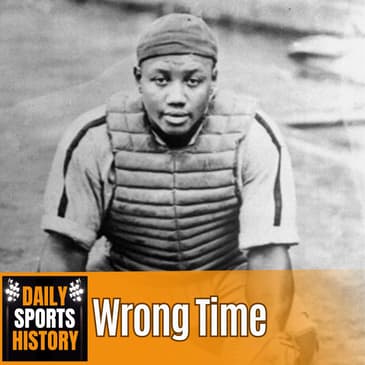
Discover the inspiring story of Josh Gibson, the Negro Leagues’ most powerful hitter and one of baseball’s greatest legends. From his early days in Pittsburgh to his record-breaking feats with the Homestead Grays and Pittsburgh Crawfords, explore Gibson’s journey through segregation, his unmatched batting stats (.372 career average, .718 slugging, 800 home run legend), and his lasting impact on the game. Learn about his Hall of Fame legacy, the recent integration of his stats into MLB records, and why Gibson is now recognized as the all-time MLB batting leader. Featuring key moments, legendary teammates, and the enduring significance of Gibson’s career for sports history fans.
Listen now! 👉 DailySportsHistory.com 📲 Follow for more daily sports history insights!
Email: dailysportshistory@gmail.com
YouTube: YouTube.com/@dailysportshistory
Twitter: twitter.com/dailysportshis
Facebook: facebook.com/profile.php?id=61551687917253&mibextid=ZbWKwL
Bluesky: https://bsky.app/profile/dailysportshistory.bsky.social
#JoshGibson #NegroLeagues #BaseballHistory #MLBRecords #SportsLegends #BlackHistory #HomeRunKing #BaseballPodcast #SportsHistory #HallOfFame
Buy me a coffee: buymeacoffee.com/dailysportz
Newsletter: https://substack.com/@dailysportshistory?r=3en496&utm_medium=ios&utm_source=stories&shareImageVariant=light
DailySportsHistory.com
Email: dailysportshistory@gmail.com
YouTube: YouTube.com/@dailysportshistory
Twitter: twitter.com/dailysportshis
Facebook: facebook.com/profile.php?id=61551687917253&mibextid=ZbWKwL
On June third, nineteen Homestead Grace catcher who go on to the Hall of Fame and hold the record for the best batting average in baseball history, showed off his power when he hit a ball feet from going outside Yankee Stadium, which was five hundred and eighty feet, the longest home run ever hit in recorded history. Gibson was a man who showed that catchers aren't just what they are behind the plate. They can master the offensive game as well with power and connectivity, and is often the most forgotten greatest player in baseball history. We're going to dive into what made him so great today on Daily Sports History. Let's go. Welcome to Daily Sports History. Am Ethan Reevees your guide as you daily learn more about sports history, increasing your sports knowledge. So Josh Gibson was born December twenty first, nineteen eleven, in Bueno Vista, Georgia, as the eldest of three children. He was looked to as a leader in his family, but life in Georgia was hard, especially for a black family under the segregation that was going on at the time, and his father struggled to provide ends meet as a farmer for his family. So seeking better opportunity. His family moved to Pittsburgh, Pennsylvania in nineteen twenty three to find work as a laborer at a steel company, and Josh ended his education after ninth grade as he left to help support his family, and he became an apprentice for an air brake factory and later would work as an elevator operator at Gimble's department store, which was a huge store back in the day. But Gibson showed a natural athletic ability, not only excelling in baseball, but was also great in track. But he became a baseball standout quickly made a name for himself in the Pittsburgh baseball team, and at the age of sixteen, he joined the gimbals Ac team. At this time, a lot of stores and companies would actually have their own amateur baseball team, similar to your work might have a softball team, dodgeball team, something like that. They did this back in the day, but they were a little bit more competitive. They would play other cities, they would traveled, and some were even so competitive that they hired people just to play on that team. And in nineteen twenty seven he actually joined the Pittsburgh Crawford, which was a semi pro team, and in nineteen twenty nine he joined the Crawford Colored Giants, another semi pro team that was recruiting. Now, what semipro means is you're receiving some financial compensation, but you're not relying on that compensation as your full time income. So basically it was his side hustle as we would call it today, and he began get a reputation as a powerful hitter in the Pittsburgh semi pro. Leagues began to fear him while he was at the plate, and in nineteen twenty eight, he would go on to meet his future wife, Helen Mason, who he would marry the following year. But tragically, Helen would die in nineteen thirty during childbirth, leaving Gibson as a widower to not just one, but two. She died giving birth to twins, Josh Junior and Helen. So this made his life even more difficult. Not only was he struggling as a black man in a segregated world, he was also struggling as a father deciding what to do with his life. And luckily, a month before Helen had passed, there was a path to professional baseball that gave him a chance at a greater success while attending a Homestead Gray's game as a spectator, the team's regular catcher, Buck Ewing, suffered an injury. When the Homestead Grays were a professional baseball team in the Negro League at the time and had been around for years as one of the top Negro leagues in the area, and Gibson was recognized for his power reputation, so the Grays co Judy Johnson, recognized him and asked him to suit up as a catcher for them, and Gibson made his debut behind the plate, elevating the Grays and helping them defeat the New York Lincoln Giants, and would continue to play for them, and in his first season while playing for them, he reportedly had a batting average of four hundred and forty one while hitting with a lot of power. Now, Gibson was rapidly ascending in the ranks of the Negro League, and by nineteen thirty one, he had already started mythical statuses and he was accredited for as many as seventy five home runs while barnstorming with the Grays, a figure while debated through the incomplete record at the time underscored just the reputation he had as a power hitter, and it wasn't just what he did at the plate, it's what he did behind the plate. He was doing this as a catcher, a position that is not notoriously known for having great hitters. If you look at the greatest hitters of all time, most of them are first baseman, third baseman, and outfielders. As catcher is a grueling position that really wears you down, but his defense was impeccable, having an accurate arm and surprising speed for his size, making it a rare combination of an elite hitter and top catcher. So in nineteen thirty two, Gibson joined the Pittsburgh Crawfords, a team assembled by Gus Greenley and is widely considered one of the greatest ever in the Negro League. The Crawfords roster featured future Hall of famers such as Satchel Page Cool, Papa bell Oscar Charleston, Judy Johnson, and Josh Gibson. His first year with him, he had thirty four home runs with a batting average of three hundred and eighty, and in the following four years he had a batting average of four hundred and thirty six, and in nineteen thirty four he had sixty nine home runs, and he would go on to become the second highest paid player in the Negro leagues, earning twelve hundred dollars a month, trailing only Satchel Page in the early nineteen forties. That would be over twenty six thousand dollars a month today. He was one of the richest black people in America at the time. Then he went on to play an exhibition game at Yankee Stadium where he reportedly struck the very top of the stadium, which would have been five hundred and eighty feet from home plate, and Buck Leonard recounts Gibson hitting the ball out of the Polo Grounds, which was estimated to be near the six hundred feet, which would be the longest home run ever recorded. In nineteen thirty seven, Gibson Will returned to the Homestead Grays in former partnership with first baseman Buck Leonard, and together they dubbed themselves the thunder Twins, becoming the most fearsome hitting duo in the Negro League history, and they would go on to win the Negro League pennant in the Negro League World Series in back to back years in nineteen forty three and nineteen forty four. Now, Throughout his career, Josh Gibson was denied the chance to play it in Major League Baseball to the color barrier, an unwritten rule that excluded black players that would be broken by Jackie Robinson in nineteen forty seven. Now, this was despite the fact that at the time many thought Josh Gibson was the best Negro player there was. He was often compared to Babe Ruth and widely considered the greatest catcher to never play in the major leagues as he was confined to only play in the Negro in Latin America, and he is reported to be very upset when Jackie Robinson got the chance to sign with the Dodgers, and unfortunately, he was an older player at the age of thirty five at the time, which made it less likely for him to be chosen. Unfortunately, it happens that sometimes players are not born in the right era. We see it all the time. Sometimes it really just depends on your timing, and unfortunately he had bad timing for the fact that there was a color barrier, and that the color barrier was broken just a little late, unfortunately, and on January twentieth, nineteen forty six, Gibson died of a stroke in Pittsburgh at the age of thirty five. This was due to an inoperable damage done by an untreated tumor. He would go on to be married in an unmarked grave and would be often forgot about, as just three months later, Jackie Robinson would break the MLB's color barrier. But luckily, Baseball has been fighting to recognize the Negro League and the accomplishments they did, and in nineteen seventy two, Gibson was posthumously inducted into the National Baseball Hall of Fame, and he's one of the first Negro players to get this honor. And his name came up again in twenty twenty four when Major League Baseball officially announced they were going to incorporate Negro League stats into historical record, which meant there was some changes coming, including the fact that the career batting average leader would no longer be Ty Cobb, who ironically was a noted racist, but now it would be Josh Gibson, with a batting average of three to seventy two for his career, and now he also has the record for the highest batting average in a Ingles season at four sixty and a career slugging percentage of seven eighteen, passing Babe Ruth and would also have a career on base percentage of one point one seven to seven. Now, there is some caveats to these numbers. Understand he didn't play as many games as they didn't have as many games in the Negro League at the time, and all his stats were not accumulated, but many agree that the stats that they do have that they have been able to verify should be in the Hall of Fame. And now he is the all time leader in multiple categories and will always be in the Hall of Fame for these moments that are counted against MLB players that he was not given the recognition for when he was alive. And there might be changes coming. They might end up naming some awards after some players from the Negro League, including a movement that's been requested to rename Major Leagues Baseball's Most Valuable Player award after Josh Gibson. So maybe his name will come up again and we can all start talking about his great legacy. That's often forgot about and should always be remembered. I want to thank you for listening to to Day's Daily Sports History. Please like and subscribe wherever you're at. That way you never miss another daily sports history and come back again tomorrow