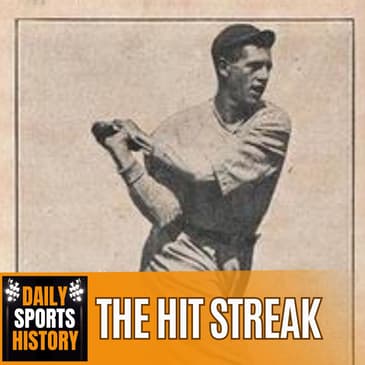
Join us on Daily Sports History as we explore Joe Wilhoit’s incredible 69-game hit streak in 1919, a record that still stands in professional baseball. Discover the story behind Wilhoit’s remarkable consistency, the challenges he faced, and why his streak remains one of the most unbreakable records in the sport. Relive a legendary achievement that has stood the test of time.
#DailySportsHistory, #JoeWilhoit, #HitStreak, #BaseballHistory, #1919, #RecordBreaking, #SportsPodcast, #LegendaryStreak, #UnbreakableRecords, #BaseballLegends
Buy me a coffee: buymeacoffee.com/dailysportz
Newsletter: https://substack.com/@dailysportshistory?r=3en496&utm_medium=ios&utm_source=stories&shareImageVariant=light
DailySportsHistory.com
Email: dailysportshistory@gmail.com
YouTube: YouTube.com/@dailysportshistory
Twitter: twitter.com/dailysportshis
Facebook: facebook.com/profile.php?id=61551687917253&mibextid=ZbWKwL
On August twentieth, nineteen nineteen, Joe Wilhoyt, playing for the Wichita Jabbers baseball team in the Western Minor Leagues, set a record that has still to this day never been broken when he ended his sixty nine game hitting streak. We often remember Joe DiMaggio's fifty six game hitting streak, but we forget about Joe Wilhoyt going above and beyond that, engraving his name into the history books for a record that will probably never be broken in professional baseball. Today. Today, we're going to dive into the history behind how he got to sixty nine games today on Daily Sports History. Welcome to Daily Sports History. I'm Ethan Reese, your guide to a rapid deep dive into sports history every day. And today's trivia question to listen out for is who has the second longest professional baseball hitting streak now? Joe was born in Kansas in eight eighty five and grew up loving baseball and was great in the field and was one of the fastest players in his era and was able to work his way up in nineteen sixteen to be part of the Boston Braves and would bounce around for the next few years, going from the Braves to the Pittsburgh Pirates to the New York Giants, where he won a World Series but only appeared in two games as a pitch hitter, where he went oh for one with a walk. So the Giants traded him to a minor league team the nineteen eighteen season as he was struggling with hitting, as he was a career two fifty seven hitter, which wasn't bad for the time, and he joined Seattle in the Pacific Coast League and he struggled mightily there, hitting with a batting average in his seventeen games there of one sixty five, and then he would get traded to the Wichita Jabbers of the Western League mid season as the Jabbers were running out of outfielders as they were playing pitchers in the outfield and they needed just someone to be able to fill that role. It didn't matter that he was struggling to hit. He was still a great fielder and was one of the better fielders of his era, but in his first twenty five games with Wichital he only batted one ninety eight, and that's when the coach tried to help him in his quest help him better his hitting, and one of the things he did was Joe was using a heavier bat, as it was more common back then to use a heavy, thick bat to try to get more power out of your hits, and so the coach in Wichital changed to a lighter bat and this seemed to change everything as Joe emerged from his slump and started to go on a streak starting on June fourteenth, nineteen nineteen, and not only did this help him as a player, it also helped the team as they went from bottom of the league to contending for the league title, as during the streak, he hit over five hundred with four home runs, nine triples and twenty four doubles. But what it really changed was they moved Joe to the lead off spot because of his speed, and this gave him more opportunity to extend his streak, as nineteen times in his streak he only had one hit, and he wasn't a guy that hit for power. He often bunted to get on base and laid out mini ground balls, and in his sixty second game, it took until the eleventh inning before he got his first hit, which was a game winning home run, and if he wouldn't have gotten that Joe DiMaggio would have tied his record in nineteen thirty three when he was in the Pacific Minor Leagues when he hit a sixty one game hitting streak, which meant they would have been tied for the most but as it stands now, DiMaggio has second at sixty one and Joe Wilhoyt is first at sixty nine. The streak finally ended on August twentieth, nineteen teen nineteen, facing off against Tulsa, where he struck out, hit a pop fly, hit a ground out, and was walked in his final at bat. But despite this, the fans in the park in the crowd actually took a collection for Joe and were able to give him six hundred for his contributions during the streak. Later, which just a few years earlier, when he won the World Series, he was paid almost twenty five hundred dollars, as the minor leagues do not pay as much as maters and despite this hitting success. But after this hit streak, the Red Sox were able to buy his contract to help them finish out the season, as he had a bidding war from almost every team in the National and American League after he had passed fifty game of fifty game hitting streak. When Joe joined the Red Sox, he was still on a hitting hot streak, as he hit three thirty three in his final eighteen at bats, but despite this, he was again and sent down to the miners, never to make it back to the major leagues again, and a few years after he would go on to retire and him and his wife would move to Santa Barbara, California, where they would open a luggage store, and sadly, in nineteen thirty he became ill and lost his life to lung cancer and would essentially be forgotten from the league, as we only remember Joe DiMaggio's fifty six game hit streak in the majors, which wasn't even Joe's highest hit streak as he hit sixty one he was in the miners, but the sixty nine game hit streak will probably never be passed again, just like Joe's will never be passed. It's a very difficult thing to pass as longevity, as hitting consistently as difficult, and pitching has become way better than what it was back in the day and become even more specialized but Joe will Hoyt should be remembered for his sixty one games. We often forget about the records that people set, even if it's not in the major leagues. He was a professional baseball player facing off against other professional players, many of whom went on to play in the major or had played in the majors, just as he had, and he was able to in a short four year major league career win a World Series that in his record is something no one can ever take away, and so he can be immortalized with that forever in baseball lore. Thank you for listening to today's Daily Sports History. If you like this, please tell a friend, share it wherever you're listening so that more people can become sports historians just like you, and come back tomorrow for more Daily sports History. And did you catch the answer to today's trivia question who has the second longest history of all time? The answer is Joe DiMaggio, who hit sixty one while he was in the minor leagues, which was eight less than Joe Wilhoyt.