Listen now! 👉 DailySportsHistory.com 📲 Follow for more daily sports history insights!
Email: dailysportshistory@gmail.com
YouTube: YouTube.com/@dailysportshistory
Twitter: twitter.com/dailysportshis
Facebook: facebook.com/profile.php?id=61551687917253&mibextid=ZbWKwL
Bluesky: https://bsky.app/profile/dailysportshistory.bsky.social
https://www.instagram.com/dailysportshis/profilecard/?igsh=OWl1MzIyYndqOGU2
Threads
https://www.threads.net/@dailysportshis
#JimThorpe #Decathlon #Olympics #SportsHistory #OnThisDay #GreatestAthlete #1912Olympics #IndigenousAthlete #OlympicChampion #Inspirational
Buy me a coffee: buymeacoffee.com/dailysportz
Newsletter: https://substack.com/@dailysportshistory?r=3en496&utm_medium=ios&utm_source=stories&shareImageVariant=light
DailySportsHistory.com
Email: dailysportshistory@gmail.com
YouTube: YouTube.com/@dailysportshistory
Twitter: twitter.com/dailysportshis
Facebook: facebook.com/profile.php?id=61551687917253&mibextid=ZbWKwL
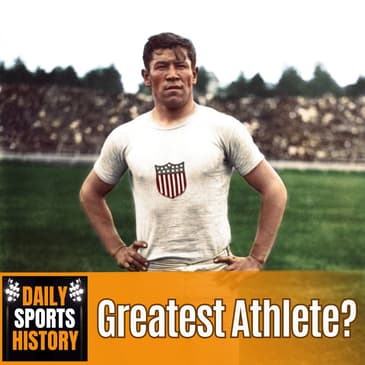
So picture this and here in Stockholm, Sweden, in nineteen twelve. Therefore, the Olympic Games famous pouring down, the crowd is roaring, and a young Native American athlete stands at the starting line ready to make history. His name is Jim Thorpe. And over the next three grueling days, Thorpe would go on to have the best Olympic to caathlon, which includes ten different track events, and become a legend, according to the King of Switzerland, the greatest athlete in the world. But Thorpe's journey wasn't just about his Olympic prowess. He went on to be an athlete in multiple different sports and be part of a controversy and would get his legacy back years after his death. So join us today as we dive into Jim Thorpe and how he became a legend on Daily sports history. So Jim Thorpe was born in Indian Territory in Oklahoma in eighteen eighty seven. He was part of the sac and Fox Nation and his native name was Wathu Hawk, meaning bright path, and he had a mixed heritage of being both Native American and Europeanist ancestry. But he identified with his Native American roots, and he actually had a twin brother named Charlie who passed away due to pneumonia at the age of nine, and his mother died at the age of twelve, And these losses did affect him a lot and made him really dive into sports as an outlet for his trauma. And he was actually able to join sports and this included track and field, baseball, and even ballroom dancing, which he would win a dancing championship in nineteen twelve. And while in college, he would become a star football player, leaving Carlisle University to historic victories over the likes of Harvard and Army, and in nineteen eleven and nineteen twelve he'd be named first team All American. And he played running back, defensive back, placekicker, punter and was dominant at every facet of the game. But he was also doing track at the same time time, winning the all around championship for a track in nineteen o nine and nineteen ten, which was a predecessor to the modern da catalon that we know today. So nineteen twelve was actually when the decathlon debuted in the Olympics. Now, if you don't know what the decathlon is. It is ten different events. Decca is a word that means ten, and so it's ten events. So it featured the one hundred meter long jump, shot put, four hundred meter high jump, one hundred and ten meter hurdles, discus throw, pule vault, javelin throw, and fifteen hundred meter run. So basically the whole gambit of most of the track and field events, most of the throws and jumps in there, and it's just really showing how athletic you are. Day one happened on July thirteenth, nineteen twelve, and open within one hundred meter long jump and shotput. It's a point based system, not necessarily based off your wins and losses, but it's more based off of your performance. So if you have dominating performance at multiple events, you can get more points, but if you have a really bad performance at one event, then you're gonna lose a lot of points. So you can win like seven events overall, but then just completely fail out of three and not win because you just even though you won the most events, and since you didn't, you know, get points from those other three, you could fail. It's a confusing system, but it's very interesting to watch the athlete participate at a high level at all these events, because most of them aren't fast enough to do one single event in the Olympics, but they can do all of these events and be good enough to get points for him. So the first day he did the one hundred meters, the long jump, and the shot put, and he would finish third in the one hundred meter with eleven point two seconds. Then he had finish second in the long jump with six point seven to nine meters and finish first in the shot put with twelve point eight nine meters. Now this really showed his all around skill, finishing top three in these events that featured running, throwing, and jumping. And he continued the success the next day, which featured four different events. So the high jump he finished first at with a jump of one point eight seven meters. Then he would go to the four hundred meter and finish fourth, his the lowest finish in all of the competition, with a time of fifty two point two seconds. Now fourth sounds bad, like how is he still the greatest athlete? But lots of times you go from first to six to eighth, you kind of balance around in this to cathline because there's so many different events, there's so many back to back there. It just has to line up perfectly for you to have success. Then he came back after that his worst finish. He came back after his worst finish to win the one hundred and ten meter hurdle with a time of fifteen point six seconds. Then he would throw the discus thirty six point eight nine meters, finishing second overall, giving him a huge lead heading into the final day of competition, which would feature the pole, to the javelin and the fifteen hundred meter. He would pull vault three point zero five meters, finishing third, and finish third in the javelin with a throw of forty five point seven meters. Then, without needing to finish first, without needing to run very hard for the one hundred meter, he would win the fifteen hundred meter with four minutes and forty seconds, finishing first overall and giving him a dominant lead and a dominant win for this. Now, this was the first to cathalon, and the cathalons are a little weird. Even though he won four vinches, which was very good for the de caathalon, he never finished below fourth, and that was what it showed to his success. He was good all around for all the different sports. And the way the point system works in the decathlon is you get so many points for your distance or your speed, not where you finish, so that way they could measure how good you do compared to anywhere else. It's not just whether you finish first or last. He finished seven hundred points in front of the next competitor, and the King of Sweden, King Gustav said he was the greatest athlete ever at the time. That's what the decathlon was known for. You won the decathlon, you were the greatest athlete ever. And it's because of Gustav for saying this. So after this he receives his medal at the podium and his legacy is growing. He gets a ticker tape parade, and he's a national hero in America and an icon. And just months after this, a newspaper reveals that Jim Thorpe had played minor league baseball in North Carolina in the summer of nineteen oh nine and nineteen ten, earning two dollars a game and a total thirty five dollars a week, but amateurism was huge back then and any improprietary meant you were banned. So he was stripped of his medal and this was known as the first international sports scandal, and it was a debated was it fair was because he was Native American. A lot of athletes in the actually would do this, but they would use aliases, but Jim didn't even think about it. He used his real name and didn't even know he was going to get money for these games he played in. He got that after the fact. He didn't sign a contract, He just received money after he played in the game. But it was over. So his Olympic career was over just as fast as it started. But his life was not over because he went on to dominate in multiple different sports. In nineteen thirteen, he would sign with the New York Giants to play six seasons in Major League Baseball, also playing for the Cincinnati Reds and the Boston Braves. Then he would also join the Canton Bulldogs in nineteen fifteen, helping them win three professional championships and played six seasons in the NFL and was a founding figure as he served as the first president in the American Professional Football Association, which would go on to become the NFL, and he also was a barnstorming basketball player with the All Native American basketball team, showcasing his skill nationwide. So despite his loss in him being the first Native American to win a gold medal in the Olympics, he did have success after the Olympics in different sports at different degrees, and that's why he's also remembered as one of the greatest athletes ever because he didn't just do it in the Olympics, he did it in other areas as well. But despite his fame, he always had financial hardships. He often struggled to find stable work after his sports career, and he actually died in poverty in nineteen fifty three, despite just years earlier being named the greatest athlete by the Associated Press. He was inducted into the Pro Football Hall of Fame in nineteen sixty three in the town of Duck, Pennsylvania, renamed itself Jim Thorpe. And then years had passed of him being dead, of him struggling financially, of him missing out on what could have been an even more historic career in the Olympics. In nineteen eighty two, he was giving back the medals that were stripped from him, giving him his legacy back. But he never got to see that. He But the thing thing is, if he didn't get stripped of that medal, maybe he never goes on to play in the NFL, maybe he never plays baseball. We don't get to see Jim Thorpe for the great athlete he was. If he wanted to continue to be in the Olympics, It's hard to know, but it's sad that we never got the chance to find out. Now there's professional athletes in the Olympics. But the question is does that change now really affect anything or is it just trying to get a good headline. I want to thank you for listening to Today's Daily Sports History. I hope you enjoyed it. If you like this, please make sure you like to subscribe wherever you're at. That way you don't miss a single episode, and share it with a friend and we'll see you on the next one.