#DailySportsHistory, #JimAbbott, #NoHitter, #MLBHistory, #BaseballLegends, #SportsPodcast, #InspiringAthletes, #1993, #BaseballHeroes, #HistoricMoments
Buy me a coffee: buymeacoffee.com/dailysportz
Newsletter: https://substack.com/@dailysportshistory?r=3en496&utm_medium=ios&utm_source=stories&shareImageVariant=light
DailySportsHistory.com
Email: dailysportshistory@gmail.com
YouTube: YouTube.com/@dailysportshistory
Twitter: twitter.com/dailysportshis
Facebook: facebook.com/profile.php?id=61551687917253&mibextid=ZbWKwL
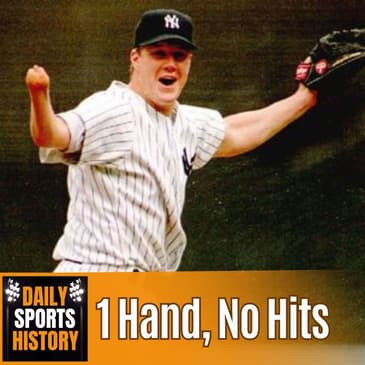
On September fourth, nineteen ninety three, Jim Abbot of the New York Yankees pitches a no hitter versus the Cleveland Indians. But what made this way more impressive than any other no hitter pitched before this was Jim born with only one hand, proving that just because you are born or have a disability does not mean you cannot reach your dreams. And today we're going to dive into how Jim Abbot got to this point and was able to make the majors so he could inspire a generation to reach for their dreams today on Daily Sports History. Welcome to Daily Sports History. I'm Ethan Reese, your guide to a rapid deep dive into sports history every day. And today's trivia question to listen out for is how many hits did Jim Habit have in his career despite only having one hand? So, Jim Abbott was born with just one hand as his right hand didn't fully develop, but he had the rest of his arm, and then right where the wrist is, there's nothing there since it was undeveloped. He just had to go through life with one hand, but his parents strived to make him as normal as possible. And at an early age, Jim really wanted to play sports now. Naturally, his parents thought soccer would be a great sport for him as he didn't need the use of his hands to play, but Jim didn't really like soccer. He saw all the other kids playing baseball and that's what he wanted to do, so he began working with his father on a technique where he would transition from throwing to using his glove and focus on two positions, pitching and first base because first base didn't need a lot of throwing and pitching could be focused on one hand at a time, and developed a technique of switching his glove while he was pitching, and at the age of eleven, while playing on a little league team, actually threw a no hitter in the first game he actually pitched. And though he would have success at that level, many didn't think he would move on, but he can continued to have success and he even made his high school team where he played first base, and he was actually very good at hitting. He was a left handed hitter and would wrap his hand around the bat and was able to hit seven home runs and have a batting average of four to twenty seven as a senior and on the mound he had a record of ten to three with an ERA of zero point seven to six, So he just based off his numbers. If you never saw who he was, you would either you would want to draft him or recruit him for your team in college, and that's exactly what happened, as he was drafted by the Toronto Blue Jays out of high school in the thirty sixth round and given a fifty thousand dollars bonus offer, but he turned it down to play in his home state at the University of Michigan, and he continued to develop as a pitcher and became Michigan's top pitcher and become Big Ten Conference Player of the Year and leading them into the College World Series tournament, as well as making the US Olympic team in nineteen eighty eight, winning a gold medal. And after his junior year of college, he actually was drafted with the number eight overall pick in the MLB Draft by the California Angels and given a two hundred thousand dollars bonus and in nineteen eighty nine he actually joined the Los Angeles Angels, starting rotation as a rookie and didn't play a single game in the minors, and he posted a twelve and twelve record with an ERA of three point ninety two. And he continued his success in nineteen ninety one. He actually won eighteen games, posting the fourth lowest ray in the AL at two point eight nine, and finished third in the cy Young voting. And though he was having success with the Angels, he was traded to the New York Yankee to save some money and this is where in nineteen ninety three he would become immortalized. In September fourth, nineteen ninety three, where he was going against the Cleveland Indians. So the game is in Yankee Stadium in New York and they're facing off against the Cleveland Indians who had a really good lineup in Kenny Lofton, Albert Bell and a young Manny Ramirez. Now, Abbott was not overpowering them in terms of strikeouts, but he was very effective with locating the ball and hitting ground balls and pop flies. But despite this, he also had five walks during the game. But his defense was able to support him throughout the no hitter, including a key play where Wade Boggs was able to field a sharp grounder and was able to make the throw all the way from third to just beat out the runner. And even though he was having a good game, it wasn't until the sixth inning that they started to talk about the possibility of a no hitter done by one handed pitcher. Then in the ninth inning, with two outs, Barrega was up to hit, and he did what almost all the other hitters did, hit a ground ball which were fielded by the shortstop and thrown out at first, giving Jim Abbott his key moment in his career, a no hitter where he allowed no hits, had five walks and struck out only three, pitching only one hundred and nineteen pitches, and the crowd of twenty seven thousand erupted and gave a standing ovation to Jim Abbott. Now this was the highlight of his career and really the peak. He played another season with the Yankees and went on to sign with the Chicago White Sox and then go on to play with the California Angels again, and after a year out of the sport, come back in nineteen ninety eight to play for the White Sox again and then was signed by the Milwaukee Brewers. Who was his first NL team, which meant they didn't have the designated hitter, and during his time with the Brewers, he recorded two hits in twenty one at bats and was the first one handed player to get a hit since the nineteen forties. But after the nineteen ninety season, where he won five games, he would not be signed again by any other team. He would slowly retire from the league after ten seasons in Major League Baseball. Now he had eighty seven wins and one hundred and eight losses, but I had ERA of four point twenty five with eight hundred and eighty eight strikeouts, So he wasn't the most dominant pitcher of his day, but he was a quality pitcher and that moment where he had no hitter was a huge moment. It led to so many athletes with disabilities to feel confident in what they doing within what they had, and it put him on center stage where everyone could look at what he did that one moment. Even though his career wasn't a Hall of Fame career. He wasn't an All Star, but he had success, and many of the Major League players that played baseball were not All stars, were not Hall of famers, but they had great careers and they led great lives because after his career, he went on to be a motivational speaker and wrote a book in twenty twelve called Imperfect My Improbable Life, which was an autobiography, and he's used this to help motivate people with disabilities. And he said that during his career he would average at least one child he would visit on every road trip who had a disability to help motivate them and be a guiding life for him. And that is huge for every one of those kids. And he touched more lives than many other baseball players ever have. I want to thank you for listening to today's Daily Sports History. I hope you feel motivated after hearing his story. It is a great story and if you liked it, please tell a friend tell them to join you in becoming a sports historian. And come back tomorrow for more Daily Sports History. And did you catch the answer to today's trivia question how many hits did Jim Abbott have in his career? And the answer is two. In the final year of his career with the Milwaukee Brewers,