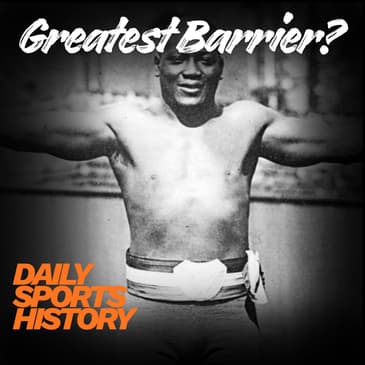
#JackJohnson, #BoxingHistory, #SportsHistory, #CivilRights, #TommyBurns, #SydneyStadium, #BoxingPodcast, #HeavyweightChampion, #BlackHistory, #HughMcIntosh, #SportsCulture, #FightOfTheCentury, #1908, #GalvestonGiant, #UnforgivableBlackness, #DailySportsHistory, #BlackAthletes, #BoxingLegacy, #SportsStorytelling, #PodcastHistory
Buy me a coffee: buymeacoffee.com/dailysportz
Newsletter: https://substack.com/@dailysportshistory?r=3en496&utm_medium=ios&utm_source=stories&shareImageVariant=light
DailySportsHistory.com
Email: dailysportshistory@gmail.com
YouTube: YouTube.com/@dailysportshistory
Twitter: twitter.com/dailysportshis
Facebook: facebook.com/profile.php?id=61551687917253&mibextid=ZbWKwL
On December twenty sixth, nineteen oh week. It was a hot summer day in Sydney, Australia, with twenty thousand fans packing the Sydney Stadium to stay cool witnessing his history. In one corner stood the heavyweight champion from Canada, Tommy Burns, the man who thought a black man could not hold the title of heavyweight champ, and across from him was a black man named Jack Johnson, known as the Galveston Giant, locked in to Tommy Burns as he finally got his chance to break the color line and face off against a white champion to show that color did not matter. It was all about The fighter came out in the first round and dropped Tommy Burns to the mat for eight seconds, and Jack Johnson was on his way to become the first black heavyweight champion in boxing history. It join us today as we learned about Jack Johnson and how he became the heavyweight champion today on Dating Sports History. Welcome to Daily Sports History. I'm Ethan Rees your guide because I'm too scared to actually get in the ring to fight, So let's go back and learn about who Jack Johnson was. He was born in the late eighteen hundreds in Galveston, Texas, which was a port city where recently freed black families worked long hours for low wages and Jim Crow laws were coming into effect. Wood and jacks were the norm. White's only signs everywhere, and his parents were former slaves. Growing up, hears stories about the challenges they faced, and as a boy he would actually start working early, running errands for the docks or blacksmith's shops, consistently being told where he was allowed to sit, where he was allowed to stand, where he was allowed to do just about everything. Learning this this, this really lit a fire under him as he wanted to break this norm. He realized there was nothing other than the color of his skin different from him and these other people he could do anything they could, and he decided that he was not going to follow in the status quo. So around the age of twelve, he started to work working doing hard labor on the docks, where it was common for entertainment purposes for lots of these men to fight and people to gamble on these fights, and he bounced around to these shots, but he was very used to seeing these street fights going on. Then he ended up working at a Dallas racetrack exercising horses and was an apprentice for a carriage painter named Walter Lewis who liked to have sparring go on in his shop, and this is where Johnson really got into the fighting and started to learn some actual techniques into boxing. As a teenager, he entered multiple battle royale bouts where several men would fight each other blindfolded or all at once for the amusement of spectators. Mainly, these alfin were black men entertaining white men for a cash prize that would go to the last man's standing. Because black men were not paid very much, this was a form of making some money, so bouncing around between jobs, he took a job at a boxing gym and the owner was a German born heavyweight Hermann Bruhn, and this gave him really access to being around boxing, being around the rings, seeing what could happen, seeing boxing firsthand, and he would save enough to bind his own gloves begin sparring with everyone in any opportunity he had working at the gym, and he would fight all these random fights for a dollar to all around Texas with these kind of amateurish semi pro fights, but his first documented professional fight happened in eighteen ninety seven at a Texas club show, and by the following year he was officially fighting for the Texas state middleweight title, which he won beating Charlie Brooks by knockout in the second round. He quickly rose up the rank and became a serious contender in the boxing community, not only in Texas but around the United States, taking any bout he could because this is how he was making his money, and he didn't care how short the notice was, how little the prize money was. He just wanted the chance to fight and prove himself, and by the early nineteen hundreds, he was a regular on the black heavyweight circuits, fighting other top African Americans for relatively low pay, But promoters liked him because he was able to draw a crowd because he would knock people out. He was not a finesse fighter. He was a power fighter. That's what they liked to see. But at the time he was only able to really fight in these black circuits at a color heavyweight champion is really what it was referred to at the time, and black fighters were really closed out to the world titles because the world was still basically segregated, and he would be so many of these great fighters, often in grudge matches after grudge matches, which means he was fighting them again and again because there were only so many fighters he could face. He wanted to fight these white fighters, offering them the chance to show they were the true real heavyweight champion, but fighters like James Jeffries and Tommy Burns just ignored him, saying Johnson existed in a different universe, he was not part of the world championship crowd, saying he was fighting lesser competition. But honestly, as we know, he was fighting competition that was equal to, or if not better than, what they were fighting for. Champion James Jeffries Whydey, considered the best heavyweight of his era, retired rather than infending his title against Johnson, publicly declaring he would never fight a black man, and a phrase that was commonly used back then is drawing the color line. He became a standard language in boxing coverage, the polight way of saying a white champion would not risk humilia of losing to a black champion. That was the problem. It wasn't that they didn't want to fight them. They didn't want to risk losing to them. Then in nineteen oh six, Tommy Burns wins the world heavyweight title. Johnson puts a plan together. He follows Tommy everywhere. He is going to have a fight country to country, publicly challenging him. Now, Burns refused multiple times, saying he would not fight a black challenger, but promoters realized this was a huge draw. People wanted to see this. People thought Jack Johnson was a once in a generation fighter and they wanted to see if you could actually beat a white man. Then Hugh McIntosh stepped in. He was a promoter showman in Australia and he built the Sydney Stadium where he had actually had a title defense that he put on for Burns previously, where they fought a local fighter named Bill Squires, and it drew a big crowd and it was a major event for Australia. And he wanted to see Burns actually fight Johnson, and he knew the only way to do this was to offer a crazy amount of money, and he offered Burns a purse of thirty thousand dollars, which would be over a million dollars today, and then offered Jack Johnson five thousand dollars, which would be just under two hundred thousand dollars a day. Now, Johnson knew he was going to be paid less no matter what the fight was, but he wanted to fight so bad he didn't care. So because of this outstanding money offer Tommy Filey Casita, he would fight Jack Johnson on December twenty six, nineteen oh eight. Now McIntosh not only promoted it, he also agreed to referee the bout and with the filmmaker shoot it with film and you can actually go watch this online. It's really grainy. It's not the best video, but it is one of the most iconic fights to ever take place. So the day comes, Sydney Stadium is filled with twenty thousand fans. Everyone is so excited across the world to see what will happen in this fight. So we have two fighters in for the ring. Tommy Burns stays about five to seven with seventy three inch reach, weighing about one hundred and eighty pounds. Is an orthodox fighter, but aggressive and more of a speed fighter. And Jack Johnson across the ring is just under six' one with this seventy four inch, reach weighing almost two hundred, pounds is an orthodox fighter as, well with a defensive mindset and a great counter. Punch he was, bigger weighed, more and, honestly it seemed like it was going to be an unfair fighters And johnson kind of made it seem that. Way he came out early in the first, round aggressively trying to rush as he was the bigger man and get to close, quarters and he showed his superior timing and, blocking slipping most of burns, punches landing sharp, counters including a hard one to the heading him to the ground where he was there for eight. Seconds but he was able to get back up and keep. Fighting but by this Point Jack johnson was in. Control over next multiple, Rounds burns did little to nothing to take Down johnson As johnson continuously brutally beat him and beat him and beat round by. Round burns's face became badly, swollen particularly around the. Eyes he could barely see what was going, on and even though it seemed Like Jack johnson could in the fight any, time by the tenth round he looked like he was holding back to extend the spectacle as it and it continued round by round and by the fourteenth, Round burns was, bloodied, overmatched and the police entered the, ring ordering the fight to stop as it seemed like it was no longer a fight there was more of an. Assault the, Referee hugh McIntosh Declared Jack johnson the winner on, point making him the first black world heavyweight title, ever one of the most lopsided heavyweight title victories that had happened up to that. Point now it's reported That hugh McIntosh made a huge profit from this. Fight he just over twenty six thousand dollars just in the gate receipts from the, event but he was able to coproalize on the filming that he did of the fight as well make him even more, money and that we don't have an exact amount, on but he made. Bank he continued to be a boxing promoter for years after, this and he would eventually pass away in nineteen forty. Two, now for the two, Fighters tommy never regained the heavyweight title after he, lost it effectively ended his boxing. Career though he continued boxing until the nineteen, twenties he had mixed results and would go on to retire in nineteen twenty and after, this he would take on various roles of training and, promoting but would be honored By canada as one of the most important early sports figures they've ever, had And johnson after this would be the heavyweight title holder till nineteen, fifteen defeating his title in high profile, fights famously in nineteen ten in The fight of The century beating former Champ James, jeffries which actually triggered riots across The United. States his flamboyant style allowed him to buy expensive, cars fine, clothes and he actually had many relationships with white, women provoking, backlash and in nineteen thirteen he was convicted under The Man act in a racially driven case and he fled exile and he ended up serving about a year in. Jail in nineteen fifteen fight In, nevana he would lose the title To Jess willard and he would fight intermittently after this till the nineteen twenties and would unfortunately die in a car wreck in nineteen forty, six and in twenty eighteen he would receive a presidential pardon for His Man act, conviction but he will always be remembered for being one of the greatest fighters of all, time even though it was in the nineteen. Hundreds he's still up there in the conversations of the greatest of all time and broke down, barriers allowing, many, many many other great black fighters to step into the ring and show what they were. WORTH i want to thank you for listening To day's daily sports. History if you like, this please make sure you share it with a friend so they can learn just as much about sports as you. Did and we'll see you on the next. One