Website: dailysportshistory.com
Email: dailysportshistory@gmail.com
YouTube: YouTube.com/@dailysportshistory
Twitter: twitter.com/dailysportshis
Facebook: facebook.com/profile.php?id=61551687917253&mibextid=ZbWKwL
Tiktok: tiktok.com/@daily.sports.history?_t=8hHPnNSCqfm&_r=1
#CharlesSherrill #CrouchingStart #TrackAndField #AthleticInnovation #SportsHistory #yale
Buy me a coffee: buymeacoffee.com/dailysportz
Newsletter: https://substack.com/@dailysportshistory?r=3en496&utm_medium=ios&utm_source=stories&shareImageVariant=light
DailySportsHistory.com
Email: dailysportshistory@gmail.com
YouTube: YouTube.com/@dailysportshistory
Twitter: twitter.com/dailysportshis
Facebook: facebook.com/profile.php?id=61551687917253&mibextid=ZbWKwL
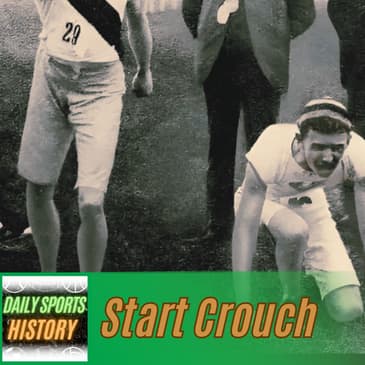
On May twelfth, eighteen eighty eight, at the University of Yale, young track star Charles Shrill does something many have never seen before. He crouches down and puts his hands on the ground before the start of his track race, perhaps being the first time anyone has ever done a crouching starts creating an innovative way to start a race in track and field that now is done around the world. Here's the story about how all this happened, and maybe he wasn't the first. Today on Daily Sports History. All right, before we hit the field on today's episode, let's huddle up and talk about sports social pro If you manage your team's sports social media and feel like it's coaching a team of cats, we got the perfixed solution. Whether you need a playbook for DIY success or you want us to handle all your social media and make it into mpep's head over to Daily Sports History slash. Welcome to Daily Sports History. I'm Ethan Reese, your guide to a rapid deep dive into sports history every day Now. Running has been around forever. It was featured in the very first Olympics and arguably could be called the very first sport where all you needed was two people to run against each other. So there's not an exact date to win. Running started, but many a tribute the basic beginning of the sport to seventeen seventy six bcee in ancient Greece in the town of Olympia, where they held the very first Olympics, holding the first official competition like race for the Olympics. Now running actually happened before then, but they had the first racing evict Then in four ninety BC, a Greek soldier name named Phidepis was commissioned to leave the town of Marathon, going towards Athens to report the victory over Persia, roughly twenty five miles away, and this is where they got the name for the marathon, which again came back in the first modern Olympics in eighteen ninety six. They but they didn't only run long distances, because back in the eighteen seventies they started to run the one hundred yard dash and I said yard, not meter, as in America we ran the one hundred yard dash, and in other parts of the world they ran the meter dash, including in the Olympics. So oftentimes you will see back before meters became consistent in the seventies. Overall track and field, you'll see some hundred yard dash times, and usually whoever runs the fastest sprinting time of either the one hundred yard as previously was done or the one hundred meter was known as the fastest man or woman in the world. Now, Charles Shrill would go on to become an ambacheldor for the United States, but back in eighteen seventy seven, he was actually a freshman at Yale where he took the running world by storm when he won the one hundred yard Intercollegiates Association of Amateur Athletes of America. It's a mouthful. They shortened it to a C four, which was a precursor to the NC Double A, and later that year he would go on to win the one hundred yard at the National Association of Amateur Athletes of America the NAAA. To gain before the NC double A, you get all these different kinds of tournaments. So already in his freshman year he was one of the best sprinners in all of America. Then in his sophomore year he ended up trying out something new, as in those days, every race began with athletes standing up and leaning kind of in a lunge formation before the race started. To start the race, no one ever crouched down and there was no racing blocks, and Charles and his coach, Mike Murphy worked on a new stance. Starting from a crouching position, he would have his hands right at the beginning line, both in the dirt because at this time they were still running on dirt tracks. He would put his hands down with his knee also down on one end and his other leg a little forward with his foot on the balls of his feet, mimicking a crouch like position similar to what we see today, but a very simplistic version, and they would unveil this style at the Rockaway Hunting Club games where he was racing off against runners from Columbia, Princeton and Harvard In Many thought, including journalists who were covering this event, that Charles had actually fallen and started from that position, but no, this was a planned start, and even the other runners were confused by what he was doing. But he took off, passing them right away and won handedly with a time ten and a half seconds. And he did the same thing for the two hundred, where he ran a time of twenty two point sixty six seconds, and he continued this through all the races for the rest of his career, and on June fifteenth, eighteen eighty eight, he set two separate American records for both the two hundred and fifty yard dash where he ran twenty five point eight eight seconds and also won one hundred and twenty five yard dash with a time of twelve point sixty six seconds, and would later also set the record for the one hundred and fifty yard dash with fifteen seconds, and he would attempt to win the Amateur Athletic Union Championship, which was known as the National Championship at the time, but he finished second in one hundred yard dash and would go on to injure attendant in his leg and not be able to finish the rest of the races. But three days later talk of this dance had started and the first crouching start seen in Britain took place at the South London Harris Promotion at the Oval Cricket Gardens by Thomas Nichols, where he also won his one hundred yard race, and by the time Charles was done, he had retired from athletics after college. He had set the record. He had the second fastest one hundred yard dash time ever and the record in the world for both the fifty yard dash and the two undred and fifty yard dash. Now, after his running career, he did not get out of athletics, as he was a part of the International Olympic Committee and was vital in bringing the Olympics to Los Angeles in nineteen thirty two, and he was also looked to help America be featured in the nineteen thirty six Summer Olympics in Berlin and met with Hitler multiple times to assure that the American athletes would be okay to run in the event. And this became one of the most important Olympics ever as this is when Jesse Owens took the stage and arguably changed the world with those Olympics. But that's for another day. What's important to remember is now there were some controversies on who actually was the first one to do a crouching start. Now Charles was the first one to be photographed doing it, but Bobby McDonald, a celebrated Australian runner, states that he had done the crouching stance years earlier, trying to mimic what he had seen kangaroos do for their starts, but he had never been photographed before Charles, and at this time, you know, people were figuring out things around the same time, so who actually did it first is never really known. But we do have a picture from Charles running this way, and that's why Charles is given the distinction of the first one, though he may have not been the first, as it's possible others had done this years and years before, as running has been around for thousands of years. But the important thing to remember it is no matter if anything has been done before, it doesn't mean that's how it has to be. We have made innovations in sports all over the place in different avenues of life. In those changes, someone had to be the first, So don't be afraid to try something new. I'm trying something new every day by putting this podcast together because I'm not a good speaker and I had to go to speech my entire childhood. Can become a better speaker myself, but trying new things is what can break you out and let you set records. And I want to thank you for listening to today's episode, and if you like this, please hit that share button wherever you're listening and send it to someone else that loves sports history just as much as you so they can join in our sports history community and come back tomorrow for more daily sports history