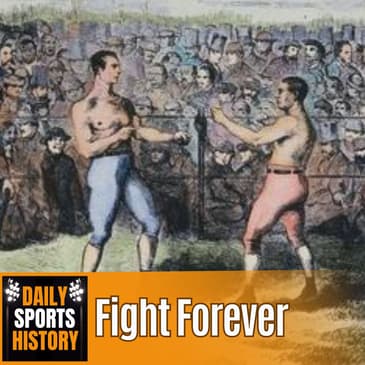
On April 17, 1860, in a secret field near Farnborough, England, English champion Tom Sayers and American John C. Heenan battled for 2 hours and 27 minutes in a brutal bare-knuckle contest—recognized as boxing’s first world title bout. With 42 rounds, a crowd of 12,000, and police intervention, the fight ended in a dramatic draw and marked the end of an era for bare-knuckle boxing. Discover the incredible story, the fighters’ backgrounds, why the bout was illegal, and how this legendary showdown paved the way for modern boxing.
Get the written podcast newsletter:
https://substack.com/@dailysportshistory?r=3en496&utm_medium=ios
📅 Listen now! 👉 DailySportsHistory.com 📲 Follow for more daily sports history insights!
Email: dailysportshistory@gmail.com
YouTube: YouTube.com/@dailysportshistory
Twitter: twitter.com/dailysportshis
Facebook: facebook.com/profile.php?id=61551687917253&mibextid=ZbWKwL
Bluesky: https://bsky.app/profile/dailysportshistory.bsky.social
https://www.instagram.com/dailysportshis/profilecard/?igsh=OWl1MzIyYndqOGU2
Threads
https://www.threads.net/@dailysportshis
#BoxingHistory #OnThisDay #SportsHistory #BareKnuckleBoxing #TomSayers #JohnHeenan #WorldTitleFight #Farnborough #BoxingLegends Y
Buy me a coffee: buymeacoffee.com/dailysportz
Newsletter: https://substack.com/@dailysportshistory?r=3en496&utm_medium=ios&utm_source=stories&shareImageVariant=light
DailySportsHistory.com
Email: dailysportshistory@gmail.com
YouTube: YouTube.com/@dailysportshistory
Twitter: twitter.com/dailysportshis
Facebook: facebook.com/profile.php?id=61551687917253&mibextid=ZbWKwL
On April seventeenth, eighteen sixty, England's bare knuckle champion Tom Sayers took on America's bare knuckle champion John Hennon in one of the fiercest battles to date, in a fight that was deemed illegal, with no gloves, no time limit, and that went on for hours, with each fighter fitting to become known as the very first world champion fighter, giving them honor and national pride in something that was more than just a fight. Today, we're going to dive into the history of bare knuckle fighting and how this fight changed the world of fighting and boxing four at today on Daily Sports History. Welcome to Daily Sports History. I'm Ethan Reese, your guide as you daily learn more about sports history. As we dive into the very first world title fight, let's look in to what fighting was back then. We talked on a previous episode about James Flagg, who was part of the very first prize fight dating back in seventeen nineteen and opened a theater for combat sports, including fist fighting, in which really started the popularity of bare knuckle fighting. After his retirement, his protege, John Broughton, took the sport into a new realm and gave it rules and regulations for rounds, allowing breaks and requiring fires to stand up instead of being knocked down. Unlike modern boxing, bare knuckle fighting lacked the gloves that we have today, which definitely allows the fight to be more tactical than just brute strength. If you get hit with the bare knuckle, it hurts worse, so it allows for fights to last longer and allowed for fighters to continue to fight better with less injury and so as a result, fighters adapted to avoid injuries to their hand and this often resulted in bare knuckle fighting having more body focus attacks because it hurt a lot less to punch someone in the stomach than in the face. But these matches would take hours. For these bare knuckle fights, as there was usually no set time limit for the rounds, it could go on until it got stopped by the cops or someone actually got knocked out or even passed away. Now, because of the severity and the injuries that came with bar knuckle fighting, it eventually declined and boxing itself came into more effect. When we realized that boxing gloves really helped change things, It changed a lot, and the Marquess of Queensberry rules developed in eighteen sixty seven marked the transition into modern boxing. This mandated gloves, limited rounds to three minutes, and ban tactics like wrestling moves. This allowed fighters to fight more and allowed the sport to grow as it was less of a violence thing and there was more strategy involved. So barre knuckle fighting was still what was happening in eighteen sixty when John Hennon took a trip over to England to face off against John Sayers and fight in the first world title fight. The match took place in Fairburn, England, attracting thousands of spectators from all social classes. Wealthy patrons made expensive train journeys to witness the event. This was even covered by Harper Weekly and Frankly Illustrated newspapers, meaning it was the first time that international journalism was being done. Another breakthrough in the sporting world. Now it's done all the time for all different kinds of sports, and there was interest across England for this fight. At the time, England was known as the fighting place. America was coming along, but we were still a new country and American England still had a rivalry growing. You have to remember it was less than one hundred years previously for the Revolutionary War, and a lot of the British people still held resentment to America and a lot of Americans still held resentment to British, something that's not as common today, but there was still that going on. So before we get to the actual fight, we need to find out who these fighters were in first dive into Tom Sayers, England's champion, also known as the Little wonder He was born in Britain, England, and grew up in the slums and it was harsh and many children were actually working for a living to help their family, and Tom was no different. He earned pennies assisting fishermen and holidaymakers on Britain's beach and by the age of thirteen he became a bricklayer and contributed to multiple projects around London and this also toughened up his hands for his future career. Now, he didn't grow up to be very big, that's why he was known as the Little Wonderer. He would be about five eight and one hundred and fifty pounds. Now, that sounds pretty small by today's standards, but that was about average for the time, and despite being small for a heavy weight, he also had the nickname of Napoleon of the Ring, as his strategy in the ring helped him overcome his lack of size. Now he became a profe national fighter in eighteen forty nine, fighting against Abe Couch, and he would go on to only lose one fight in his sixteen professional fights, against Nate Langham, after a sixty one round contest that blinded him by the end of the fight. Despite the loss, though he was resilient and came back. It was still a rising star and in eighteen fifty seven he defeated Bill Perry in a dramatic fight to claim the English heavyweight title and the American John C. Hinton was born in New York and worked as an iron worker in Benicia, California, where he earned the nickname the Benicia Boy, and he had raw power in aggressive style because he was a more prototypical heavyweight as he was six feet two inches and weighed one hundred and ninety pounds, which gave him a significant side advantage when he faced off against Sayrs and he declared himself the American heavyweight champion after John Morrissey retired without granting him a rematch, so this self proclaimment gave him the states to face off against Aairs, even though he didn't have that many fights and didn't have as much experience as says. It was also the fact, as there was limits that people wanted to go to Europe and fight because it was an illegal fight over there. You had to travel all the way across the sea. Remember this was old wooden ships. Took weeks to get across the Atlantic. Not a very fun trip. Wasn't very clamorous like we see in the Titanic. It wasn't like that. This was still the mid eighteen hundreds, so this trip took a lot to get someone to go to and he wanted to make a name for himself by going over there and defeating the English champion. So the fight starts at seven point thirty am in the morning. Yes you heard that right, seven am. Now different time. You woke up with the sun. Back then, you didn't have alarm clocks. Work was mainly farming or man labors, and you needed the sun to fight, and you never knew how long these fights would actually go. And because this was actually an illegal fight because England had banned prize fighting, especially bare knuckle fighting. Despite them having a champion. It was often illegal, but the events were more what was illegal. You could have the fight, but the event was what was illegal. So that's why they held it at a weird time in the country, away from as many people as possible, and they ran by the traditional rules. The rounds ended when a fighter was knocked down, and fighters would have thirty seconds to come up to scratch a mark in the ring or forfeit the match, and wrestling and grappling was allowed, but no choking was prohibited, and there was no time limits for the rounds or the fight. Overall, it went basically till someone didn't make it, someone stayed down, or someone forfeited the fight. And in the opening rounds, hitting, size and power dominated or He knocked Sayers down heavily, and by the sixth round he had broken stears right on arm by landing a blow on his forearm. Despite this injury, Sarah fought on with one hand. Sayahs displayed remarkable resiliency, countering with precision in his targets to Hennon's face, and by the seventh round hidden right eye was swollen shut and Sayrhs adopted a conserved energy tactic and exploited hinden Its increasing fatigue, as when you have more power and you go stronger at the beginning, you slow down at the end. And Hennen continued to press. His mounting injuries began to overtake him, and by the thirty third round, both his eyes were nearly swollen shut, making difficult for him to see where Sayrs was other than by here alone. The crowd roared as Sayrs landed sharp counters despite fighting with just one arm and looking like he was going to take the fight. But Hinden did not give up, and he was frustrated, so he grabbed Sayrs by the throat and choked him against the ropes, a clear violation of the bare knuckles etiquette rules that they had set out and outraged spectators stormed the ring, and some of them even striped Hinden with their canes. Luckily, they were able to break up the choking situation, but the fight was not over. It continued. After order was restored, the ring was repitched and the fight continued for five more rounds as both men were severely injured and could barely fight effectively. I like to imagine this has just like two very very old men that could barely stand just got out of the wheelchair, trying to fight each other with a hit that wouldn't even hurt a baby, like the satisfight. At this point, it's gone so long, both men are so injured. By the forty second round, this has lasted over two hours and twenty seven minutes when the police show up to break up the fight, which was declared a drawl with lack of a decisive winner. Both fighters were later award championship belts for their effort. Now, it was one of the most brutal contests in the boxing world's first and this was something that really led to the Queensberry Rules being introduced to transform bare knuckle fighting into boxing, as it was so brutal. These two men were so injured and made the fighting by the end just boring. A fight that lasts two and a half hours is crazy, but the public celebrated the heroics of both fighters and they both go down in history. Sarahs would retire shortly after and live modestly, but was a public figure throughout England until his tragic death just five years later in eighteen sixty five from tuberculosis, and John Hennan would return to America as a celebrated figure, but never achieve another major victory. His health also deteriorated due to illnesses and it was unable to sustain his career and passed away thirteen years later at the age of thirty nine. Now, this was the first world title battle. Now, because it ended in a draw, didn't really get the publicity. It's often kind of forgotten about. When things don't have a clear winning you kind of forget about them. But it really led to the change in boxing because it was such a monumous moment and it was marred by the injuries. It showed that the sport needed a change, and the Queensberry rules really changed everything and led it to boxing that we know today, allowing for more breaks, allowing for fighting to be better, allowing you to see more fights, and fighters to live on after they fought, because it was often once you were done fighting, you died not too long after because of the injuries you've got. Now we see that boxing fighters live on years after they're done, even if they might have a lot of health issues because of their sport. It's still a lot safer than it was back in the day. The question is there is some underground, bare knuckle fighting coming back. Is that something we want to see? I don't think so. I think boxing itself is a lovely sport and has its own spots. We have other fighting sports such as MM and kickboxing other things like that to relive fighting. But we don't want but we have to remember these are sports and sports is meant more for winning a game rather than hurting an opponent. I want to thank you for listening today's Daily Sports History. If you like this, please make sure you follow and subscribe wherever you're listening. That way, you do not miss a single episode, and come back for more Daily Sports History