#DailySportsHistory, #GertrudeEderle, #EnglishChannel, #SwimmingHistory, #1926, #Trailblazer, #SportsPodcast, #HistoricSwim, #SwimmingLegend, #WomenInSports
Buy me a coffee: buymeacoffee.com/dailysportz
Newsletter: https://substack.com/@dailysportshistory?r=3en496&utm_medium=ios&utm_source=stories&shareImageVariant=light
DailySportsHistory.com
Email: dailysportshistory@gmail.com
YouTube: YouTube.com/@dailysportshistory
Twitter: twitter.com/dailysportshis
Facebook: facebook.com/profile.php?id=61551687917253&mibextid=ZbWKwL
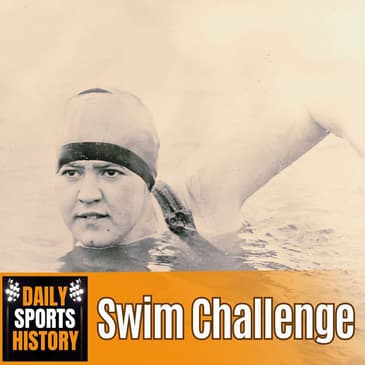
On August sixth, nineteen twenty six, former Olympic gold medalist Gertrude Utterly becomes the very first woman to ever swim across the English Channel, one of the most grueling endurance swims in the world, and becomes an American hero. We're gonna dive into her story today on Daily Sports History. Welcome to Daily Sports History. I'm Ethan Reese, your guide to a rapid deep dive into sports history every day. And for today's trivia question, what popular swimsuit did Gertrude help pioneer for her trip across the English Channel. Now, before we dive into Gertrude's story, let's first figure out why the English Channel is such a well known and such a highly thought after milestone of swimming. Now, if you don't know, the English Channel is a twenty five mile stretch of water between England and France. So it's technically part of the ocean that makes England an island, which adds even more challenges. On top of that, there's multiple currents that go in between this so when you do swim or even ride a boat in between these two locations, even though it's only twenty one miles, it's very difficult to just run it straight. You're gonna be doing almost an s as there's one current that goes up and one current that goes down as you cross. On August twenty fifth, eighteen seventy five, Matthew Webb became the first person to cross the English Channel without aid of artificial buoyancy, meaning he swam across and it took him twenty one hours and forty five minutes to do so, with changing tides and being sung by a jellyfish, and it would be thirty six years before the next person would cross the English Channel. It was a challenging thing and you needed help to do so because it would be hours, so you needed someone to help, food and a boat to follow you to make sure you didn't just drown and fade away. Make sure you're going in the right direction because when you're swimming you can easily lose directions, especially when you get out where you can't see land. And the first four that were actually successful, we're actually doing it from England to France until nineteen twenty three when Enrique Tarabucci from Italy did it from France to England and he beat the best time by over five hours, and so this way going from France to England became more of the norm, and it's actually the way Gertrude would go three years later. Now, Gertrude grew up in New York in Manhattan, where she learned to swim at a young age. Unfortunately, at an early age in her life, she would attract She would attract the disease the measles, which can affect your hearing and would limit her hearing for the rest of her life. But that didn't stop her from swimming, and we go on to train at the Women's Swimming Association. This is where she learned American crawl, which morphed into freestyle that we know today, and she would go on to set the eight hundred and eighty yard freestyle world record and the youngest world record holder ever at the time in swimming. And she wouldn't stop there. She would continue to set world records, setting eight more after that, and would go on to set a total of twenty nine US and world records in a four year span between nineteen twenty one and nineteen twenty five, and qualified for the nineteen twenty four Summer Olympics in Paris, where she won gold as a member of the US four by one meter freestyle relay, and she would go on to win bronze for the one hundred and four hundred meter freestyle races in the Olympics as well, and then shortly after these Olympics she turned professional for her swimming and this is where she turned to more endurance swimming, which was becoming more popular at the time, and she swam twenty two miles from Battery Park located in Manhattan to Sandy Hook located in New Jersey. It took her seven hours in eleven minutes. That was a record at the time which stood for eighty one years, and they used this as a warm up for her to attempt the English Channel crossing, and in nineteen twenty seven, the Women's Swimming Association actually sponsored Helen Wainwright and Gertrude to attempt to swim across the English Channel. Now Helen had cancel due to illness, but Gertrude decided to go to France on her own and attempt the crossing. Now she had actually trained with Jabez Wolfei who had attempted to cross the channel twenty two times, although unsuccessful each time, and on August eighteenth, nineteen twenty five, Gertrude made her first attempt to swim the English Channel, although it was disqualified because another swimmer had made contact with her, attempting to pull her out of the water when her coach thought it was too dangerous for her to continue to swim. This devastated her. She was so upset that she found a new coach in Bill Burgess, who had actually successfully crossed the Channel in nineteen elve, and made a deal with her team and her father that no matter what, they would not allow the next time she swam. But at this time she was still one of the most popular female athletes in America, and so the New York Daily News and the Chicago Tribune helped pay for her expenses in training and to get to France to attempt the race, and just about a year later, on August sixth, nineteen twenty six, she would be on the shores of France attempting to cross over to England. Now to do this, there were certain things they realized from her last attempt that needed to change. One, her suit was kind of restrictive as it was a one piece suit, which was very common back in the day, but she felt it cost her immobility, so her mother actually cut it in two, making the first two piece swimsuit, which was the first foray into what is now known as the bikini. But this allowed her more mobility, and on top of that, they actually created a new type of goggle, which this was the first one piece goggle that we often see today in snorkeling. Hers was different as it was more of a prototype and at first it wasn't a water seal tight goggle, but they found some wax and put it along the edges, which made it water tight so she could see. But it's also not the most comfortable as it makes more of a permanent seal they could eventually take off like a band aid. These all helped her, but there was challenges along the way, as the tides that we talked about previously make your route go like an S shape to the other side, were very violent and caused her to have times where she just waited in the water to kind of calm down and gain her strength back. But she made a deal with her father and her team that unless she said to get her out of the water, do not attempt to get her. And her team said there was at least five times. They would have actually taken her from the water if she had not made this deal with them, but she continued to go and despite all her challenges crossing the English Channel, she actually finished and in time of four eighteen hours and thirty four minutes, which is almost a full two hours faster than the fastest time anyone had ever done it man or woman, And upon getting ashore in England, she was actually approached by a British immigration officer asking for her passport as she was now in a new country, and this made her an instant celebrity back in America, as when she came back to Manhattan a few days later, they held a ticker tape parade where over two million people attended to celebrate her achievement. But unfortunately, due to the cold, frigid waters of the channels and being in there for multiple hours, it caused her even more hearing loss damage than she had from when she was a kid, and by the nineteen forties she would be declared legally deaf. Now, following her successful cross of the English Channel, she wanted to capitalize on her achievement, and she actually appeared in a movie based off herself called Swim Girl Swim, and then would go on a vaudeville circuit tour, which is a theater variety show where she would do different swimming attractions and would go on to meet President Calvin Coolidge as she was now a national hero. But the problem was in nineteen twenty nine the Great Depression happened and it ended her career as a traveling act almost immediately as people didn't have the money to see these shows anymore, and in nineteen thirty three she would be involved in an accident where she fell down the stairs in her apartment and twisted her spine and left her bedridden for years. Although she would recover and appear at a nineteen thirty nine New York World's Fair, she was never the same, but she would be inducted into the International Swimming Hall of Fame in nineteen sixty five and the National Women's Hall of Fame in two thousand and three, but sadly, she would also pass away that same year, and that swim in New York from Battery Park to Sandy Hook is still held to this day and is in memory of Gertrude, as they follow the same course that she once swam and she has a recreation center in New York that was named after her in twenty thirteen on the Upper West side of Manhattan, and it includes an indoor swimming pool. And if you want to see more about this story, Disney Plus has just released a movie called The Young Woman in the Sea starring Daisy Ridley as Gertrude, following her path to become the first woman to cross the English Channel. And I want to thank you from the bottom of my heart for listening today. And if you want to help support us, the best thing you can do is make sure that you are subscribed wherever you're listening so you do not miss a single episode. And come back tomorrow for more daily sports history. And did you catch the answer to today's trivia question what swimsuit to Gertrude and her team help develop. The answer is the two piece swimsuit, which went on to become the bikini that we all know today.