Website: dailysportshistory.com
Email: dailysportshistory@gmail.com
YouTube: YouTube.com/@dailysportshistory
Twitter: twitter.com/dailysportshis
Facebook: facebook.com/profile.php?id=61551687917253&mibextid=ZbWKwL
Tiktok: tiktok.com/@daily.sports.history?_t=8hHPnNSCqfm&_r=1
Buy me a coffee: buymeacoffee.com/dailysportz
Newsletter: https://substack.com/@dailysportshistory?r=3en496&utm_medium=ios&utm_source=stories&shareImageVariant=light
DailySportsHistory.com
Email: dailysportshistory@gmail.com
YouTube: YouTube.com/@dailysportshistory
Twitter: twitter.com/dailysportshis
Facebook: facebook.com/profile.php?id=61551687917253&mibextid=ZbWKwL
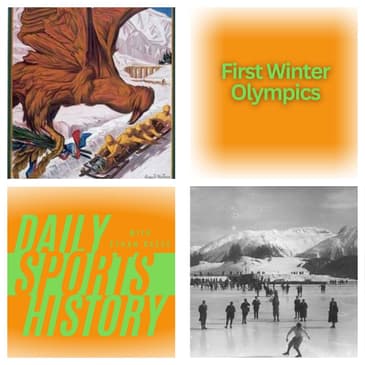
It's hard to imagine today, but there was a point when there was no Olympics, and there were even years when there were no Winter Olympics. And today we're going to go back to the history of how the Winter Olympics got started, back in January nineteen twenty four today on Daily Sports History. Welcome to Daily Sports History. I'm Ethan Reese, your guide to a rapid deep dive into sports history every day. Before the dazzling spectacles of skiers soaring through the sky and snowboards flipping through the air, there was a pioneering legend. His name was the rough Haw. In nineteen twenty four, on the grand stage of Shamani Francs, he sped down the slope and captured the world's imagination with not one, two three gold medals. Has multiple cameras now capture these feats. We journeyed back to a time where there are a mere sixteen countries gathered to compete. Was the first Olympic Games held back in January twenty fifth to February fifth, nineteen twenty four, A time when figure skate, speed skate, hockey, curling and moore took the stage. A time when Canada's hockey team established itself as a powerhouse. This was the world a century ago, but it laid the foundation for we know today the world of ice and snow, combined with athletics and making legends. Today, the Winter Olympics are celebrated every four years, and the dominant nations have evolved, but this beer remains the same, from the icy mountains of France to the bustling cities of Korea. The Games of Grome welcoming three thousand athletes from ninety two countries, including non traditional winter countries such as Nigeria, Ecuador and Malaysia. And it all began with an idea floated at the seventh session of the IOC in June nineteen twenty one. The concept of a designated Winter Olympics faced resistance from Scandinavian countries, who already had their Nordic Games, but the idea was embraced in a celebration of winter sports was set for nineteen twenty four in France. The French National Olympic Committee sept in financing the new facilities needed for the first Winter Olympics, and they estimated approximately ten thousand people would witness history. It was there that they would have twelve days a competition, and the president of the IOC declared that it was an unprecedented success and they hoped to continue to grow like the Summer Olympics had. In May nineteen twenty five, they officially named the event the first Winter Olympic Games. But what were the events themselves? In these first Winter Games? There were six sports and sixteen events, featuring sixteen nations and featuring over two hundred and fifty athletes, and Norway led the way in points, followed by Finland, Great Britain and the United States. And Charles Jutraux made history as the first American to win gold in the five hundred meter speed skating, and the Nordic skier Pharoah Haw captivated the world, winning three gold medals, cementing Norway's dominance, and his legacy lives on in the races named after him, from the depths of Norway's to the heights of Finland. Class Thurbough dominated speak skating, earning three gold medals, a silver and a bronze. Austrian ice skater Hermana Zabo dazzled judges, defeating her competition with grace in the figure skating competition, and Canada dominated hockey as they do similar today, scoring one hundred and twenty two goals and only allowing three. The final match versus the US was a teamwork battle, ending in a six to one victory. The spectators were a mix of European and Americans. They produced house and cheers as they watched competition unfold in front of them. Over the years, the Olympics have changed from their humble beginnings. Today we see everything, more countries, more sports, more athletes, more events, and more medals. Yet the challenges remain. The inaccessibility of certain winter sports to some nations persist limiting the Winter Olympic reach as it's very difficult for warm climate countries to compete and the qualification standards and requirements can be very expensive to train for. Over the years, more sports have been added and everything is now televised. We can watch an event that you want to see any time of day, and superstars have come from these Olympic Games, just as they have from the Summer Olympics. In the nineteen eighties, they made the switch instead of going the same year as the Summer Olympics, to go have the Olympics every two years. The Summer Olympics and then two years later the Winter Olympics, so that the Olympics could be in the minds of the world every two years instead of four. What do you think which is better, the Summer or the Winter Olympics. Thank you for joining us for today's daily sports history. If you want to see photos from to day's topic, you can always join us on our socials daily sports history on Twitter, Instagram, Facebook, tik tok and YouTube. Come back tomorrow for more daily sports history.