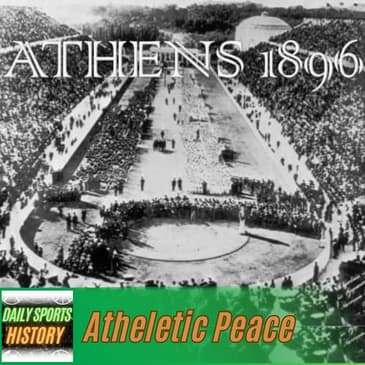
Join us as we witness the revival of the Olympic spirit, from the stirring opening ceremony to the awe-inspiring feats of athleticism displayed by competitors from around the world. Delve into the challenges faced by organizers, the historic performances of athletes, and the profound impact of the games on the world stage.
Through concise storytelling, we capture the essence of the first modern Olympics, its significance in the history of sport, and the enduring legacy it has left on the Olympic movement.
Tune in for a quick sprint through Olympic history as we celebrate the dawn of a new era in athletic competition.
Website: dailysportshistory.com
Email: dailysportshistory@gmail.com
YouTube: YouTube.com/@dailysportshistory
Twitter: twitter.com/dailysportshis
Facebook: facebook.com/profile.php?id=61551687917253&mibextid=ZbWKwL
Tiktok: tiktok.com/@daily.sports.history?_t=8hHPnNSCqfm&_r=1
#sports #sportshistory #sportspodcast #podcast #greece #olympics #nations #countries #summerolympics
Buy me a coffee: buymeacoffee.com/dailysportz
Newsletter: https://substack.com/@dailysportshistory?r=3en496&utm_medium=ios&utm_source=stories&shareImageVariant=light
DailySportsHistory.com
Email: dailysportshistory@gmail.com
YouTube: YouTube.com/@dailysportshistory
Twitter: twitter.com/dailysportshis
Facebook: facebook.com/profile.php?id=61551687917253&mibextid=ZbWKwL
On April sixth, eighteen ninety six, the opening ceremonies for the very first modern Olympics was held in Athens, Greece. There was over fourteen nations and two hundred and forty one athletes participating in nine different sports and an event that lasted over nine days. Here's the story behind the very first modern Olympics today on Daily Sports History. Welcome to Daily Sports History. I'm Ethan Reese, your guide to a rapid deep dive into sports history. Now, the ancient Olympic Games held in Greece with a number of athletic competitions for people to help honor the gods such as Zeus. Well fast forward thousands of years into the nineteenth century, they had stopped doing the Olympics were starting to do Olympic like sports. In eighteen fifty nine, eighteen seventeen, eighteen seventy five Greek businessmen sponsored an Olympic type event at the Parthenon Stadium in Greece, which had recently been refurbished and had an audience of over thirty thousand people. One of those men was Pierre de Gubertin, a French prodigy and historian who had the idea to do this event, but open it not just in Greece, but to the whole world, because it wasn't just Greece that was holding these types of events. There were small athletic events happening across the world where people were trying to show the great skill they had against everyone in the region. So Pierre tried to get everyone he could together that might have an interest in this global event. In eighteen ninety four, they all met for congress in Paris, where there was a total of eleven countries represented, and he laid out his proposal for the first modern Olympic Games, and he suggested actually be held in Paris, as he was a Frenchman, but one of the people there was the King of Greece. He said the first Olympic should be held where it all started in Athens, Greece, as they had most of the original locations and they wanted to start earlier and not nineteen hundred. But in eighteen ninety six they all eventually agreed and they later became known as the International Olympic Committee. But it wasn't all hunky dory and easy to get started, and as Greece wasn't the most financially viable place. They needed help, so they started to raise money doing fundraising and selling tickets ahead of time to help pay for all the renovations they needed. So the IOC group got together in eighteen ninety four to set some rules for the games. They said that only amateur athletes should participate and set the rules for all the events they wanted to have. They did decide that only men should participate, as Pierre said, women's inclusion would be impractical, uninteresting and incorrect. Just shows you the difference in the time. So there would be seven venues that they would host the eighteen ninety six Summer Olympics. The Parthenon was the main venue and would host four of the nine contests. The City of Marathon would host the marathon events. Swimming would be held in the Bay of z so they wouldn't have to spend money to make a pool. Fencing would be at the Zappion, shooting events would be at the CARLIETHH, and tennis would be at the Athens Lawn Tennis Club. Now the events eventually decide on including were athletics, cycling, fencing, gymnastics, swimming, tennis, weightlifting, and wrestling. Between those nine sports, they would have forty three different events. Now, one thing that they did decide on that they didn't set in place that later became popular, was they did not have everyone separated by nation. Sure, they would represent their nation wherever they went, but they were not be nation teams. Each athlete would be there individually and retroactively they would separate them by country as we have a medal count for that first Olympics, but each one was there not by their country but by themselves. And on Easter Monday, April sixth was the very first opening ceremony. This was very different than what we have today. Although there were many in attendance and there was a parade, there was not the flame that we are used to, and not everyone walked with their country. But there was nine bands and one hundred and fifty choirs singing throughout the opening ceremonies, and the awards for winning were very different. They would wait till the final day of the Games where the King would actually hold a banquet with all the athletes and give them their award after a speech. First place would get a silver medal along with an olive branch and a diploma, and then runner up would get a copper medal with the Laurel branch and a diploma, and third place would receive nothing. And there were fourteen countries represented in this Olympics, including Austria, Australia, Bulgaria, Chile, Denmark, France, Germany, Great Britain, Greece, Hungary, Italy, Sweden, Switzerland, and the United States, and the final medal count when they retroactively separated them by country, ended up with the United States on top with eleven golds, with Greece close behind with ten in Germany finishing in third, and Greece did finish with the most medals, but they also had ten times the amount of athletes as any other country in the event as it was their home event. Later they would change much during the first few iterations of the Olympics, changed to go every four years, changed the location that hosted it, and add a woman to the participation as well as other athletic events. But this was a great start to allow a peaceful competition around the world for everyone to watch and enjoy the time every four years that we got to see the Olympics. Thank you for listening to today's Daily Sports History. If you like this, please like and subscribe wherever you're listening. That always puts a smile on my face. Any time I see a review or alike, it makes me so happy, and I love to hear how you are enjoying the show and anything we can do to make it better. And come back tomorrow for more daily sports history.