We are being featured on PODCAST GURU:
https://app.podcastguru.io/podcast/daily-sports-history-1715849627
Website: dailysportshistory.com
Email: dailysportshistory@gmail.com
YouTube: YouTube.com/@dailysportshistory
Twitter: twitter.com/dailysportshis
Facebook: facebook.com/profile.php?id=61551687917253&mibextid=ZbWKwL
Tiktok: tiktok.com/@daily.sports.history?_t=8hHPnNSCqfm&_r=1
#sports #sportshistory #sportspodcast #podcast #BostonMarathon #RoadRaces #MarathonHistory #RunningEvents #AthleticTraditions #SportsHeritage
Buy me a coffee: buymeacoffee.com/dailysportz
Newsletter: https://substack.com/@dailysportshistory?r=3en496&utm_medium=ios&utm_source=stories&shareImageVariant=light
DailySportsHistory.com
Email: dailysportshistory@gmail.com
YouTube: YouTube.com/@dailysportshistory
Twitter: twitter.com/dailysportshis
Facebook: facebook.com/profile.php?id=61551687917253&mibextid=ZbWKwL
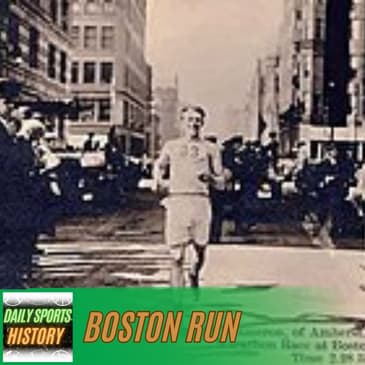
On April nineteenth, eighteen ninety seven, John J. McDermott of New York wins the very first Boston Marathon, running in just under three hours starting was arguably known as the best marathon in America, impossibly the whole world. And here's the story behind how it all began. Today on Daily Sports History, Welcome to Daily Sports History. I'm Ethan Reese, your guide to a rapid deep dive into sports history. Now, the Boston Marathon was the brainchild of the Boston Athletic Association and one of its members John Graham, who actually participated in the very first Modern Olympics in eighteen ninety six. Now, on a previous episode, we talked about the Modern Olympics and the marathon was one of those events. Now, at this time, the marathon didn't have an actual distance that was supposed to be. It was thought to be around twenty four twenty five to twenty six. It may change based off where you're actually running the race. Now it's twenty six miles in three hundred and eighty five yards or forty two point one nine five kilometers, and that's been set since the early nineteen hundreds. But in the late nineteen eighties that wasn't set yet, not even at the original Olympics. And the marathon is actually based off an ancient run done by Philtitis in the Greek mythology from Marathon to Athens to send a message about the Battle of Marathon, which is roughly about twenty four miles apart, and that's where we get the distance that we start with today. The Boston Athletics Association were better known as the BAA, wanted to put together a marathon like they did in the Olympics, so they'd looked for various locations and they set it on the Irving Oval in Boston to the Metcalf Mill in Ashland, which was roughly twenty four point five miles. And back then athletic clubs were all over the country. It was similar to YMCA's or gyms you would have today, but they were all local and every gym kind of sponsored their athletes in different competitions, and some would put on athletic competitions like the Boston Athletics Association did for the marathon. So it was just a very different time in culture of how these things got started, and so everyone in the Boston Athletics Association was a sports enthusiast, or an entrepreneur, or a politician, somebody that wanted to put on events and wanted to be a part of the community. And the BAA actually put in their constitution that they encouraged all manly sports to promote physical culture. Yes, they said, mainly, which will actually come into play as women were not able to participate in the Boston Marathon until the nineteen seventies. But the Boston Athletic Association was a gym. They had facilities at a gymnasium, a bowling alley, a billions hall, Turkish bath, tennis courts, shooting ranges, a country club, and they had daily activities such as boxing, fencing, water polo, running, track and field events in their first competition, the track and Field competition, which they eventually transformed later into their Boston Marathon, where John J. McDermott actually won the first marathon where he was part of the Knickerbockers Athletic Club of New York and he had actually participated in another marathon held in New York a few months prior, and he was one of only fifteen of runners in that first Boston Marathon, and six of them were all from New York and he he said that he lost ten pounds over the course of the race, and he didn't take the lead for the race until eight miles into the competition when he was going downhill at the Newton Lower Falls. But then that's where he started to increase his lead. Despite running into a funeral procession and two stalled cars, he was able to maintain his lead and finish two hours, fifty five minutes and ten seconds, three minutes and forty seconds faster than Spender Lewis, who won the Olympic Marathon a few months earlier, and at this time it was a world record for a marathon. After the marathon had he had bloody im blistered feet, his skin was starting to peel off, and he said this would be probably his last long race, although he returned the next year to defend his title, but he only finished fourth in the second Boston Marathon, and the Boston Marathon would go on to become a staple in Boston and the worldwide, and it's held every day on Patriots Day unless that falls on a Sunday, and they even ran during each World War, entering the Great Depression and as the oldest annual marathon ran to this day. In nineteen twenty four, they added length to the marathon, making it the official miles that we know today. Now, it hasn't been all fun in games with the marathon. In nineteen oh five, James Edward Brooks actually passed away of pneumonia running the marathon, and in nineteen ninety six, a sixty one year old Swedish man named Humphrey Cisage died of a heart attack attempting his one hundredth marathon. In two thousand and two, Cynthia the Crow passed away of hypothermia at the age of twenty eight. The worst of all was back in twenty and thirteen when terrorist attacked spectators, wounding over two hundred and sixty spectators and killing three of them. One of these two men that did this attack was killed, another was taken into custody, and it was one of the saddest moments in sports history. But the Boston Marathon continues to go to this day, representing those that have been lost and showing the pride of all the patriots to not give up. The only time the Boston Marathon has not been held was in twenty twenty during the pandemic, but has since resumed continuing the great tradition to this day. Thank you for listening to today's daily sports History. If you like this, please hit that share button wherever you're listening, send it to a friend and say, hey, check this out. Learn more about sports with me, and we can go to the sports trivia night and dominate if you're into that kind of thing. I don't know, but come back tomorrow for more daily sports history. He painted on the