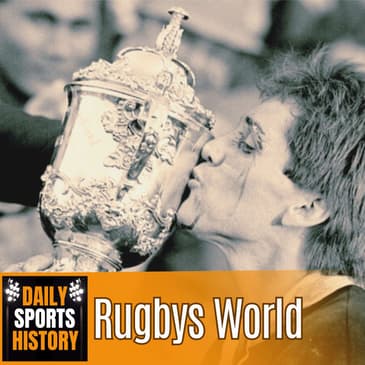
Join us on Daily Sports History as we explore the origins of the Rugby World Cup and delve into the inaugural tournament held in 1987. Learn about the key figures and decisions that led to the creation of the World Cup, and relive the excitement of the first competition where New Zealand emerged as champions. Discover how this historic event shaped the future of rugby.
#DailySportsHistory, #RugbyWorldCup, #1987, #RugbyHistory, #NewZealandRugby, #InauguralWorldCup, #SportsPodcast, #RugbyLegends, #HistoricEvents, #WorldCupOrigins, #RugbyChampions
Buy me a coffee: buymeacoffee.com/dailysportz
Newsletter: https://substack.com/@dailysportshistory?r=3en496&utm_medium=ios&utm_source=stories&shareImageVariant=light
DailySportsHistory.com
Email: dailysportshistory@gmail.com
YouTube: YouTube.com/@dailysportshistory
Twitter: twitter.com/dailysportshis
Facebook: facebook.com/profile.php?id=61551687917253&mibextid=ZbWKwL
On June twentieth, nineteen eighty seven, New Zealand took on France in the very first Rugby World Cup held in New Zealand, where they defeated France twenty nine to nine to win the very first Rugby World Cup. Here's the story behind how the World Cup started and this first match today on Daily Sports History. This episode is brought to you by Our Weird World. Every week, I John Henson dive into weird, crazy and forgotten stories from the history books that you have probably never heard before. I try to put some humor into it, or maybe I just come off sounding like a dick. That's really up for you to decide. But join me every Monday subscribe everywhere that you get your podcasts. I'm Ethan Reese, your guide to a rapid deep dive into sports history every day, and today's trivia question to listen out for is how many teams participated in the very first World Cup. Now, rugby has been around since the eighteen hundreds and was a very popular sport throughout the nineteen hundred and started to catch steam in the nineteen eighties and nineteen nineties, but up until nineteen eighty seven, there was no global union like soccer does in FIFA for the World Cup, which we talked about in a previous episode, which started way back in nineteen oh four. Now, there was a governing body known as the International Rugby Football Board that started in eighteen eighty six which featured Scotland, Wales, Ireland and England, with England joining in eighteen ninety and they continued to add members as they went but this wasn't a global thing as it was mainly just an organization that made the rules, but they didn't put on rugby events. But it continued to grow throughout the years and now it has over one hundred and thirteen members. But there were other tournaments that were very popular, such as the six National Championships which was which was a European championship that featured England, France, Ireland, Italy, Scotland and Wales as one of the oldest tournaments in all of sports. And also rugby got featured in the Paris Olympics in nineteen hundred and was featured at the London Olympics, the nineteen oh eight, nineteen twenty and nineteen twenty four Olympics, but sadly it has not been featured in the Olympics since nineteen twenty four, and many times the IRFB tried to discuss a possible World Cup as they saw the success of the Soccer World Cup, but there was always opposition and they could never get a consistence on where to hold it, when to hold it, and put the whole tournament together. They had country they proposed options in nineteen eighty three, nineteen eighty four and in nineteen eighty five, and in nineteen eighty five they actually got the votes they needed to pass the proposal ten to six for all the sixteen countries involved in the union. And they had a unique situation where the host of this World Cup would actually be two countries in Australia and New Zealand, as they are somewhat near each other in the specific ocean and lessen the burden on each country to host. And for this very first World Cup they did not need to have it qualifying as they just wanted to get the just invited teams that wanted to play, and there were sixteen available spots and seven of them were filled by the seven members of the International Rugby Football Board, which included Australia, France, New Zealand, Ireland, Scotland, England and Wales now South Africa was a part of this but due to a part tide policies at the time, they were excluded as they were boycotting sports. And then they invited other nations who had quality rugby programs and those other nations were Zimbabwe, Argentina, Canada, United States, Japan, Italy, Romania, Fiji, Tonga, and they did extend an invite to the Soviet Union but they declined. So they decided this and they had it all set to take place in nineteen eighty seven between the dates of May twenty second to June twentieth, when they would hold their championship and it would be a pool stage match style where each of them are divided into groups and the winners of those groups go on to the second part of the tournament. They'd hold twenty one matches in New Zealand and have eleven matches held in Australia. So the first pool included Australia, England, Japan and the United States, where Australia and England would come out of this pool. The second pool was Canada, Ireland, Tonga and Wales, where fivet where five matches were held in New Zealand, with one in Australia and this was won by Wales in Ireland. The third pool was New Zealand, Fiji, Italy and Argentina won by New Zealand and Fiji and this would be held in New Zealand and the fourth and final pool was France, Scotland, Romania and Zimbabwe. Won by France and Scotland and this was held in New Zealand as well. And if you noticed, the seven union countries were very dominant and they all advanced to the next round. So then after pool play they went to a knockout stage which is similar to the playoffs that we have in America like the NFL one game winner take all move on to the next round. And they were seeded by how many points they got in their pool play and the winners of the first round were New Zealand, Wales, France and Australia. So they took place in the semi final round where New Zealand absolutely dominated Wales, winning forty nine to six and headed into the World Cup Final where France had a hard fought battle against Australia, winning thirty to twenty four and headed on to take New Zealand now. They did hold a third place game where Wales faced off against Australia and Wales and it was a close game where Wales won by just one point twenty two to twenty one, which was held two days before the championship. And a quick explanation of the points for rugby, a try is worth five points and is when the ball is scored crossing the goal line on the ground and a penalty try is when he would have scored on a try but there was a foul on the play and that's where seven points. A penalty is awarded. When a team chose to kick is when there was infringement by the opponent and the team chose to kick a goal after that the conversion is after the try the team would take to add two further points by kicking the ball over the cross between the two posts and that is worth two points. A drop goal is worth three points and that is when a player kicks the ball for a goal in open play. So the final match was held in Eden Park in New Zealand, which was a home matchup for New Zealand which gave them and it was broadcast by both ABC which is the Australian broadcast system, not the one we have in America and the United Kingdom's BBC. But coming out, it looked like France had given all they could in their final in their semi final bout against Australia, as they looked very lackluster and New Zealand quickly took the lead, playing mainly a kicking game as they scored a drop goal with fourteen minutes into the game and then they got a try just three minutes later, giving them a nine to zero lead at the half. Now the second half, France comes out and tries to fight their way back, getting a penalty four minutes into the half, finally putting them on the board, and France fought back, but this was just a little bit too late and after this New Zealand took off as they got two tries and took their lead to twenty nine to three, which was just too much to come back from and they ended with the final score of twenty nine to nine in front of mostly home fans of forty eight thousand spectators. Now France would go on to be in the finals in nineteen ninety nine and twenty and eleven, but they have not won a World Cup just yet, and New Zealand would not win a World Cup again until twenty and eleven, and they would win again in twenty and fifteen, which until two thousand and twenty three was the most that any country had won until South Africa passed them, winning the twenty twenty three World Cup, giving them four World Cup wins. Thank you for listening to today's Daily Sports History. It means a lot to me they did this. Please if you could share about us on your social media, share us with a friend, let everyone know about all the sports you're learning in the history behind it, and come back tomorrow for more daily sports history. And did you catch the answer to today's trivia question how many teams were in the very first World Cup? The answer is sixteen and the last World Cup in twenty twenty three had twenty nations and thirty four attempted to qualify