Listen now! 👉 DailySportsHistory.com 📲 Follow for more daily sports history insights!
Email: dailysportshistory@gmail.com
YouTube: YouTube.com/@dailysportshistory
Twitter: twitter.com/dailysportshis
Facebook: facebook.com/profile.php?id=61551687917253&mibextid=ZbWKwL
Bluesky: https://bsky.app/profile/dailysportshistory.bsky.social
https://www.instagram.com/dailysportshis/profilecard/?igsh=OWl1MzIyYndqOGU2
Threads
https://www.threads.net/@dailysportshis
#EricLiddell #OlympicHistory #ChariotsOfFire #SportsLegends #OnThisDay #Olympics #Athletics #SportsInspiration #FaithAndSports #Paris1924 #TrackAndField #HistoryMakers
Buy me a coffee: buymeacoffee.com/dailysportz
Newsletter: https://substack.com/@dailysportshistory?r=3en496&utm_medium=ios&utm_source=stories&shareImageVariant=light
DailySportsHistory.com
Email: dailysportshistory@gmail.com
YouTube: YouTube.com/@dailysportshistory
Twitter: twitter.com/dailysportshis
Facebook: facebook.com/profile.php?id=61551687917253&mibextid=ZbWKwL
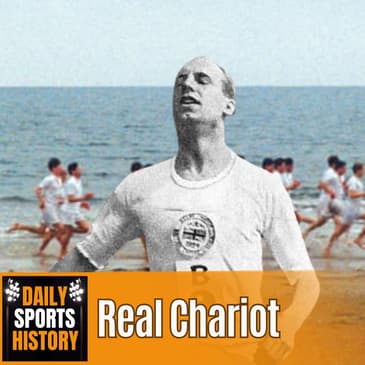
Imagine standing at the starting line of the nineteen twenty four Paris Olympics. Your country in the world expects you to win the one hundred meters. You are by far the favorite, but the race is held on Sunday, and you are a man of faith, and you refuse to run on Sundays, so you give up that medal, but instead you step on the track for a race you don't run the four hundred meter and make history winning that race to win gold. That is the story of Eric Lindall, an Olympic champion that went on to be told one of the most iconic sports movies of all time, Chariots of Fire. If we're going to dive into his story about how this all happened today on Daily Sports History, let's go. Welcome to Daily Sports History. I'm Ethan Reese, your guide because I carbo load every day like an an Olympic athlete. So first we got to go back to how Eric Lindell got here. Born in nineteen o two in Tangent, China to Scottish parents who were missionaries part of the London Missionary Society. His parents were deeply committed to their faith, in a legacy that would shape Eric's character from the start. At the age of five, Eric and his older brother left China to go to Eltham College, just south of London. It was a boarding school for sons of missionaries, and life here was marked by many kids being separated from their families, many of who remained in China. But despite all these challenges that Eric faced, he actually thrived ethemically and athletically. He won the prestigious Blackheathed Cup, which was given to the school's top athlete, and he captained both the cricket and the rugby team by the age of fifteenth. His headmaster described him as entirely without vanity, so despite him being such a good athlete, he was not cocky like the average jock, and his athletic prowess actually went beyond the school. He became a standout rugby player and earned a place on the Scottish national team and actually participated in seven international matches. However, his true love and where he left his true mark was on the track. By the time he entered the university in nineteen twenty to study pure science. Now, this is common for people of faith that enjoyed science, but by this time Eric was known and recognized as the fastest runner in Scotland and he would regularly draw large crowds and media attention just to the races he competed in, and everyone touted him as the next Olympic contender. But through all of this Eric maintained his faith and would visit hospitals to volunteer all over the country using his platform. He gained from athletics and while at the University of Edinburgh he actually was doing great on the rugby, but his speed on the track kept overshadowing it, and by nineteen twenty three he had set the British record for the one hundred yard dash at nine point seven seconds, and that record would stand for twenty three years. He would also win the one hundred and the two hundred and twenty yard dash at the Trade Championships that year. He was known to be the top sprinter in Britain by a long shot. The following year, in nineteen twenty four, was the Paris Olympics, and this was what made Eric Lindall really stand out because he qualified and he was set to run the one hundred meter, his best event. Everyone thought he was going to win it hands down. It was like Usain Bolt running win the one hundred. Now he knew he was going to win, but when the schedule came out, the one hundred meter dash was set to be run on Sunday, and Eric was still a devout Christian. Due to his beliefs, he did not believe he should compete on the Sabbath. So what he did was changed his focus to the two hundred meter. In the four hundred meter races, most sprinners that run the one hundred do also run the two hundred meter. That's not a surprise, but the four hundred meter is what was really surprising. That's a huge gap in running terms. You're going from short distance to mid distance, and most runners don't do that. But these races were not ran on the Sabbath, so he could actually run both of them. So his first event was the two hundred meter and the field was stacked, but he was able to run fast enough to get a bronze medal. Then on July eleventh, nineteen twenty four, he ran the four hundred meter dash. Now, his best attemp at this was forty nine point six seconds, wasn't really considered a competitive time against the rest of the world, yet on this day, running against the best competition, despite not having everything ready, he used his faith to help him do something he's never done before. The atmosphere was electric. A pipe band was playing just outside of the stadium, giving a nod to his Scottish roots, and Eric drew the outside lane, unable to see his competitors. And the four hundred is a unique race. You're still sprinting, but you want to hold back a little bit to try to make it up at the very end and give you're all at the end. But he didn't do that because he doesn't know how to run the four hundred. So he exploded out of the blocks. And if you know anything about the outside lane, it's you can't see anybody. You're ahead of everybody. Everyone else is behind you because they stagger it on the turn, because that's how it makes it equal. So he starts ahead of everybody and he bust out of the blocks just like he's running the one hundred, and he reaches the halfway mark the two hundred meter with twenty two point two seconds, just zero point three seconds slower than his two hundred meter time he had just ran. And everyone was convinced he would just fade away. Yes, he could run that distance and he was ahead of everybody, but no one was. At this point, he couldn't see anybody, so he just kept running the same speed and he didn't fade like normal sprinters do. He kept that speed through the entire lap and he would cross the speed with a time of forty seven point six seconds, which broke the Olympic and world record. No one expected this guy to win. He only did this race because of his fate. It was the only one he could run because they couldn't run his best race. So what would you do after this? You have fame and glory. Everyone's so excited. Your story is amazing, so amazing that it would be made into a movie years later with that iconic soundtrack. So do you step into that fame? No? He left behind his glory after he was done with college and went to go serve as a missionary in China, just like his parents, and he became a teacher at an Anglo Chinese College, teaching science, English, and sports and quickly became beloved and shaped a generation of Chinese leaders through educational sports and Christian values. And just ten years after he won his gold medal in the four hundred, he would marry Florence McKenzie, who was a missionary nurse, and during World War Two, him and his wife wereked to save civilians and soldiers throughout the time until he told his wife and kids to go to Canada for safety while he stayed there to serve the Chinese in need. Then he would be interned by Japanese with over two thousand foreigners in harsh conditions, but used his faith to get through and after years in the camp, he was able to be liberated, but would pass away just a few from a brain tumor. Now after this, his story started to spread about how he was selfless and he used his faith to help through this time. In some of the worst conditions in an interment camp, he still helped guide others through his faith, and in nineteen eighty one his story or would be broadcast to the world when it was immortalized in the Oscar winning film Charity to Fire, a story that showed conviction and courage to a new generation. His refusal to run in his improbable victory and what it symbolized for sports in life, and also gave us one of the greatest sports songs ever. He would be inducted into the Scottish Sports Hall of Fame. Memorials of him are in China and the UK to honor both his athletic and missionary work. And what his story really shows is that life is more than sports. He was also able to touch even more off the track, and I think that's what we often forget about. All these sports are great, but what are they doing off the field? Off the track? Who they are as a person is what it really means in life. So the question is do you believe in something so much that you would give up a sure thing? Like Eric Lindell. Thank you for listening to Today's Daily Sports History. If you like this, please make sure you like and subscribe wherever you're listening. This show is produced, written, recorded, and published by me Ethan Reese and I can't wait to see you on the next one.