#DailySportsHistory, #EddieGaedel, #BaseballHistory, #MLB, #BillVeeck, #SportsPodcast, #UnforgettableMoments, #StLouisBrowns, #BaseballLegends, #HistoricAtBat
Buy me a coffee: buymeacoffee.com/dailysportz
Newsletter: https://substack.com/@dailysportshistory?r=3en496&utm_medium=ios&utm_source=stories&shareImageVariant=light
DailySportsHistory.com
Email: dailysportshistory@gmail.com
YouTube: YouTube.com/@dailysportshistory
Twitter: twitter.com/dailysportshis
Facebook: facebook.com/profile.php?id=61551687917253&mibextid=ZbWKwL
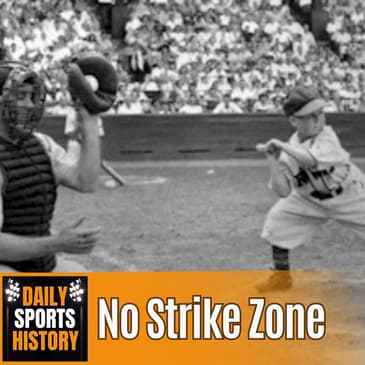
On August nineteenth, nineteen fifty one, Eddie Gaudell becomes the shortest player to ever play in a Major League Baseball game for the Saint Louis Browns. At a height of three feet seven inches, he is put into the batter's box, having the smallest strike zone possible and led to a rule being changed in baseball. Here's the story behind Eddie and all that went into his iconic moment in Major League Baseball today on Daily Sports History. Welcome to Daily Sports History. I'm Ethan Reese, your guide to a rapid deep dive into sports history every day. And today's trivia question is what number did Eddie wear when he took his at bat for the Saint Louis Browns. So to understand why Eddie was even given the opportunity to get a major league at bat, you have to understand what a strike zone is. Now, a strike zone is obviously over the plate, so the ball has to travel over their plate, but it's also from a batter's shoulders all the way down to their kneecaps, so every batter has a different strike zone. And the smaller players actually have a smaller strike zone, which means they have a better chance to get walked so possibly get on base and requires pitchers to be more accurate. And another reason why Eddie got a shot at this was the owner of the Cleveland Indians. Now you've heard on a previous episode on Satchel Page that Billy Vivek loved to promote. He would take Satul Page, who was in his forties before he ever made the Majors, to pitch all over, including pitching Satchel Page when he was fifty nine in a game versus the Boston Red Sox, making him the oldest player. But in nineteen fifty one he had a new idea for the shortest player to ever play in the league. Now. Eddie Godell was born in Illinois to immigrants that required him to work very hard, and even though he had a version of Dwarfism and is a little person, it didn't mean he didn't actually work. He actually found work during World War Two as a riveter because he was able to crawl inside the wings of airplanes and get to those hard to reach places that an average sized person couldn't get to. And he also found some work doing some vaudeville shows or circus acts, which at the time was very common for little people to do, as they would have tall people, short people, big people, overweight people, people with lots of hair, quote unusual looking people for people to come see, and he would be hired for different events. Mercury Records actually hired him to portray the mascot Mercury Man, and he would go on to become the logo at the time for the record company. So as he was doing all these little acts, he caught the eye of Billy Viveck, who had an idea to have a short person playing a game because he would have a very small strike zone. So he contacted up the booking agency that Eddie worked for and he signed him to the Browns. But he did this without anyone knowing. He didn't want to cause a stir, and he also knew this was kind of against the rules. It was a gray area of baseball at the time. So on August nineteenth, nineteen fifty one, they had a double header against the Detroit Lions, and in between the games, they were celebrating the fiftieth anniversary of the American League, and they actually had Eddie pop out of a paper machet cake to celebrate the event. Something very common for performers to do. And when he popped out, Eddie was wearing a jersey that had the number one eighth on it, a fraction saying he was a fraction of a person. So in the bottom of the first inning of the second game of the double header, Eddie came out for the first at bat, pinch hitting for Frank Saucier, and the umpire was a bit confused and he called the manager of the Browns because he didn't think that this was an actual player, and he actually came out with a copy of Guardial's contract. Now we talked about it being a secret. They signed the contract on a Friday and submitted it last minute to the league office. Now, the league office worked Monday through Friday, so if you submitted something that came in last minute on a Friday, it wouldn't get seen till that Monday. So you could get by with some gray area stuff. That's exactly why his contract kind was valid for the umpire, but necessarily wasn't valid for Major League Baseball. But the umpire looked at the contract and allowed Eddie to step into the batter's box. Now Billy had told Eddie not to swing at anything he wouldn't have to, but it looked like Eddie was really trying to swing. He got into an actual stance and looked like he was going to swing the bat to chance at hitting the ball. And so he actually took a million dollar insurance policy out on Eddie's life, making sure he would be safe as he was a smaller person and didn't want anything bad to happen. Now, Eddie's strike zone when he stepped in there, when he crouched down into a stance, was about one and a half inches high, because he really crouched down really low and made it almost impossible to throw a strike. In that game, pitching was Bob King, who thought this was all a joke, and the catcher, Bob Swift, actually got down on his knees to try to get low enough to give a target for Cain to actually pitch, and he told him just pitch it low as much as you can. But Bob Kane didn't have the accuracy and most people wouldn't to be able to make that, And on four consecutive balls they were all high and it was four balls and Eddie got to take his base, becoming the smallest player to ever get on base, and as he took his way to getting the first base, he actually bowed to the crowd two times as they were all cheering and excited, and he was replaced by a pitch runner, and there was eighteen thousand fans in the stadium giving him a standing ovation as he left. Now, Billy hoped know this strategy would work. He got an automatic man on first base in the first inning, maybe they would go on to score, but sadly he would get stranded at third and the Tigers would go on to win the game six to two. Now, because he was pitched run four by the rules, Eddie couldn't come back in and hit again. So we only got that one at bat. And on Monday, the American leagues vetoed the contract, saying they made a mockery of the game and say they changed the rules that no one could play a game unless the contract was approved by the Commissioner of Baseball, which seemed like it should be a rule in place. But as we've talked about before, sports is often reactive and not proactive. And Bivack actually came back and actually kind of threatened to threaten that and said that Phil Rizzuto, who was the American MVP only stood five to six and maybe he's just a tall dwarf. Now this was a silly argument, as five six and three foot seven is very different in size, and Eddie didn't play baseball. This was strictly a ploy or a gimmick, not an actual player. Now, Initially, Major League Baseball struck Eddie from the record books, saying it didn't happen, but a year later he was re enlisted. So he had an on base percentage of one thousand, and he heard one hundred dollars, which is equivalent to about twelve hundred dollars today, was about the price he would get paid, which was about the price of his appearance fee for any event. Now, this wouldn't be the last time that Billy Vveck would call on Eddie, as in nineteen fifty nine, after Billy had acquired the White Sox, he actually had Eddie and three other little people dressed up as spacemen and invade the park. And as at that time UFOs in space was all the rage, and in nineteen sixty one he would again hire Eddie and several other little people as vendors as a joke for the complaining fans saying that the vendors were in the way and they would miss the game. And so this allowed him to have vendors and yet they not get in the way because they were so short. Now, unfortunately, that same year, in nineteen sixty one, on June eighteenth, Eddie was at a bowling alley in Chicago and after he left, he was followed and beaten to death. Now, the coroner said he died of a heart attack, but the family said he had way too many bruises for to just be heart attack, so it was never really investigated. It's a sad way to see his life end at just thirty six years of age, especially since he was a smaller person and probably couldn't defend himself even if it was just one person or multiple people. It's a sad way to end, but his legacy does live on. He is one of only five Major League players to draw a walk in their only appearance, and his great grand nephew, Kyle Goodell would actually get drafted by the San Diego Padres in twenty eleven and make it as high as Double A in the minor leagues. So baseball was in his blood and in nineteen ninety four, Mike Fiveck, who was Billy's son who owned the minor league Saint Paul Saints team, had Bob Kane reenact it with a ten year old with the manager's ten year old son playing the Eddie rule. And because Eddie didn't know, wasn't a baseball player, and wasn't involved in a lot of things, he didn't sign a lot of autographs, and so his autograph, if you are able to find it, sells more than Bay Bruce autograph as it is so scarce. I want to thank you for joining us today on Daily Sports History, and I hope you enjoyed this random moment in sports history. And if you like this, please subscribe wherever you're listening. That way you don't miss out on any of our episodes that come out, because we're gonna come back tomorrow for more Daily Sports History. And today's trivia question is what number did Eddie wear when he took his hat bat for the Saint Louis Browns. Eddie was wearing a jersey that had the number one eighth on it, a fraction saying he was a fraction of a person.