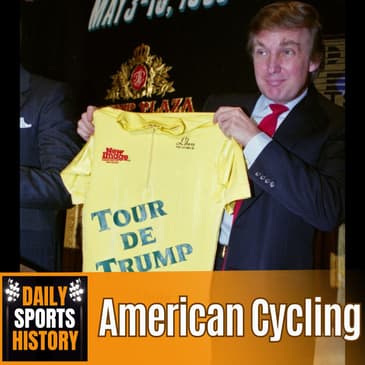
On May 5, 1989, the first Tour de Trump kicked off in Albany, NY, launching an 837-mile, 10-stage race that brought world-class cycling to the US. Backed by Donald Trump and modeled after the Tour de France, the event attracted top international teams, including cycling legends like Greg LeMond and Dag-Otto Lauritzen. The race traversed five states, ending with a dramatic time trial outside Trump Plaza in Atlantic City. Despite controversy and spectacle, the Tour de Trump elevated American cycling’s global profile and paved the way for future events like the Tour DuPont. Discover the drama, the rivalries, and the legacy of this unforgettable sporting event.
Check out Roadman Cycling Podcast
https://www.roadmancycling.com/
Get the written podcast newsletter:
https://substack.com/@dailysportshistory?r=3en496&utm_medium=ios
📅 Listen now! 👉 DailySportsHistory.com 📲 Follow for more daily sports history insights!
Email: dailysportshistory@gmail.com
YouTube: YouTube.com/@dailysportshistory
Twitter: twitter.com/dailysportshis
Facebook: facebook.com/profile.php?id=61551687917253&mibextid=ZbWKwL
Bluesky: https://bsky.app/profile/dailysportshistory.bsky.social
#TourdeTrump #CyclingHistory #SportsHistory #TourdeFrance #AmericanCycling #DonaldTrump #TourDuPont #ProCycling #GregLeMond #DagOttoLauritzen #1989 #AtlanticCity #AlbanyNY #CyclingLegends
Buy me a coffee: buymeacoffee.com/dailysportz
Newsletter: https://substack.com/@dailysportshistory?r=3en496&utm_medium=ios&utm_source=stories&shareImageVariant=light
DailySportsHistory.com
Email: dailysportshistory@gmail.com
YouTube: YouTube.com/@dailysportshistory
Twitter: twitter.com/dailysportshis
Facebook: facebook.com/profile.php?id=61551687917253&mibextid=ZbWKwL
Did you know that the United States try to compete with the Tour de France. Well, at least one man did. Donald Trump somehow got full in a race to help compete in America with the Tour de Fronce, calling it the Tour de Trump, spending over eight hundred miles in ten stages, starting in Albany, New York, finishing in Atlantic City, covering five different states, featuring the likes of stars like Greg Lemon, who had just won the Tour de Fronts. The race featured dramatic moments, challenging weather, and was won by a writer from Norway. But what happened to this race? Why is it still not around? Joining us today as we dive into the Tory Trump in cycling in America today on Daily Sports History. Welcome to Daily Sports History, I mean Fan Reese, your guide as you daily learn more about sports history, increasing your sports Now as we dive into the Tour to Trump. So in the cycling world, we all know about the Tour de France. It's like the biggest race across the world. Now it's only in France, but it's known throughout the world. It's the biggest cycling race there is. But there's some other races that are pretty big. There's the Guero de la Daia, which is held in Italy, the Espaniana, which is held in Spain, and those are known as the Grand Tours, the three Majors. Just like in tennis and golf, they have their majors, but all the top races are in That doesn't mean we don't have races here in the United States. We have the Tour California, which is one of the most prestigious US races, attracting top international competition. We have the Tour of Utah, the Tour of Gila, which is held in New Mexico. Those are three of the most premier professional stage races. And maybe it's because our races don't sound as pretty as the Tour de France the Tour of Utah. I mean that that doesn't sound engaged. And it's a simple reason why it's more popular in Europe than it is here, because cycling is more common in Europe. Cycling is woven into the daily life and nationality of some cities. There are cities in Europe that you cannot get to with a car. At most you can have a moped, but many used bikes as their main form of transportation, so cycling is woven into it, whereas in America, cars are woven into what we have to day. Most of us have to take a car to work, have to take a car to the grocery store, have to take a car to school. Anything we do, we have to take the car to whereas in Europe you can do all those things by walking or riding a bike. So that transition really is probably why there is more support for racing across Europe than here. Also, it started earlier the twitter France, and we're kind of started there before they came here. At the time they were starting in the eighteen hundreds, we were still in the midst of finding our own independence and having the Civil War, and while we were doing that, Europe had wars as well. But you know, they were focusing on growing tours and things. That's why a lot of things in Europe are older than they are here. As simple as that. But that doesn't mean we can't jump into the game. But there was a race attempting to go after the tours of France, and that was the Tour de Trump. Now this didn't start with Trump, and it didn't start with cycling. It actually started with a basketball commentator named Billy Packer and a TV reporter named John Tesh in nineteen eighty seven. Tesh had to cover the Tour de France for CBS as it was so big that was being covered in the eighties by America, and it was suggested that to Parker that America needed a grand cycling event just like the Tour de France. When you go over to these international competitions and see all the support and joy that they have there and everything that surrounds it, you're like, Okay, this makes sense, we should have this in America. Now. Neither of these men had any experience with cycling, but Parker saw it as a major event that could be tied to his businesses in Atlantic City to His first idea was the Tour Dey Jersey going from Manhattan to Atlantic City. Now and his initial idea was to go to Atlantic City casinos executives with a concept, but he stalled out. But he did approach Mark Edis, the executive at the Trump Casino, who quickly arranged a meeting with Donald Trump and Manhattan Now. Trump hadn't ridden bicycles since childhood, had no cycling background. It was skeptical, but saw the promotional appeal. He saw CBS covering it, he saw the crowds there. He thought this could be something that could be exciting, so he challenged Parker to secure the city permits to tests commitment, and Parker succeeded, and Trump agreed to be the primary sponsor, but the event would have to carry his name, and that's how it became the Tour Day Trump. And Trump actually announced the race in late nineteen eighty eight as a direct rival to the Tour de France, aiming to elevate American cycling, and he put up a two hundred and fifty thousand dollars perce to cover the prize money. That'd be over half a million dollars today, but it was still just a third of what the Tour de France was doing. But it was a start, and with Trump's branding at front and center, he believed his name would attract top talent and global attention, stating that a lot of racers came because of the name and that this would likely make this the equivalent to the Tour de France. Now. The race was set to start on May fifth, nineteen eighty nine, stretching eight hundred and thirty five miles over ten stages across the northeastern United States, starting in Albany, New York and finishing in front of Trump Casino in Atlantic City. Now. The stages would include flat sprints, rolling hills, challenging mountain terrain, particularly through Pennsylvania and Maryland, and the final stage would be a time trial in Atlantic City. Now. Invitations were sent out to race organizers aiming to attract the top international squads and American squads, and the race would include one hundred and fourteen writers from fifteen different countries and included Greg LeMond, who just won the Tour de France, giving it instant credibility, and he was American. Now. There were no specific qualifications to get into the race. Teams were accepted based on reputation, international standings, and organizers' desires for competition, and the race itself would be covered by MBC, who agreed to broadcast six hours of the event, a rarity at the time because this was pre satellite, so you had about five channels total and to have one of them cover your event for six hours was huge. It really gave it credibility in America. Now it got off with a bang, having an individual trial we through opening New York, won by viet Lev Kama of Russia, who actually go on to win stage one as well. And Stage one was Albany, New York to New Pals, New York. Stage two was New Palace. Next stage was Allentown, PA to Writing PA. Next stage was Reading PA to Harrisburg, PA. Then Harrisburg, Pa. To Baltimore, Maryland. Baltimore, Maryland to Washington d C. Washington d C. To Richmond, Virginia, and then Richmond, Virginia to Atlantic City. In Atlantic City, they held another individual time trial which held the only win by US writer and Ron kielv, but he was not the overall winner. The winner ended up being Dagado Lareensen of Norway, who ended up winning stage four, five, seven, and eight, winning the most stages out of any writer with a total time of thirty three hours, twenty eight minutes and nine seconds over the ten day race, and the top Americans the race ended up being Rankiev who finished sixth and Greg Lemon finished tenth, and Lawrenson took home fifty thousand dollars over one hundred and fifty thousand dollars into day's winnings, and the media was surrounded at the final event across the boardwalk. There was television cameras everywhere. Trump himself presided over the closing ceremonies and it looked like it was a huge success as it was flashy and spectacle and it really showed that some of the best riders were there to compete. And the race was covered by NBC and other medias in five different continents in over one hundred different countries globally. And the next year they actually expanded the scope as they started in Delaware and finished in Boston, as the route was designed to go through even more states in major cities to rival even more the Tour de France in both sides and prestige. But despite the success in the media bus, after this, Trump withdrew his name from the event as the main sponsor. Now they were quickly able to secure another sponsor in the DuPont Company. If you don't know the DuPont Company, they do a lot of chemicals that we use every single day. But they also sponsored Jeff Gordon's car back in the nineties and early two thousands, so you probably remember them in their logo from that in NASCAR, but they want to sponsor another kind of race for him and they renamed it Tore DuPont and the event actually continued to grow, running until nineteen ninety six. A young Lance Armstrong actually won the final two editions of this race, and after the nineteen ninety six race, DuPont ended their sponsorship as the DuPont family was going through a crisis where John DuPont, a member of the family that owned the company, had been arrested for murder of a wrestler, Dave Schultz, and cast a shadow over the DuPont name and you may have seen this in the documentary and movie called Froxtrotter. So they dropped out as a sponsor and they struggled to find another sponsor. There was legal disputes from Billie Packer and Mike Plant who suit each other over the rights for the events and the profits, and because of this dispute, it made it hard to find another sponsor to be able to put on the race, and it fizzles out and it was not held again, and it never really was able to reach the level of a Tour de France. Major cyclists from across the world had come to compete, it just wasn't the main race. Sometimes if you're not the main one, you get left behind. And cycling in America, at least race cycling is not what it is in Europe. It may never be, but that doesn't mean we can't enjoy it here too. Cycling is one of the greatest activities, one of the greatest exercises you can do, and I encourage you if you want to get there in cycle and maybe you can start the next tour in America. I want to thank you for listening to today's Daily Sports History. If you want more cycling content, check out the Roadman Cycling podcast, where you will get tips, strategies inside of how to use cycling as a tool for health and happiness and longevity as they talk with world tour writers, authors and academics every week to give you all you might need to know in the cycling world. I'll put a link in the description below for you to check them out. And if you enjoyed today's episode and there's a topic you want us to cover, all you gotta do is email us at Daily Sportsistory at gmail dot com. Give us a topic and I will get that done. Personally for you and give you a shout out at that end of the episode. I look forward to hearing from you, and come back tomorrow for more Daily Sports history.