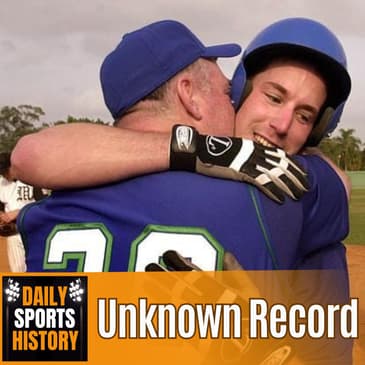
On March 12, 2003, one of the greatest streaks in baseball history came to an end. Damian Costantino, an outfielder for Salve Regina University, defied the odds by hitting safely in 60 consecutive NCAA games, breaking Robin Ventura’s legendary record of 58 games. His streak spanned across three seasons (2001-2003), making it one of the most impressive yet underrated achievements in sports history. In this episode, we take a deep dive into:
✅ Who is Damian Costantino? The underdog story of a Division III star.
✅ How the streak began: The first hit on April 14, 2001 and the quiet start.
✅ Breaking Robin Ventura’s record: The moment Costantino made history on April 5, 2002.
✅ How the streak finally ended: The game on March 12, 2003, when Eastern Connecticut ended history.
✅ Why this record still stands: The legacy of Costantino’s incredible feat.
🔊 Listen now on Spotify, Apple Podcasts, and dailysportshistory.com
Email: dailysportshistory@gmail.com
YouTube: YouTube.com/@dailysportshistory
Twitter: twitter.com/dailysportshis
Facebook: facebook.com/profile.php?id=61551687917253&mibextid=ZbWKwL
Bluesky: https://bsky.app/profile/dailysportshistory.bsky.social
https://www.instagram.com/dailysportshis/profilecard/?igsh=OWl1MzIyYndqOGU2
Threads
https://www.threads.net/@dailysportshis
#BaseballHistory #NCAARecords #DamianCostantino #HittingStreak #CollegeBaseball #OnThisDay #RobinVentura #BaseballStats #MLBHistory #UnbreakableRecords #March12 #SalveRegina #SportsHistory
Buy me a coffee: buymeacoffee.com/dailysportz
Newsletter: https://substack.com/@dailysportshistory?r=3en496&utm_medium=ios&utm_source=stories&shareImageVariant=light
DailySportsHistory.com
Email: dailysportshistory@gmail.com
YouTube: YouTube.com/@dailysportshistory
Twitter: twitter.com/dailysportshis
Facebook: facebook.com/profile.php?id=61551687917253&mibextid=ZbWKwL
On March twelfth, twenty thirteen, Damien Castanetto did something that had not happened in nearly three seasons when he played a game for a Division III college out of Rhode Island, and he took all his at bats and got no hits, ending his hit streak at sixty, becoming the Joe DiMaggio of college baseball, breaking a record that has not been broken since hitting consecutively in sixty games. We're gonna dive into this incredible streak and what it means to baseball today on Daily Sports History. Welcome to Daily Sports History. I'm Ethan Reese, your guide as you daily learn more about sports history, increasing your sports knowledge. Now, Damien was a good baseball player in high school and even thought about possibly playing for a Division I school, but he didn't get an actual scholarship. As college baseball is known as an equalitative sport rather than a head count sport that we see a lot in football and basketball, it means the program doesn't offer full scholarships to every player. Instead, they have a limited pool of scholarship money that they had to divide over the whole roster, and there's different amounts of scholarships you can give depending on division one two three in AIA in JUCO and Division one has a total of eleven point seven scholarships that they can give out and teams usually consist of around twenty five to twenty seven players, so not every player can get a full ride at Division one, and so he wasn't given a full ride or close to it, and he didn't have the means to pay for school himself, so he decided to enlist in the army after graduating high school, where he joined the four hundred and forty third Civil Battalion and was deployed to the Persian Gulf. Now this was before nine to eleven, and he was able to get out before a lot of that fighting started. And after two years in the army, he enrolled at a Division III school where they don't give out scholarships and you don't necessarily walk onto the team. But as a coach in Division three, I know that there's a lot of recruiting. You don't just get on the team because you want to. You can join the team in a lot of different ways. You can kind of walk on, but you can also really show your skill, and that's what he did he showed the coaches he did have skills in high school and then he took this break to go to college. So he was an older player, a more mature player, which is always great to have on any team. Having maturity helps and you have that stage even as a freshman. He came in with stage and wisdom. Now Salve Regina is known as the Salve Regina Seahawks and their Division III school and a member of the Commonwealth Coast Conference, which consists of many New England sports mainly in Connecticut, Maine, Massachusetts, and Rhode Island, and they compete in all different kinds of sports such as soccer, field, hockey, tennis, cross country, basketball, ice hockey, volleyball, softball, track and field, and lacross, as well as football and a co ed sailing team. And the school itself was started in nineteen thirty four and has just a little over two thousand undergrad and graduate programs on the eighty acre coastal campus and about eighteen percent of their student body are athletes, which is not uncommon in Division three athletics is actually used as a ploy for the Division three in these small schools to increase their enrollment. It's not uncommon to see fifteen to twenty percent of a student body at Division three be athletes, which means you have a lot of athletes on campus. Not a lot of these athletes don't go pro in anything, but they want to continue to play the sport they love at a competitive level, and Division three is very competitive in their sports. Some do go on to go pro, some go on to be great successful coaches, but many just go on to have successful careers in things outside of sports. And his streak began on April first, two thousand and one, against Rhode Island College, where he would end the season getting twenty two consecutive hits in the time. He was a sophomore at the time, and he was able to get and he played the outfield, so he wasn't just a hitter for the team, and he wasn't a power hitter. He didn't have a lot of home runs on his team. He was more of a contact hitter with excellent eye control and composure at the plate. And even though he ended the season with his twenty two game hit streak, it wasn't huge news. It was covered by the school and it was known around town, but it didn't make national news or anything most Division three schools don't. But then coming to the next season in two thousand and two, he hit in every single game, all thirty five games, breaking the previous Division three hit breaking the previous Division three hit streak, and that was at forty seven games. But he wasn't done, helping lead the team to a winning record that season twenty and eighteen, although they would not make the NCAA tournament, and then he came into the next season again continued his hit streak. He made it safely to fifty eight games, tying Robert Van TURA's record when he played at Oklahoma State and when he would go on to be an All Star in major leagues. But Damien wasn't done yet. He would go on to break Robert Vanchure's record and extended another two games. But it all came down against Baldwin Wallace when he for the first time in almost three seasons, he did not get a hit, ending his streak at sixty games. As he ended the game not striking out, he grounded out. He had a sacrifice fly and flied out, always making contact but unfortunately just didn't get the ball to land where it needed to land. After this, which was his senior year, he would finish his career with a four to twenty one batting average, have over two hundred hits, and beat it in one hundred in batters. Though he wanted to continue to play professional baseball, just wasn't in the cards. Not only was he coming from a smaller school a Division III, but he was also an older player. He took those two years to help fight for our country while in the Army, and unfortunately, most teams did not want a twenty four year old player from a small school, and then made the transition to coaching and went back to coach his high school team, and he will always be remembered for that season he had where he broke the NCAA hits streak record and became the Joe DiMaggio of college baseball. Thank you for listening to today's Daily Sports History. If you want more college baseball content, check out the College Baseball Experience podcast, where your hosts take you from the SEC to the Big West, covering the best of college baseball every week. As you get down to the road to Omaha, I'll put a link in the description below for you to check them out, and if you want to follow it. If you want more daily sports history, you can follow us on our socials, Twitter, Instagram, Facebook, threads, Blue Sky, wherever you like to socialize, will be there and come back tomorrow for more daily sports history. The pat painted potat